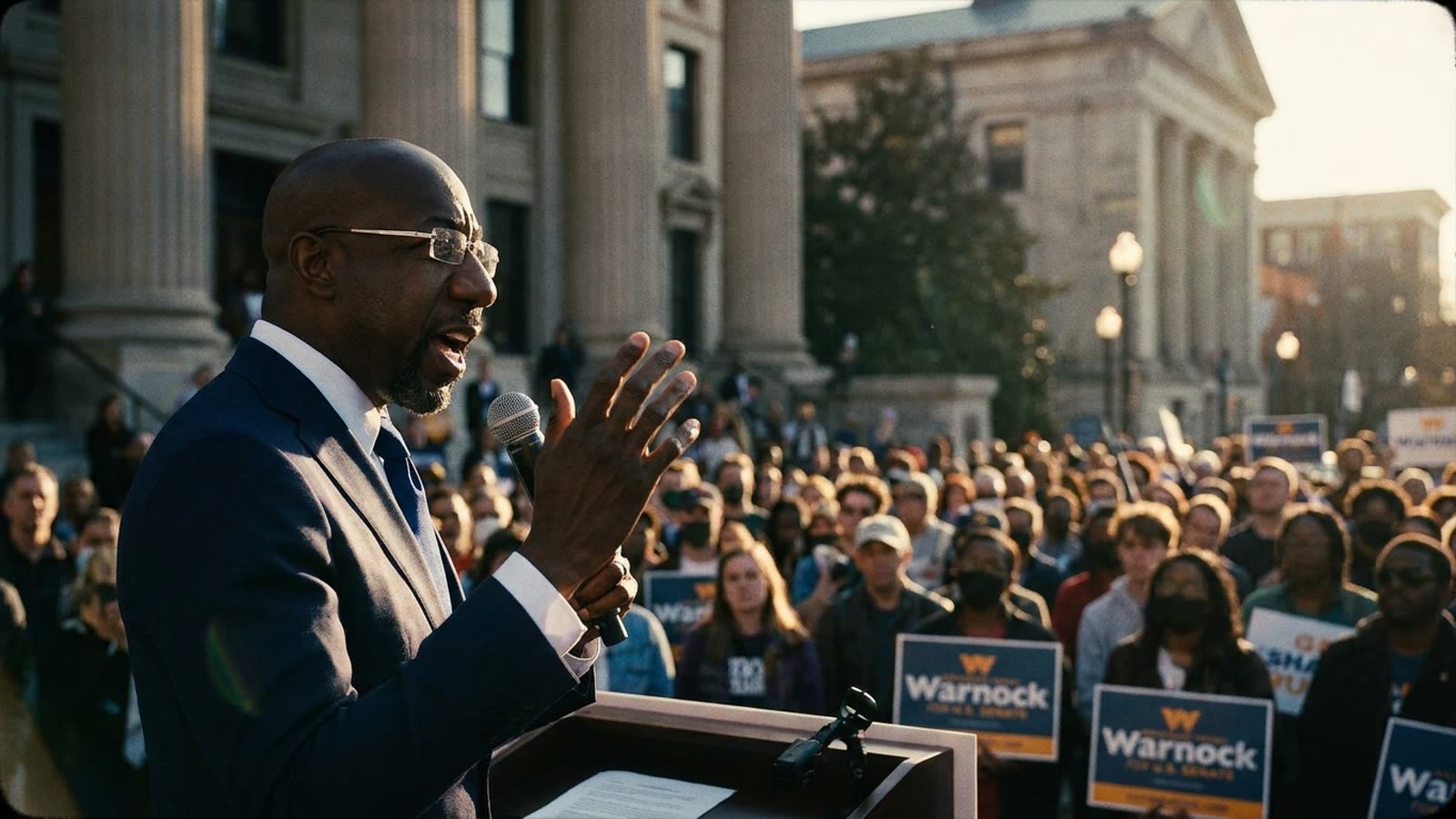
When a sitting United States senator accuses the nation's highest court of committing "violence" against democracy, the statement demands either serious engagement or serious dismissal. Raphael Warnock, the Georgia Democrat and senior pastor of Ebenezer Baptist Church, has chosen his words with the precision of a preacher who understands that language shapes reality. His critique of the Supreme Court is not hyperbole—it is diagnosis.
Warnock's remarks arrive at a moment when the Court's conservative supermajority has spent several terms systematically dismantling precedents that once seemed settled: voting rights protections, regulatory agency authority, reproductive autonomy, and affirmative action, among others. The senator's framing of these decisions as a form of violence is theological as much as political, drawing on a tradition that recognizes harm can be structural, institutional, and bloodless while remaining devastating.
The case for confrontation
Democrats have long struggled with how to talk about a judiciary they view as captured by ideological interests. The instinct toward institutionalism—the belief that criticizing the Court too harshly undermines the rule of law—has produced years of muted responses to decisions that progressives consider catastrophic. Warnock's willingness to break with that timidity reflects both his personal brand of moral clarity and a growing recognition within the party that deference has produced nothing but more defeats.
The senator's critique also carries particular weight given his state. Georgia has been ground zero for voting rights battles since the 2020 election, with Republican legislators enacting restrictions that disproportionately burden Black and young voters. When Warnock speaks of violence to democracy, he is describing what his constituents experience as a lived reality, not an abstraction.
The limits of rhetoric
Yet even the sharpest language faces the same obstacle that has frustrated Democrats for years: the Court is insulated from electoral accountability by design, and the current composition will likely persist for decades. Warnock can name the problem with unusual directness, but naming it does not solve it. Court expansion remains politically unviable. Ethics reform has stalled. The justices themselves have shown no inclination toward restraint.
This leaves Democratic rhetoric in a familiar bind—forceful enough to energize the base, insufficient to change outcomes. Warnock's statement may be remembered as a turning point in how mainstream Democrats discuss the judiciary, or it may be another data point in a long decline of institutional legitimacy that neither party seems capable of arresting.
Our take
Warnock is correct that the Court's recent trajectory represents something more consequential than ordinary judicial conservatism. When a institution designed to check majoritarian excess instead amplifies minority rule—gutting voting protections while expanding executive immunity—the word "violence" captures a truth that gentler terms obscure. Whether Democrats can translate this rhetorical clarity into political power remains the question that matters. Diagnosis without treatment is just eloquent suffering.