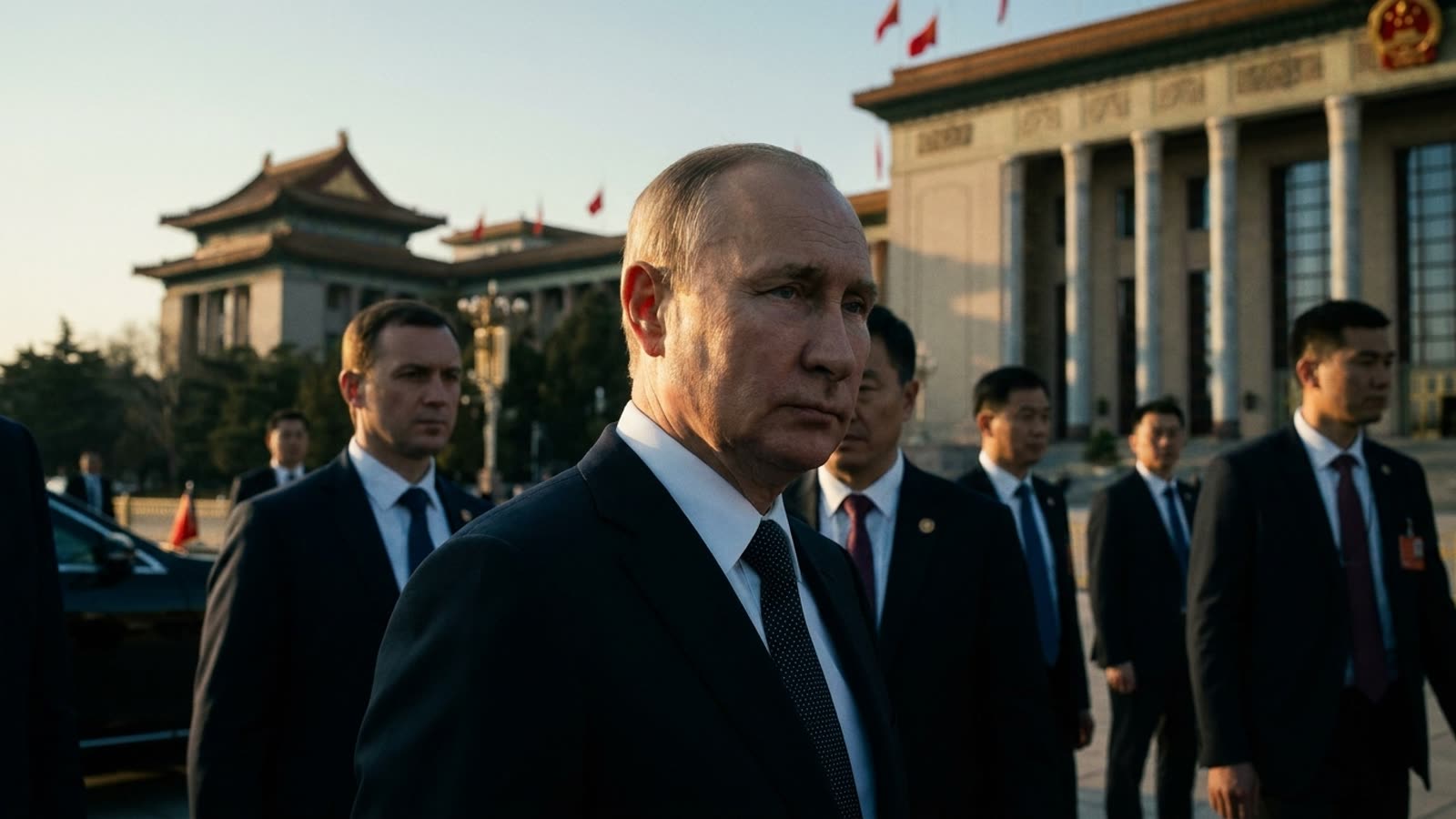
Vladimir Putin's trip to China this week is the geopolitical equivalent of a pickpocket working a crowded subway car. While American attention remains fixed on the Iran conflict—casualty counts, ceasefire negotiations, congressional revolt—the Russian president is in Beijing cementing an alliance that may prove far more consequential to the global order than whatever emerges from the Persian Gulf.
The visit comes as Washington finds itself in an awkward diplomatic crouch: simultaneously prosecuting a war and negotiating its end, with Republican hawks accusing their own president of capitulation and Democrats calling him a fool. Putin, whose invasion of Ukraine has largely faded from American front pages since the Iran conflict erupted, could not have scripted a better moment to remind Xi Jinping that the authoritarian bloc has options.
The strategic calculus
For Putin, the China relationship has become existential rather than merely strategic. Western sanctions have redirected Russian energy exports eastward, making Beijing not just a partner but increasingly a patron. The power asymmetry that Putin once carefully managed—playing Europe against Asia, maintaining the fiction of Russian great-power independence—has collapsed. He arrives in Beijing as the junior partner, and both men know it.
Yet Xi has his own reasons to receive Putin warmly. The Iran war has demonstrated both American military reach and American political fragility. A superpower that can strike Tehran's nuclear facilities in days but cannot maintain domestic consensus for weeks offers lessons for Taiwan contingency planning. The Chinese leader is watching not just what Washington can do, but how long it can sustain the doing.
What they want from each other
The summit agenda, per official statements, covers trade, energy, and "regional security"—diplomatic shorthand for coordinating positions on everything from sanctions evasion to UN Security Council vetoes. More interesting is what goes unsaid. Putin needs continued Chinese purchases of Russian oil at prices that keep his war economy functional. Xi needs Russian raw materials and, perhaps more importantly, a partner willing to absorb Western pressure that might otherwise focus exclusively on Beijing.
The Ukraine conflict, now grinding through its fourth year with diminished Western attention, will feature prominently. Putin has every incentive to frame the Iran distraction as evidence that American security guarantees are unreliable—a message with obvious applications from Taipei to Warsaw. Xi, for his part, has maintained studied ambiguity about the invasion, providing economic lifelines while avoiding the military assistance that would trigger secondary sanctions.
Our take
The Putin-Xi meeting illustrates a truth that Washington's foreign policy establishment has been slow to internalize: America's adversaries coordinate while America compartmentalizes. The Iran war is treated as a discrete crisis, Ukraine as yesterday's problem, and China as tomorrow's challenge. Moscow and Beijing suffer no such categorical confusion. They see a single competitive landscape and position accordingly. Putin's Beijing pilgrimage, conducted while American soldiers die in the Gulf and American politicians bicker about the terms of their sacrifice, is less a summit than a statement: the authoritarian axis has patience, and it is paying attention.