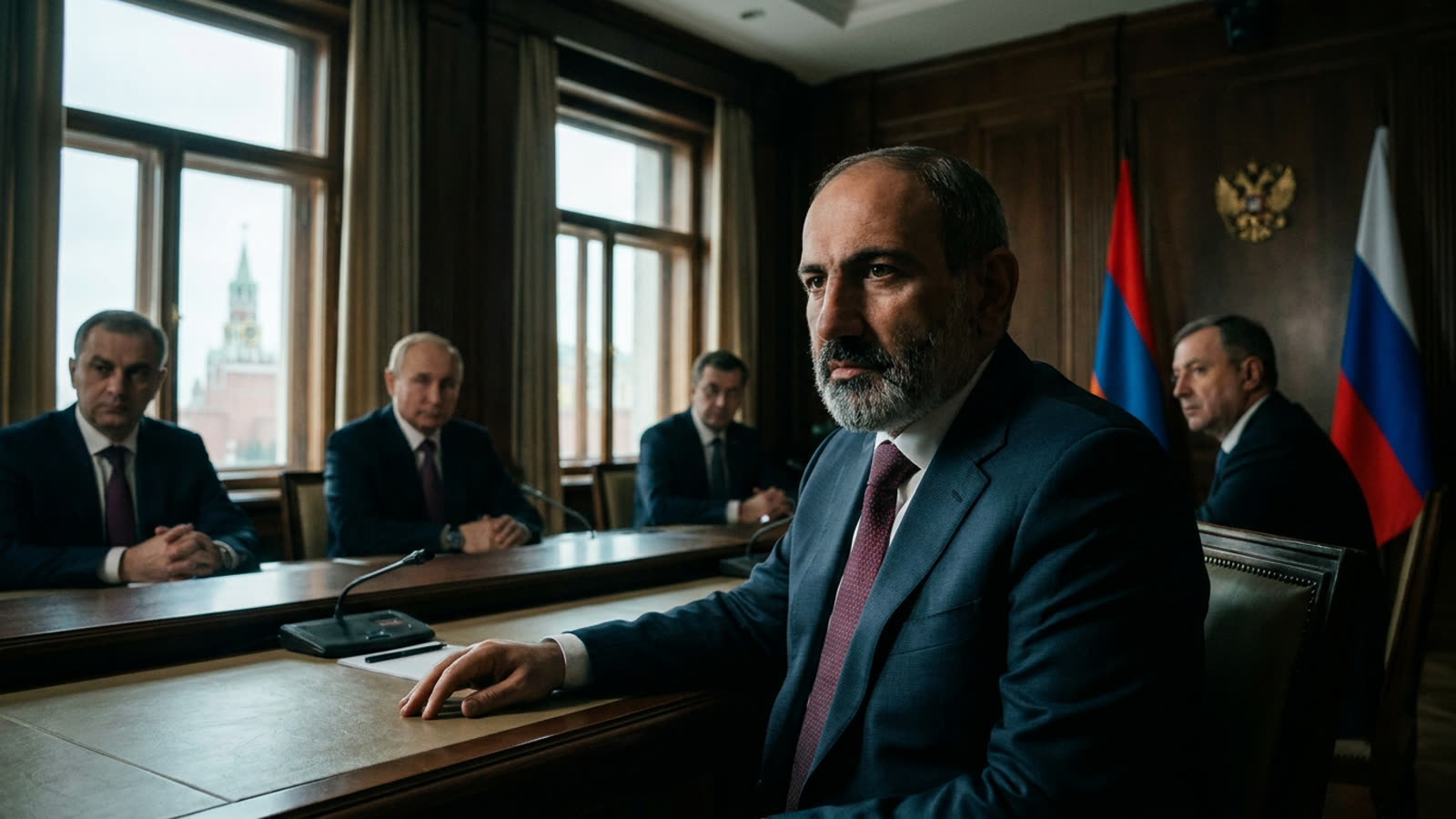
The photograph tells one story; the strategic reality tells another. Vladimir Putin welcomed Armenian Prime Minister Nikol Pashinyan to Moscow this week in what the Kremlin framed as a routine bilateral meeting between allies. But there is nothing routine about the encounter. It is a damage-control exercise for a relationship that has deteriorated so severely that Armenia—a founding member of Russia's Collective Security Treaty Organization—is now openly courting NATO membership and has frozen its participation in the Russian-led military bloc.
The meeting comes as Armenia navigates the aftermath of Azerbaijan's lightning conquest of Nagorno-Karabakh in September 2023, a military operation that displaced over 100,000 ethnic Armenians and exposed the hollowness of Russian security guarantees. Moscow's peacekeepers, stationed in the region under a 2020 ceasefire agreement, stood aside as Azerbaijani forces swept through. For Yerevan, the lesson was unambiguous: the CSTO umbrella leaks.
The westward pivot accelerates
Pashinyan has moved with remarkable speed since the Karabakh debacle. Armenia has conducted joint military exercises with the United States, ratified the Rome Statute of the International Criminal Court—making it theoretically obligated to arrest Putin if he visits—and initiated a formal dialogue with NATO. The prime minister has publicly questioned whether CSTO membership serves Armenian interests, a statement that would have been unthinkable five years ago.
The Kremlin's leverage is diminishing but not gone. Russia maintains a military base at Gyumri, controls critical infrastructure, and remains Armenia's largest trading partner. Russian gas keeps Armenian homes warm. These dependencies explain why Pashinyan continues to meet with Putin rather than breaking ties entirely. Armenia cannot afford a clean divorce; it can only pursue a gradual estrangement.
What Moscow wants
Putin's calculus is straightforward: prevent a complete defection. The loss of Armenia would represent the most significant unraveling of Russian influence in the post-Soviet space since Ukraine's Maidan revolution. It would also embolden Georgia, where anti-Russian sentiment runs deep despite the current government's accommodationist stance. The Kremlin is offering economic inducements and security rhetoric, but it cannot offer the one thing Armenia actually needs—a credible deterrent against Azerbaijan and its Turkish patron.
The summit produced the usual communiqués about bilateral cooperation and regional stability. Neither leader addressed the fundamental contradiction at the heart of the relationship: Armenia wants protection from a threat that Russia is unwilling or unable to counter, while Russia wants loyalty from a partner it has already failed.
Our take
Pashinyan is playing a weak hand with considerable skill. He cannot abandon Russia overnight without economic catastrophe, but he can methodically build alternative relationships that reduce his dependence over time. Putin, meanwhile, is learning that security alliances require actual security provision. The Caucasus is not yet lost to Moscow, but the trajectory is clear. Every meeting like this one is a rearguard action, not a reset.