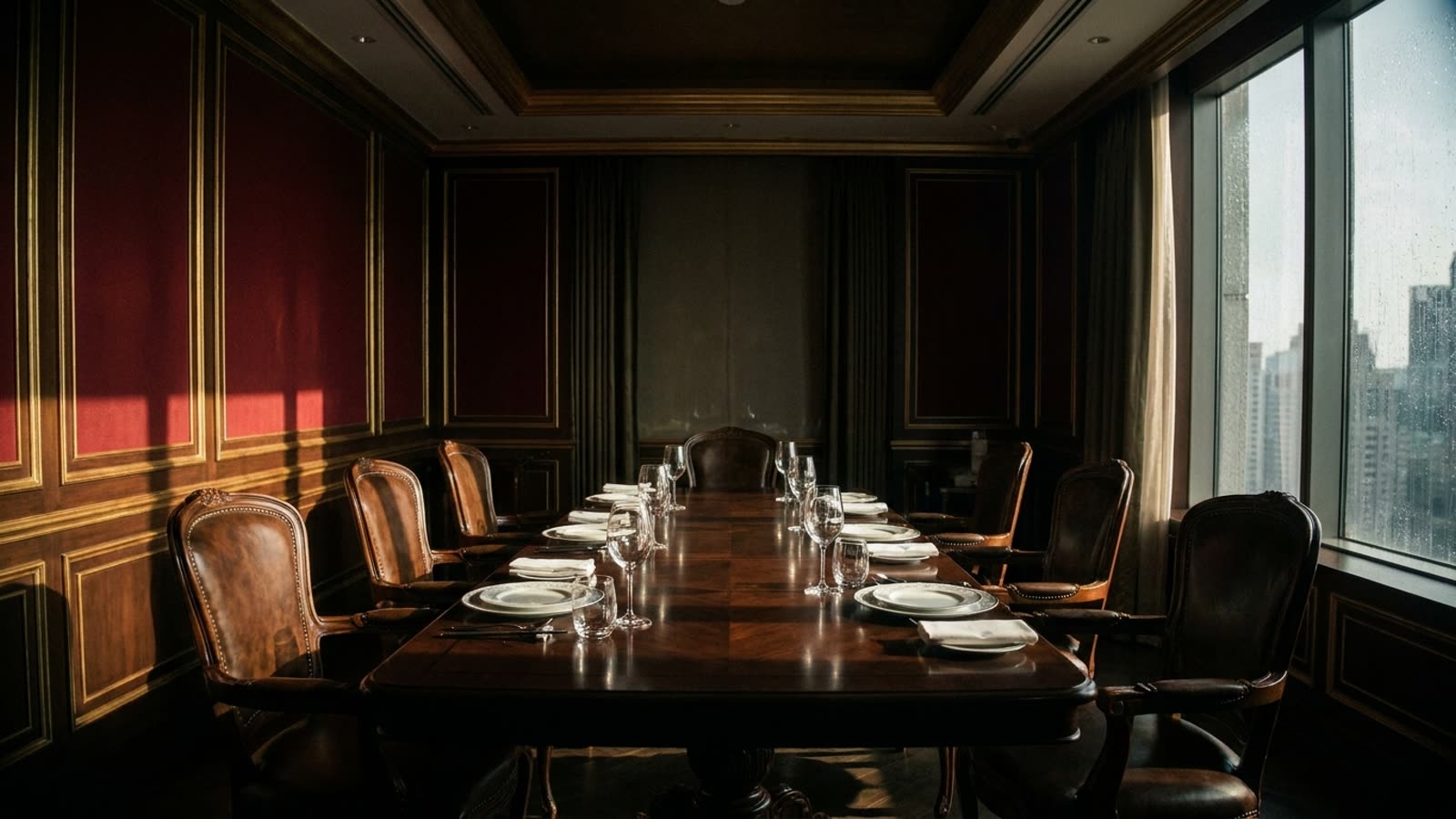
The most consequential meals in history were never eaten in public. They happened behind closed doors, in rooms designed to signal that what occurred within them mattered precisely because outsiders could not see it. The private dining room is not merely a restaurant amenity; it is a spatial technology for power, refined over two centuries to serve the specific needs of people who prefer their influence exercised away from prying eyes.
The form emerged in its modern incarnation in nineteenth-century Paris, where the cabinet particulier offered aristocrats and their mistresses a velvet-lined refuge from bourgeois morality. These rooms were small by design—intimacy was the point—and typically accessed through separate entrances or discreet corridors. The architecture encoded plausible deniability. You could dine at the same establishment as your business rival, your spouse, or your creditor, and none of you would ever cross paths.
The American translation
When Delmonico's opened in Manhattan in the 1830s, it imported the concept but adjusted the purpose. American private dining rooms became theaters for commerce rather than romance. The dimensions expanded. Tables grew to accommodate twelve, then twenty. Rooms acquired names—the Red Room, the Oval Room—transforming anonymous spaces into addresses that could be dropped into conversation. "We'll take the Oak Room" became a sentence that communicated budget, taste, and social standing in six words.
The design grammar solidified: heavy doors that muffled sound, lighting calibrated to flatter aging faces, art that suggested cultivation without demanding attention, and service entrances that allowed staff to appear and vanish without interrupting conversation. Every element served the central fiction that the diners were alone, even as a small army worked invisibly to sustain them.
The contemporary calibration
Today's private dining rooms have inherited this grammar while adapting to new anxieties. The phone has replaced the mistress as the primary threat to discretion, and serious establishments now offer Faraday-cage-equipped spaces where signals cannot escape. Soundproofing has evolved from heavy curtains to acoustic engineering borrowed from recording studios. Some London clubs have installed white-noise generators tuned to the specific frequency range of human speech.
The aesthetic has shifted from opulence to what might be called studied understatement—rooms that telegraph wealth through the quality of materials rather than their abundance. A single perfect piece of contemporary art. Linen so fine it appears almost industrial. Chairs that cost more than most people's monthly rent but look like they belong in a design museum's permanent collection.
What has not changed is the fundamental transaction: money purchases not just food and space but the temporary suspension of the outside world. The private dining room sells the illusion that, for two hours, the only reality that matters is the one contained within its walls.
Our take
The persistence of the private dining room in an age of radical transparency tells us something important about how power actually operates. For all our rhetoric about openness and accountability, the people who shape economies and governments still prefer to do so over Dover sole, behind closed doors, in rooms specifically designed to leave no record. The architecture of discretion is not a relic; it is a growth industry.