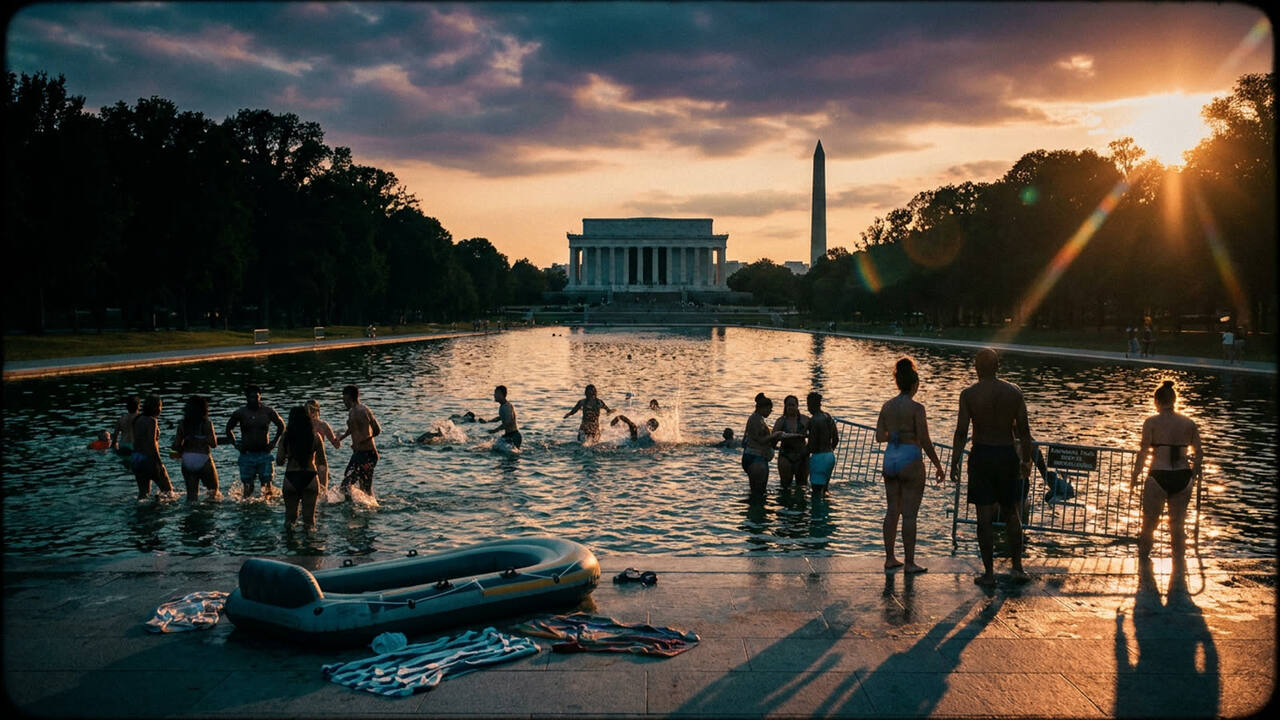
The image has become inescapable on social media this summer: families splashing in the shallow waters of the Lincoln Memorial Reflecting Pool, children launching themselves off the marble edges, influencers posing mid-wade with the Washington Monument rising behind them. What was designed in 1922 as a mirror for democratic contemplation has become, in the sweltering summer of 2026, something closer to a public lido.
The phenomenon is not entirely new—people have dangled feet in the pool for decades—but the scale has shifted dramatically. Videos tagged #ReflectingPoolSwim have accumulated tens of millions of views across platforms, and on any given weekend, the pool now hosts what can only be described as a beach scene, complete with inflatable toys, picnic blankets, and the occasional dog.
The Park Service's Dilemma
Officially, swimming in the Reflecting Pool is prohibited. The National Park Service has posted signs, deployed rangers to issue warnings, and released statements emphasizing that the pool is not treated with the same chemicals as recreational swimming facilities. The water is recycled, filtered, but not chlorinated to swimming-pool standards. Health officials have raised concerns about bacterial contamination, particularly given the resident population of ducks and geese.
Yet enforcement has proven nearly impossible. The pool stretches more than 2,000 feet, and on peak days, hundreds of people enter the water simultaneously. Rangers report that issuing citations feels both futile and politically fraught—no agency wants to be seen hauling children out of a pool during a heat wave. The result is a kind of studied non-enforcement, where warnings are issued but rarely followed by consequences.
Why Now?
Several factors have converged. Washington has experienced its hottest June on record, with multiple days exceeding 100 degrees Fahrenheit. The city's public pool system, chronically underfunded, has struggled with closures and capacity limits. Meanwhile, the Reflecting Pool sits in the middle of the most visited stretch of the National Mall, accessible to millions of tourists who arrive already dressed for summer.
There is also something generational at play. For younger visitors raised on social media, the pool represents an irresistible backdrop—the kind of shot that performs well precisely because it subverts expectations. Swimming where you are not supposed to swim, in front of Lincoln's gaze, carries a frisson of transgression that a municipal pool cannot match.
Our take
The Reflecting Pool was never meant to be a swimming hole, and there are legitimate reasons—sanitary, symbolic, practical—to discourage the practice. But the images also reveal something worth noting: a public hungry for accessible, free, beautiful space in which to simply exist during brutal heat. Washington has world-class monuments and woefully inadequate public amenities. The swimmers are not desecrating anything; they are filling a void the city has failed to address. Perhaps the answer is not more rangers with citation books, but more pools.