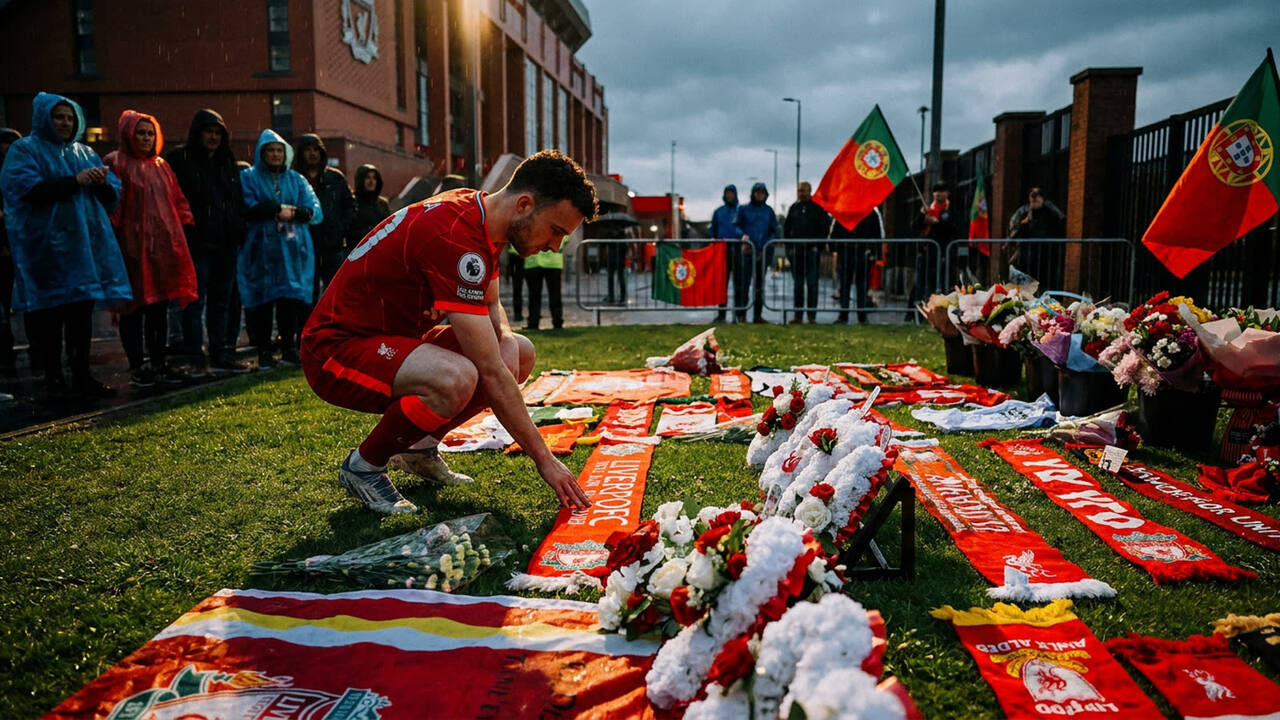
The Portuguese dressing room at MetLife Stadium has acquired a small shrine. Diogo Jota's number 21 shirt hangs in his assigned locker, untouched since the Liverpool forward ruptured his Achilles tendon in training three days before the tournament opener. His boots sit beneath it, laces still tied. Before every match, players touch the fabric on their way to the tunnel.
This is not performative grief. It is something stranger and more potent: a team that has found its identity in absence.
The injury that changed everything
Jota's Achilles gave way during a routine finishing drill on June 8th, the kind of non-contact rupture that ends careers and haunts physios. At 29, in the form of his life, he had been expected to lead Portugal's attack alongside Cristiano Ronaldo—the present and the past, hunting a trophy together. Instead, he was on a flight back to Liverpool within 48 hours, his World Cup over before a ball was kicked.
The squad's response was immediate and, by all accounts, genuine. Captain Ronaldo, not known for ceding spotlight, dedicated Portugal's opening victory to Jota without prompting. Bruno Fernandes wore Jota's initials on his wrist tape. Manager Roberto Martínez, typically measured, called the injury "a wound we carry together."
Grief as tactical advantage
What has surprised observers is how Portugal has played since. A squad sometimes criticized for its collection of individual talents has suddenly resembled a unit. The pressing has been coordinated. The defensive shape has held. In two group-stage matches, Portugal has conceded zero goals and created chances at the highest rate of any team in the tournament.
Sports psychologists have a term for this phenomenon: galvanizing loss. A team that might otherwise fracture under pressure instead coheres around a shared emotional anchor. The 2001 Arizona Diamondbacks, playing in the shadow of September 11th, are the canonical example. Portugal may be writing a new one.
The Ronaldo factor
There is, of course, the matter of Ronaldo himself. At 41, playing in what is almost certainly his final World Cup, the Portuguese icon has been subdued by his standards—one goal, few of the theatrical celebrations that once defined him. Those close to the squad suggest Jota's injury has affected Ronaldo more than most. The two had grown close during the pre-tournament camp, the veteran apparently seeing in Jota the kind of successor he could respect.
Ronaldo's restraint has been tactical as much as emotional. He has dropped deeper, linked play, allowed Rafael Leão to occupy the spaces he once claimed as his own. Whether this is sustainable remains to be seen. But for now, Portugal looks less like a Ronaldo vehicle and more like a team.
Our take
Sporting narratives are cheap, and the temptation to over-read a few good performances through the lens of tragedy should be resisted. Portugal has an excellent squad regardless of Jota's absence. They would likely have won their group anyway. But something does feel different about this team—a seriousness, a lack of the infighting that has plagued previous Portuguese campaigns. Whether that carries them to a trophy or merely to a dignified exit, Jota's empty locker has given them something money cannot buy: a reason to play for each other rather than themselves.