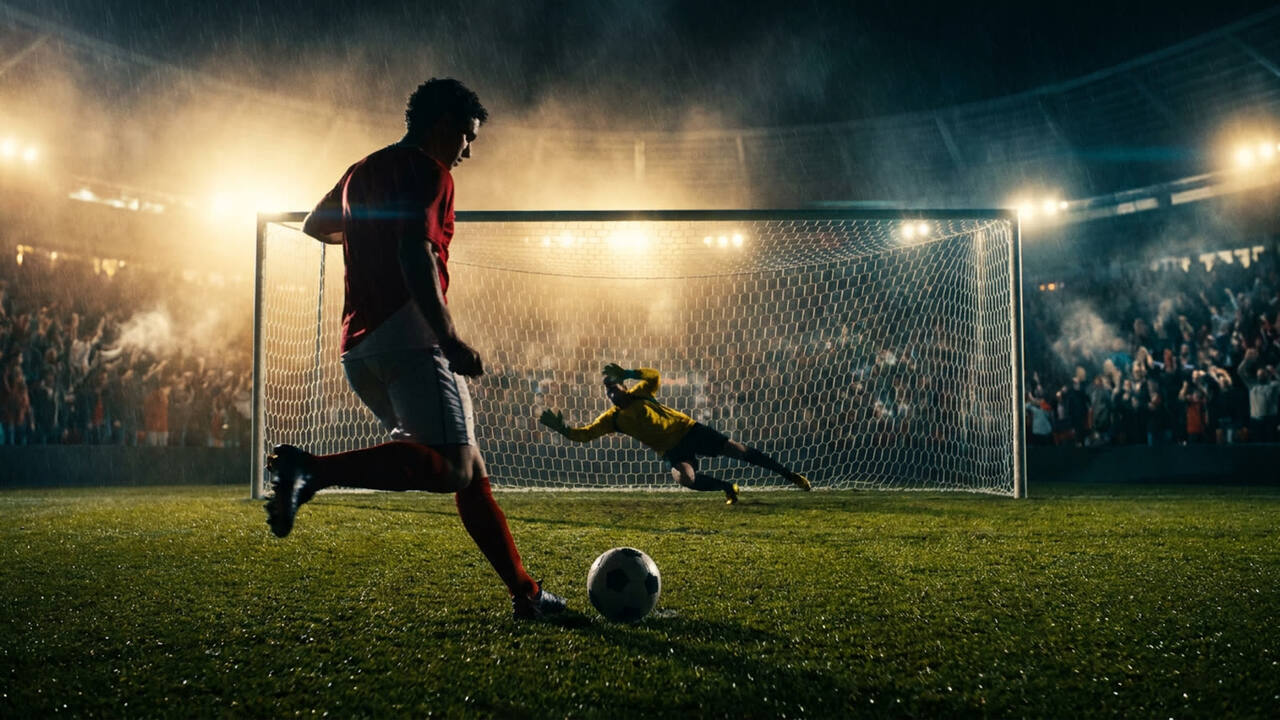
No other sport has devised a tiebreaker so psychologically sadistic, so cinematically perfect, and so fundamentally divorced from the game it concludes. The penalty shootout asks players who have spent two hours in collective tactical warfare to step forward alone, twelve yards from glory or infamy, and execute a skill they have practiced ten thousand times under conditions that make practice irrelevant. It is, by design, unfair. It is also irreplaceable.
The shootout's genius lies in its simplicity and its terror. A goalkeeper faces a ball traveling at speeds that make reaction nearly impossible; the striker faces a target so large that missing it seems absurd. And yet. Roberto Baggio, the finest Italian player of his generation, sent the ball sailing over the crossbar in the 1994 World Cup final, handing Brazil the trophy. The image of Baggio standing motionless, hands on hips, staring at the Pasadena turf, became the tournament's defining photograph. Not a goal. Not a save. A miss.
The mathematics of heartbreak
Statistically, penalty shootouts favor the team that shoots first — a psychological edge that compounds with each successful conversion. The player stepping up when his team is behind faces exponentially greater pressure than the one who merely needs to match. This asymmetry has prompted periodic calls for reform, including an experimental ABBA format that alternates the advantage. FIFA has resisted wholesale change, perhaps recognizing that the shootout's perceived unfairness is inseparable from its dramatic power.
The numbers reveal patterns invisible in the moment. Goalkeepers dive left or right on roughly ninety percent of penalties, yet staying central would save more shots. Strikers who wait for the goalkeeper to commit convert at higher rates, but the nerve required to pause while the world watches proves too much for most. The shootout exposes the gap between what players know and what they can execute under duress — a gap that widens precisely when the stakes demand it close.
Theatre of the isolated
What makes the shootout singular is its transformation of a team sport into individual ordeal. A midfielder who has run twelve kilometers, won aerial duels, and orchestrated attacks must now succeed or fail entirely alone. Teammates can only watch. Coaches can only hope. The crowd noise, deafening during open play, often falls to a hush that makes the striker's footsteps audible.
The 2022 World Cup final offered perhaps the format's ultimate expression. Kylian Mbappé scored a hat-trick in regulation and extra time, a performance that would have defined any other final in history, then watched Gonzalo Montiel convert the decisive penalty for Argentina. Mbappé's brilliance was rendered footnote by a moment he could not control. Lionel Messi, who had spent his career haunted by Argentina's shootout failures, finally lifted the trophy not through his own conversion but through Montiel's nerve and Kingsley Coman's miss.
Our take
The shootout's critics miss the point when they call it a lottery. Lotteries require no skill; penalties require supreme skill deployed under supreme pressure, which is a different and more interesting proposition. The mechanism has given us some of soccer's most indelible images precisely because it strips away the comfortable alibis of team performance and tactical complexity. One player, one ball, one chance. The shootout does not determine who played better football. It determines who can bear the unbearable weight of a nation's hopes while executing a task a child could complete in training. That distinction is not a flaw. It is the entire point.