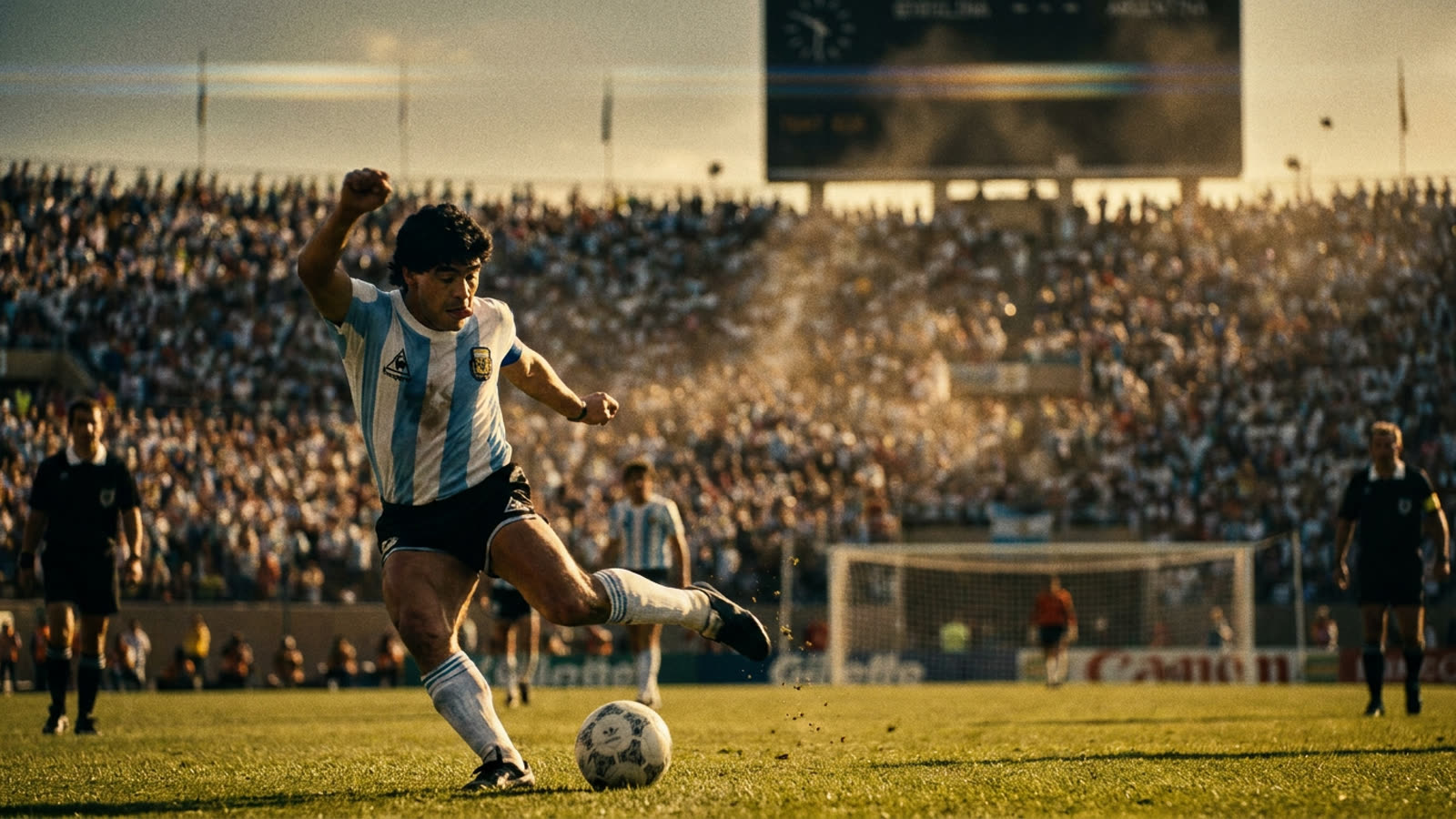
No single sporting moment has been more thoroughly dissected, condemned, celebrated, and mythologized than Diego Maradona's first goal against England in the 1986 World Cup quarterfinal. It was, by any objective measure, cheating. The diminutive Argentine clearly punched the ball past Peter Shilton. The referee didn't see it. The goal stood. Argentina won 2-1. And somehow, impossibly, the act became sacred.
What makes the Hand of God endure isn't the controversy itself but what Maradona did with it afterward. Rather than offer the usual athlete's deflection—"I didn't see it clearly" or "the referee made the call"—he leaned into the transgression. "A little with the head of Maradona, and a little with the hand of God," he said, grinning. The audacity was breathtaking. He had cheated, admitted to cheating by invoking divine complicity, and dared anyone to be angry about it.
The context that made it mythology
The Falklands War had ended just four years earlier. England and Argentina had killed each other's sons over a cluster of islands in the South Atlantic. Football offered no real catharsis for that wound, but it offered something: a stage, a proxy, a chance for symbolic revenge. Maradona understood this instinctively. "Although we had said before the game that football had nothing to do with the Malvinas war," he later wrote, "we knew they had killed a lot of Argentine boys there, killed them like little birds. And this was revenge."
This is what separates the Hand of God from ordinary cheating. When a sprinter takes steroids or a cyclist blood dopes, they're pursuing personal glory through deception. Maradona's handball carried the weight of a nation's grief and rage. He wasn't just getting away with something; he was getting away with something against them, the colonial power, the invaders. The moral calculus shifted. In Argentina, the goal became an act of resistance. In England, it remained an injustice. Both interpretations are correct.
The goal that followed
What prevents the Hand of God from being merely notorious is what happened four minutes later. Maradona collected the ball in his own half, dribbled past five English players and the goalkeeper, and scored what FIFA would later name the Goal of the Century. The juxtaposition is almost too perfect: the most illegitimate goal in World Cup history followed immediately by the most beautiful. Maradona contained multitudes, and he demonstrated both within the span of a few minutes.
The second goal reframed the first. Had Maradona scored only with his hand, history might have judged him harshly. But by proving, moments later, that he was capable of the sublime, he made the handball seem almost beside the point. Yes, he had cheated. But he was also, inarguably, the best player on the planet. The hand was a shortcut; the feet were a revelation.
Our take
Sports morality is simpler than we pretend. We forgive the transgressions of the transcendent. Maradona's handball endures not despite its dishonesty but because of how nakedly it exposed our hypocrisy. We want our athletes to be role models, but we worship the ones who aren't. We demand fair play, but we build statues to the cheaters who win. Maradona gave us no comfortable outs, no plausible deniability. He punched a ball into a net, told us God helped him do it, and then danced while we tried to decide whether to be outraged or enchanted. Most of us chose enchantment. That says more about us than it ever did about him.