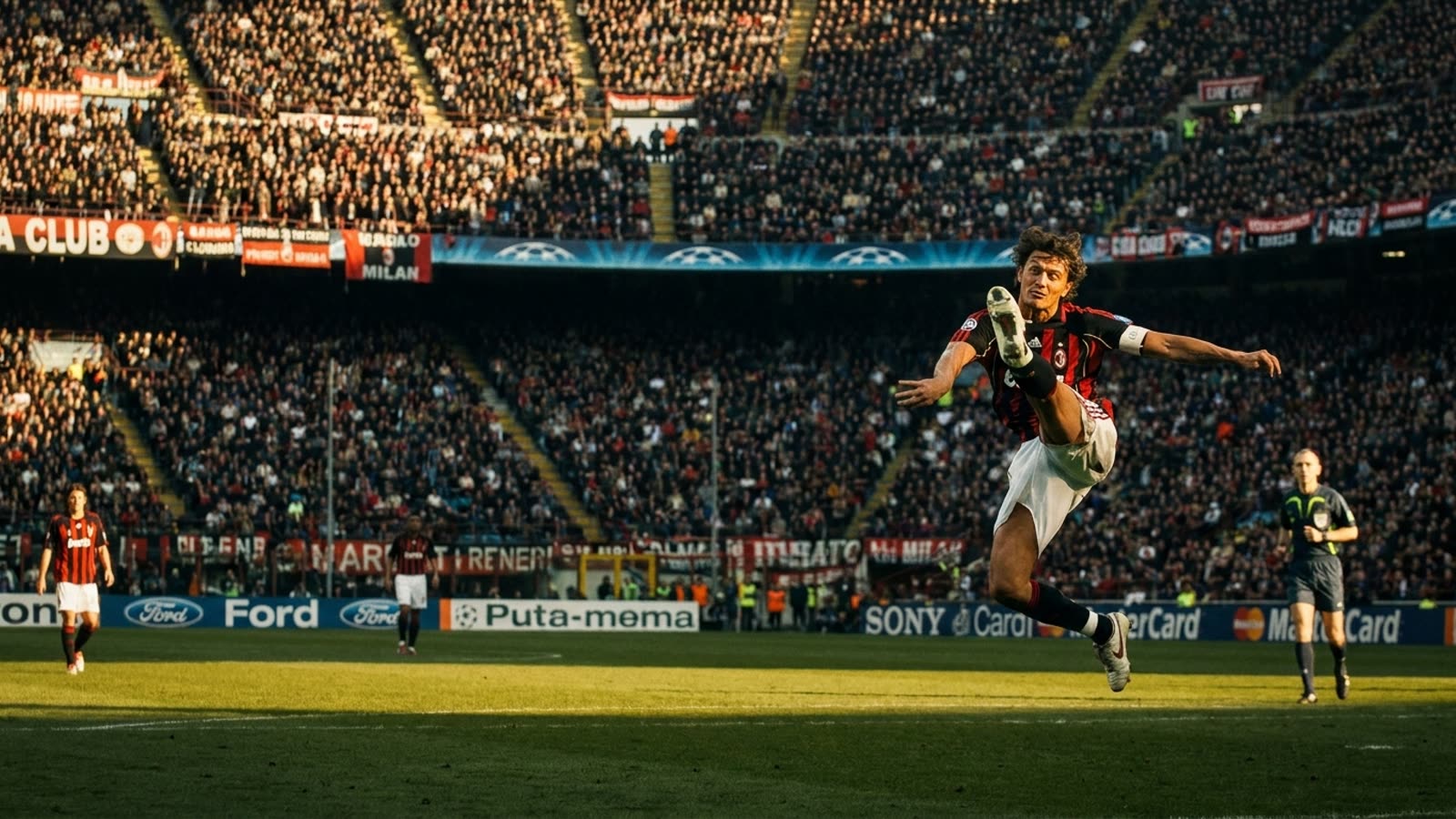
The greatest compliment ever paid to a defender came from Johan Cruyff, who once observed that Paolo Maldini rarely needed to make tackles because he was always in the right position. It sounds like faint praise until you consider what it actually means: Maldini had so thoroughly mastered the geometry of football that he could neutralize danger before it materialized. He didn't defend. He anticipated.
This distinction matters more than it might seem. Modern football celebrates the spectacular — the sliding block, the last-ditch clearance, the desperate lunge that saves a certain goal. Maldini offered something rarer and less photogenic: the quiet extinction of threat through positioning, timing, and an almost supernatural ability to read attacking intent. His career at AC Milan spanned a quarter-century, during which he collected five Champions League titles and seven Serie A championships while making defensive excellence look effortless.
The education of a natural
Maldini inherited football intelligence. His father Cesare captained Milan and later managed the club, and young Paolo grew up studying the game from the inside. He made his first-team debut as a teenager and initially played left-back despite being naturally right-footed — a detail that speaks to his adaptability and technical completeness. By his mid-twenties he had transitioned to central defense, where his reading of play could influence the entire backline rather than just one flank.
What set him apart was the synthesis of physical gifts and cognitive superiority. He possessed enough pace to recover from the rare positioning error, enough strength to compete aerially, and enough technique to begin attacks with crisp distribution. But these attributes were common enough among elite defenders. Maldini's edge was interpretive: he seemed to know what attackers would do before they knew themselves.
The aesthetics of prevention
There is a philosophical tension in football between creation and destruction, between the artist who makes goals and the pragmatist who prevents them. Maldini dissolved this binary. He defended with such economy and elegance that watching him became its own pleasure, separate from the drama of scoring. His interceptions arrived not as interruptions but as punctuation — the logical conclusion of a sequence he had been tracking several moves ahead.
This style influenced a generation of defenders who understood that positioning could substitute for aggression. The modern center-back who steps into midfield to break up play, who uses anticipation rather than physicality, owes something to the template Maldini established. He proved that defending need not be reactive, that the best way to stop an attack is to ensure it never properly begins.
Our take
Football's highlight culture will always favor the goalscorer over the goal-preventer, and there is nothing wrong with that — goals are the point, after all. But Maldini's career stands as a reminder that mastery takes many forms, and that some of the game's deepest intelligence operates in the negative space, in the chances that never came to exist. He retired having played more than a thousand professional matches, and the remarkable thing is how few of them required him to be spectacular. He had already done the work.