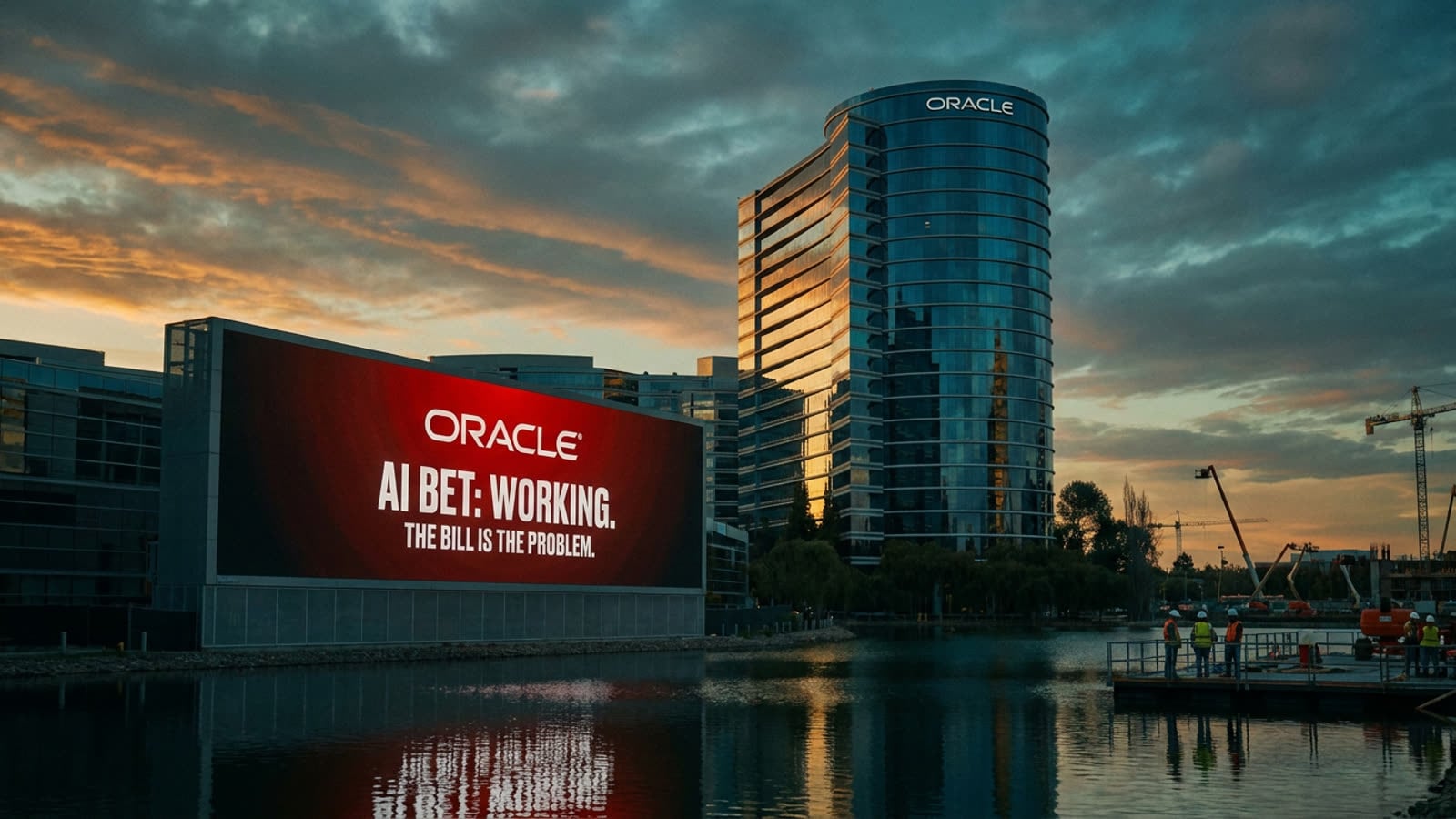
Oracle has become the tech industry's most instructive case study in the difference between winning and profiting. The company's latest earnings reveal a business successfully pivoting toward artificial intelligence—cloud revenue climbing, enterprise customers signing multi-year commitments, partnerships with hyperscalers deepening—yet its stock fell sharply after hours. The culprit is the oldest tension in capitalism: growth costs money, and Oracle is spending it faster than Wall Street's patience allows.
The numbers tell a bifurcated story. Cloud infrastructure revenue accelerated meaningfully, driven by demand for GPU capacity and AI training workloads. Oracle's database-as-a-service offerings are finding traction with enterprises reluctant to fully commit to AWS or Azure. The company is no longer the legacy software vendor critics dismissed five years ago. It is, genuinely, an AI infrastructure player.
The capex problem
But becoming an AI infrastructure player requires building AI infrastructure, and that means data centers—lots of them, filled with expensive Nvidia chips, cooled by elaborate systems, connected by fiber that must be laid across continents. Oracle's capital expenditure guidance came in well above analyst expectations, and the market's reaction was immediate. Investors who had bid up the stock on AI enthusiasm suddenly remembered that enthusiasm must be funded.
This is not unique to Oracle. Every company chasing the AI opportunity faces the same arithmetic: the revenue comes later, the capex comes now. Microsoft, Google, and Amazon can absorb these costs within diversified empires. Oracle, despite its $300 billion-plus market capitalization, remains more exposed. Its traditional licensing business is mature. Its cloud margins are thinner than competitors'. Every dollar spent on data centers is a dollar not returned to shareholders, at least not yet.
The competitive squeeze
Oracle's position is further complicated by its place in the cloud hierarchy. It is not the market leader—that remains AWS—nor the enterprise incumbent with unlimited distribution—that is Microsoft. Oracle must spend to compete while lacking the scale advantages that make spending efficient. Its data center costs per unit of compute are higher. Its negotiating leverage with Nvidia is weaker. It is running the same race with heavier shoes.
The company's strategy has been to differentiate on database integration and hybrid cloud flexibility, targeting enterprises with complex legacy systems that cannot easily migrate to hyperscaler platforms. This is a real niche, and Oracle is executing well within it. But niches do not command premium valuations. Investors want Oracle to be an AI platform company, not a database company with AI features.
Our take
Oracle's earnings miss is less about Oracle than about the entire AI investment thesis reaching a moment of reckoning. For two years, markets have rewarded any company adjacent to artificial intelligence, assuming the revenue would eventually justify the spending. Oracle's results suggest investors are beginning to ask when. The company is doing almost everything right—growing the right segments, signing the right customers, building the right infrastructure—and still getting punished for the cost of doing so. That is either a buying opportunity or a warning that AI's winners will be fewer than the market has priced in. Probably both.