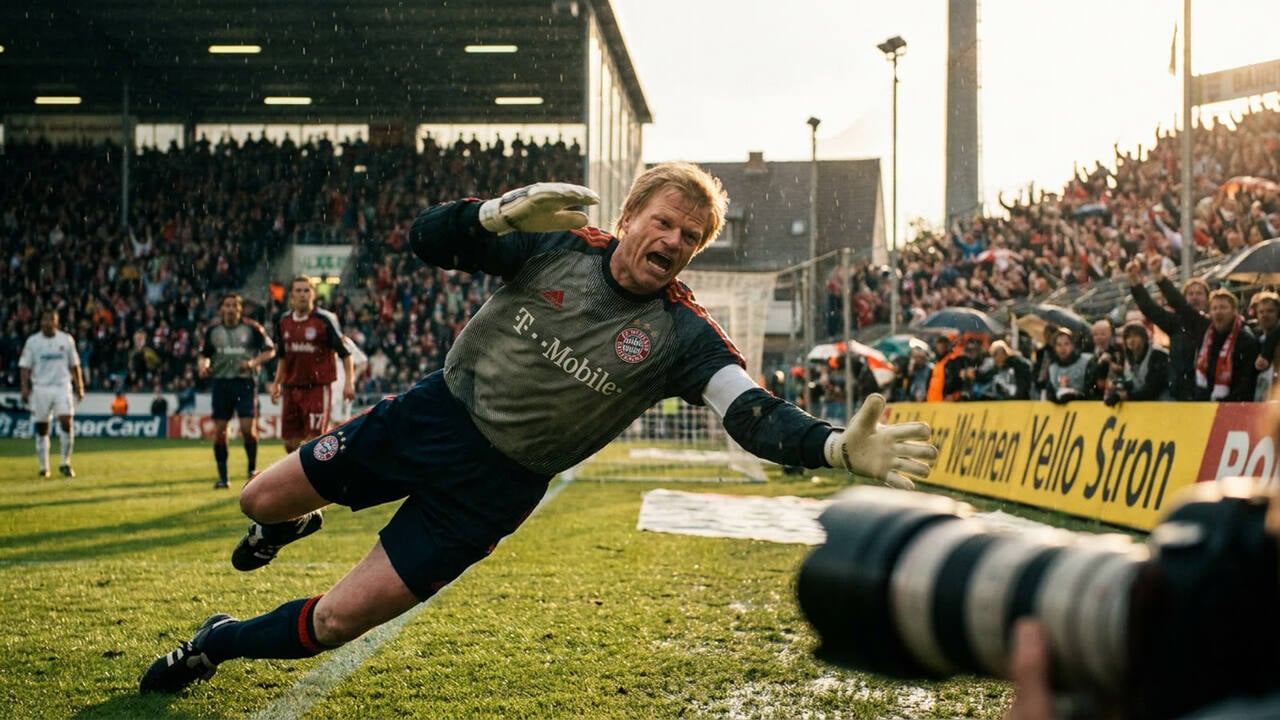
For most of football history, the goalkeeper was the position you gave to the kid who couldn't run. Then Oliver Kahn arrived and made it the most terrifying job on the pitch — for everyone except himself.
The German keeper, who spent his entire top-flight career at Bayern Munich, didn't merely guard the goal. He patrolled it like a man defending his home from invaders, complete with the volcanic temperament that implied. His eyes bulged. His neck veins throbbed. He screamed at defenders who had the audacity to let opponents shoot. He once bit an opponent's neck during a melee. The footage still circulates online, equal parts horrifying and mesmerizing.
The method in the madness
What distinguished Kahn from mere hotheads was that his rage served a purpose. Strikers approaching his penalty area faced not just a technically excellent shot-stopper but a psychological obstacle course. His reputation preceded him into every match, creating hesitation in forwards who might otherwise have finished with composure. Penalties against Kahn became mental battles as much as physical ones — his aggressive positioning and unblinking stare turned routine spot-kicks into ordeals.
The numbers supported the theater. During Bayern's treble-winning season in 2001, Kahn conceded just 37 goals in 34 league matches while his team scored 62. The defensive record was exceptional, but the real statistic was harder to quantify: how many goals were never attempted because attackers rushed their shots under his glare?
The 2002 paradox
Kahn's finest individual tournament ended in his most famous failure. At the 2002 World Cup, he dragged a mediocre German side to the final through sheer will, earning the Golden Ball as the tournament's best player — the only goalkeeper ever to receive the honor. Then, in the final against Brazil, he fumbled a Rivaldo shot that Ronaldo converted for the opening goal. Germany lost 2-0.
The moment crystallized something essential about Kahn's career: the same intensity that made him great also made his failures spectacular. There was no quiet mediocrity available to him. Every match was operatic, which meant every mistake was too.
Our take
Modern goalkeeping has moved toward the cerebral — distribution skills, sweeping range, almost midfielder-like composure. Manuel Neuer, Kahn's successor at Bayern, perfected this evolution. But something was lost in the transition. Kahn understood that football is entertainment, and that entertainment requires characters. He made the position dramatic in ways that analytics cannot capture and coaching manuals cannot teach. The game is poorer for having fewer players willing to be genuinely, magnificently unhinged.