The United States turns 250 years old today, and the nation is celebrating by doing something profoundly un-American: caring deeply about a sport it didn't invent, can't dominate, and doesn't fully understand.
The 2026 FIFA World Cup, now entering its knockout rounds across eleven American cities, has produced the predictable spectacles—packed stadiums, record television audiences, infrastructure chaos. But the tournament's quieter gift has been psychological. For perhaps the first time in its sporting history, America is learning to be a host rather than a protagonist, to find joy in excellence that isn't its own.
The paradox of the home tournament
American sports culture has always operated on a simple premise: we play our games, and we expect to win them. The NFL, NBA, MLB, and NHL are structured as closed ecosystems where American dominance is guaranteed by design. The World Cup offers no such comfort. The USMNT advanced from the group stage—barely—but enters the Round of 16 as underdogs against a resurgent Netherlands side. The host nation is, for once, a supporting character in its own production.
This has proven unexpectedly liberating. In cities from Miami to Seattle, American fans have adopted second teams with an enthusiasm that would be unthinkable during the Super Bowl. Mexican-American families in Los Angeles pack bars for El Tri matches. Nigerian flags fly in Houston. The tournament has revealed an America that exists beneath the ESPN highlight reel: polyglot, immigrant-rich, hungry for connection to the global game.
What the rest of the world sees
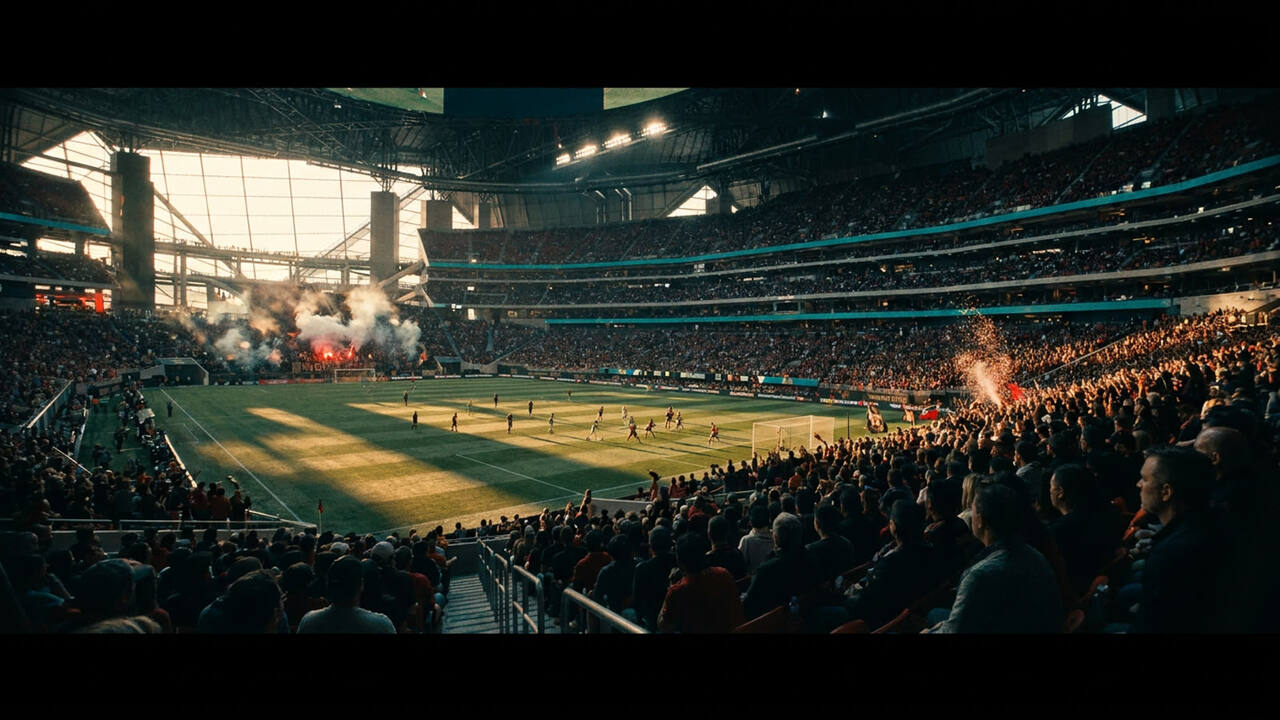
Foreign observers have noted the peculiar American relationship with soccer for decades—the sport of suburban children and recent arrivals, never quite achieving the cultural centrality it holds elsewhere. But 2026 has shifted the calculus. The infrastructure works (mostly). The crowds are genuine. The atmosphere in Atlanta for the Argentina-Cape Verde thriller suggested a nation that has finally stopped asking whether soccer belongs here and started simply experiencing it.
The timing matters. At a moment when American politics feels maximally polarized and American institutions face legitimacy crises, the World Cup offers something rare: a shared experience that doesn't require choosing sides. You can root for your heritage, your adopted team, or simply the beautiful goal. The tribalism is real but temporary, bounded by ninety minutes and a final whistle.
Our take
There's something fitting about America discovering soccer's pleasures on its sestercentennial. The sport demands patience, rewards collective movement over individual heroics, and operates on a global calendar that no single nation controls. These are not traditionally American virtues. But perhaps that's precisely why the tournament feels like a gift rather than a conquest—a reminder that the best parties are the ones where you learn something from your guests. The United States may not win this World Cup. It might win something more interesting: a new way of watching.