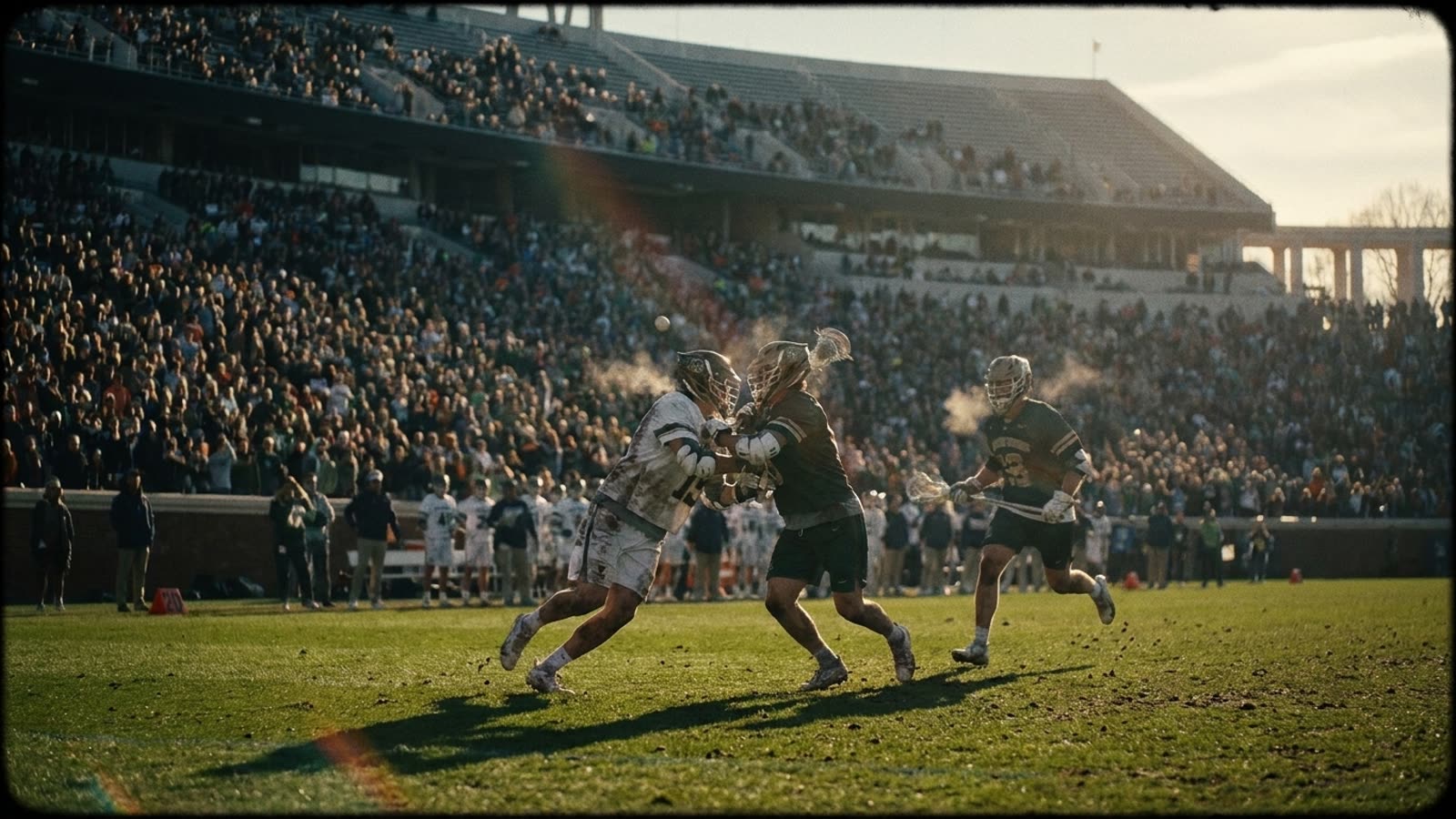
The NCAA men's lacrosse championship arrives Monday as the final punctuation mark on the college athletics calendar, a tournament that has somehow avoided becoming a referendum on everything wrong with amateur sports. In an era when every major college competition doubles as a labor dispute, lacrosse persists as something closer to the original promise: regional pride, genuine amateurism (relatively speaking), and athletic excellence performed for crowds that actually care about the game itself.
This is not an accident. It is a function of lacrosse's peculiar economics.
The last amateur standing
Lacrosse occupies a strange position in the college sports hierarchy—prestigious enough to attract serious athletes, niche enough to avoid the corrupting attention that has transformed football and basketball into minor-league professional operations. The sport's talent pipeline runs through prep schools and suburban club programs rather than the AAU circuits that have turned basketball recruiting into a bidding war. NIL deals exist, but they are not yet determinative. The transfer portal churns, but not at the frantic pace that has made roster continuity a quaint memory elsewhere.
The result is a championship weekend that still resembles a championship weekend. Teams that have built programs over years, not assembled them over weeks, compete for a title that cannot be purchased outright.
Geography as identity
Lacrosse remains one of the few sports where regional identity still matters. The traditional powers—Syracuse, Johns Hopkins, Virginia, Maryland—carry weight that transcends any single season. The sport's expansion westward and southward has diluted this somewhat, but the championship still feels like a cultural event for the lacrosse corridor stretching from Long Island through Baltimore. When Syracuse takes the field, it represents something more than a collection of athletes who happened to choose that particular institution this year.
This stands in stark contrast to the rootlessness that has infected other college sports, where players cycle through multiple programs and fans struggle to form attachments to rosters that dissolve annually.
Our take
The NCAA men's lacrosse championship will never rival March Madness in viewership or the College Football Playoff in revenue. That is precisely what protects it. The sport exists in a sweet spot—competitive enough to produce genuine excellence, obscure enough to avoid the forces that have turned college athletics into a farm system with better marketing. Enjoy it while it lasts. The moment lacrosse players start commanding six-figure NIL deals, this particular magic disappears. For now, Monday's final offers something increasingly rare: a college championship that is actually about college.