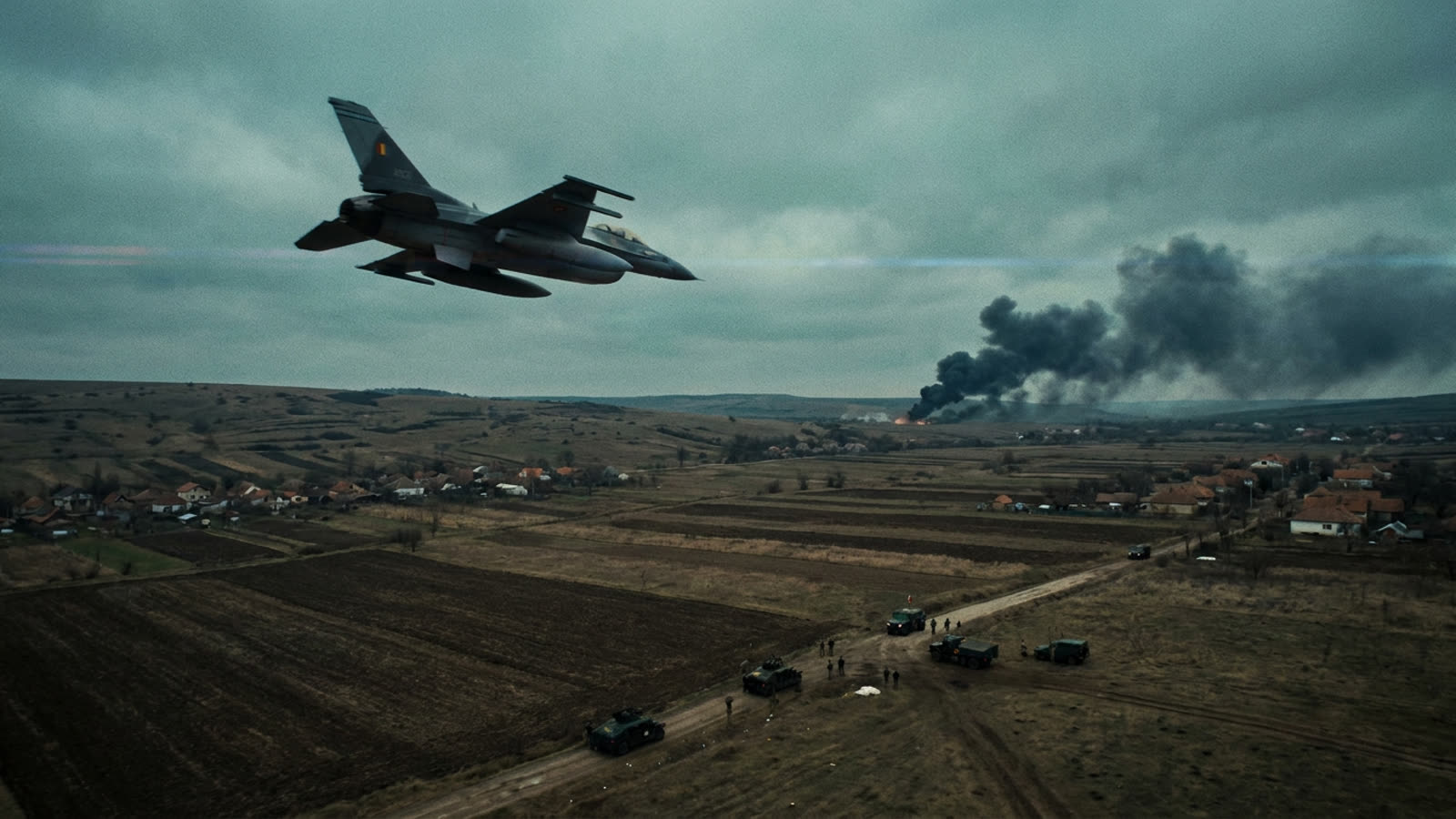
NATO finds itself in a familiar bind: outraged enough to issue a stern communiqué, cautious enough to ensure that communiqué changes nothing. A Russian drone slammed into a residential building in Romania this week, wounding two civilians and marking yet another incursion of Moscow's war into alliance territory. The response—collective condemnation, calls for accountability, zero indication of material consequence—tells you everything about where the Western alliance stands nearly four years into the Ukraine conflict.
The incident is not unprecedented. Romanian and Polish airspace have been violated repeatedly since 2022, with debris and drones drifting across borders during Russian strikes on Ukrainian infrastructure. But a direct impact on a civilian structure, with injuries, crosses a threshold that NATO's carefully calibrated rhetoric has long tried to avoid acknowledging. Article Five, the alliance's mutual defense clause, looms over every such event like an heirloom sword no one wants to unsheathe.
The geometry of restraint
NATO's posture reflects a calculation that has remained remarkably stable since the war's early months: support Ukraine materially, contain Russia rhetorically, avoid direct confrontation at nearly any cost. The Romanian strike tests this framework without breaking it. Two wounded civilians in an apartment building is tragic but not catastrophic; it permits condemnation without demanding action. Alliance officials can point to enhanced air policing, additional deployments to the eastern flank, and the usual diplomatic machinery grinding forward.
What they cannot do is pretend the incident was accidental. The drone's trajectory, the target's proximity to Ukrainian border regions under active bombardment, and the pattern of previous violations all suggest Moscow is comfortable probing NATO's red lines. The Kremlin has learned that these lines are drawn in something more forgiving than permanent ink.
Bucharest's awkward position
Romania now faces domestic pressure that its NATO membership was supposed to relieve. The country joined the alliance in 2004 precisely to escape the shadow of Russian influence; two decades later, Russian ordnance is landing on Romanian soil. President Klaus Iohannis's government must balance genuine alarm among citizens with the alliance's preference for measured responses. Escalation serves no one's interests, but neither does the appearance of impotence.
The broader eastern flank—Poland, the Baltic states, Moldova's nervous neutrality—watches Bucharest's handling of the crisis as a preview of their own potential futures. If NATO's response to a direct strike on member territory amounts to a press release and a promise of continued vigilance, smaller states may quietly recalculate their assumptions about collective defense.
Our take
NATO's strategic coherence depends on the credibility of Article Five, and credibility erodes through a thousand small concessions rather than a single dramatic failure. The Romanian strike is one more data point in a pattern Moscow has every incentive to continue testing. The alliance's condemnation is appropriate; its sufficiency is another matter. At some point, the gap between rhetoric and consequence becomes the message itself—and that message is not one NATO can afford to send indefinitely.