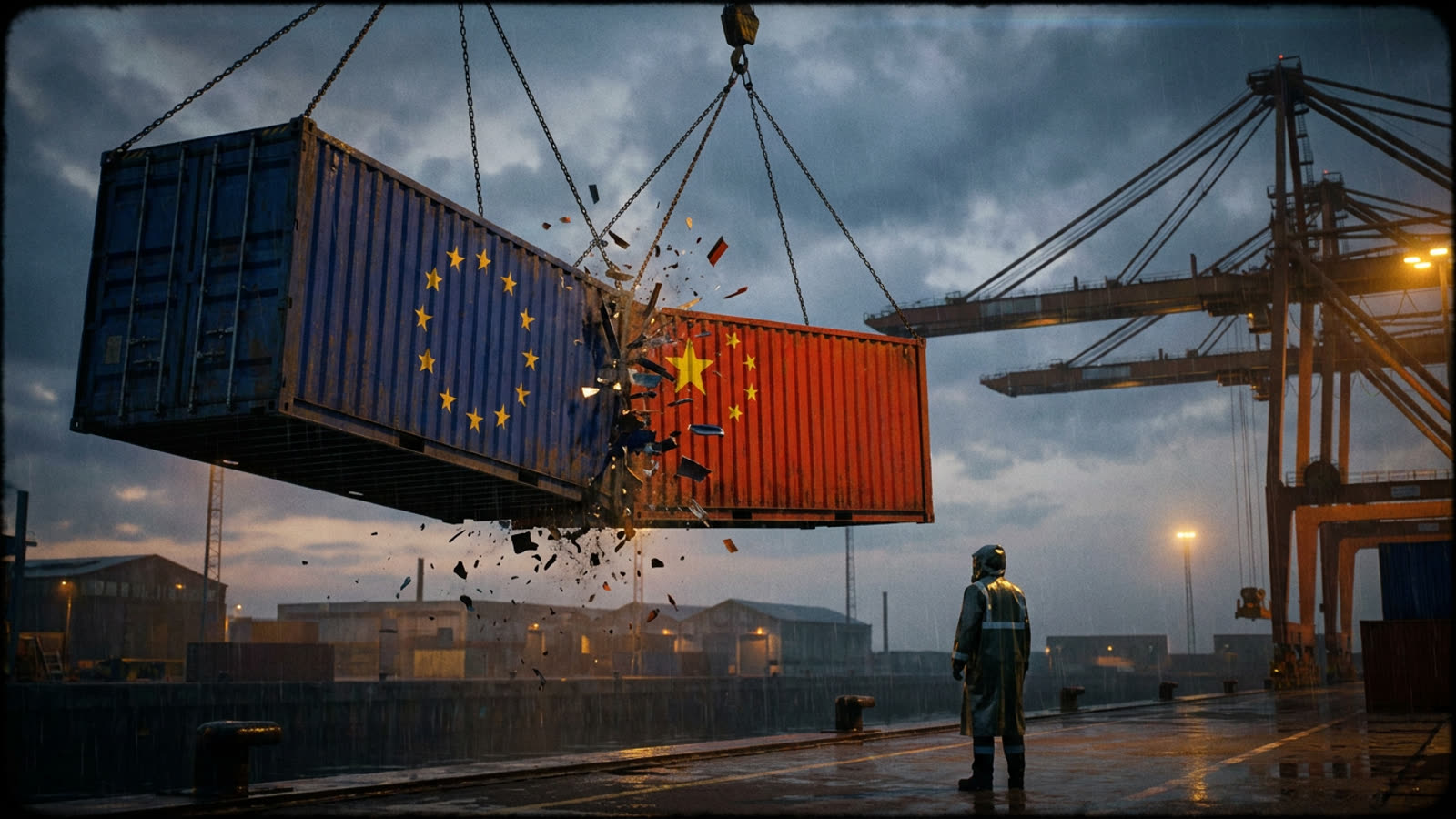
The European Union has spent the better part of two decades preaching the gospel of rules-based trade while quietly benefiting from China's factory floor. That sermon is over. Brussels is now actively courting a commercial confrontation with Beijing that it lacks the unity, leverage, or stomach to win.
The proximate cause is electric vehicles. Chinese EV manufacturers, led by BYD and a constellation of state-subsidized newcomers, have flooded European markets with competitively priced cars that make legacy automakers look like they're still debugging the internal combustion engine. The European Commission's response—threatened tariffs of up to 45 percent on Chinese EVs—follows the American playbook of industrial protectionism. But Europe is not America, and what works for a continent-sized economy with energy independence and a unified federal government may prove catastrophic for a fractious bloc still arguing about fiscal transfers.
The German problem
Germany, Europe's industrial anchor, is also its most exposed member. Volkswagen, BMW, and Mercedes-Benz derive roughly a third of their global sales from China. Beijing has already signaled that any tariff escalation will be met with countermeasures targeting European luxury goods, agricultural products, and—most pointedly—German cars. The irony is exquisite: Berlin's manufacturers spent years building Chinese production capacity to serve the local market, and now that same integration makes them hostages to Brussels' trade posturing.
Chancellor Friedrich Merz has publicly urged caution, but the Commission, under pressure from France and southern European states with negligible Chinese exposure, appears committed to escalation. The result is a policy driven by members who bear few costs and opposed by those who bear most.
Beijing's asymmetric leverage
China's retaliatory toolkit extends well beyond automobiles. European aerospace, luxury fashion, wine, and dairy exports are all vulnerable. More concerning is the rare-earth dimension: China controls roughly 60 percent of global rare-earth mining and nearly 90 percent of processing. A supply squeeze would cripple European battery and semiconductor production precisely when the bloc is trying to reduce strategic dependencies.
Beijing has also mastered the art of selective punishment. When Lithuania permitted Taiwan to open a representative office, China effectively blacklisted the country from its supply chains. The EU's response was tepid at best. There is little reason to believe Brussels would mount a more vigorous defense of, say, French cognac producers or Italian machinery exporters.
Our take
Europe is attempting American-style industrial policy with European-style governance, which is to say it wants the confrontation without the cohesion. The tariff threats may play well domestically in Paris and Rome, but they risk fracturing the Franco-German axis that underwrites the entire European project. If Brussels wants a trade war with China, it should first ensure it can survive one. At present, that assurance is conspicuously absent.