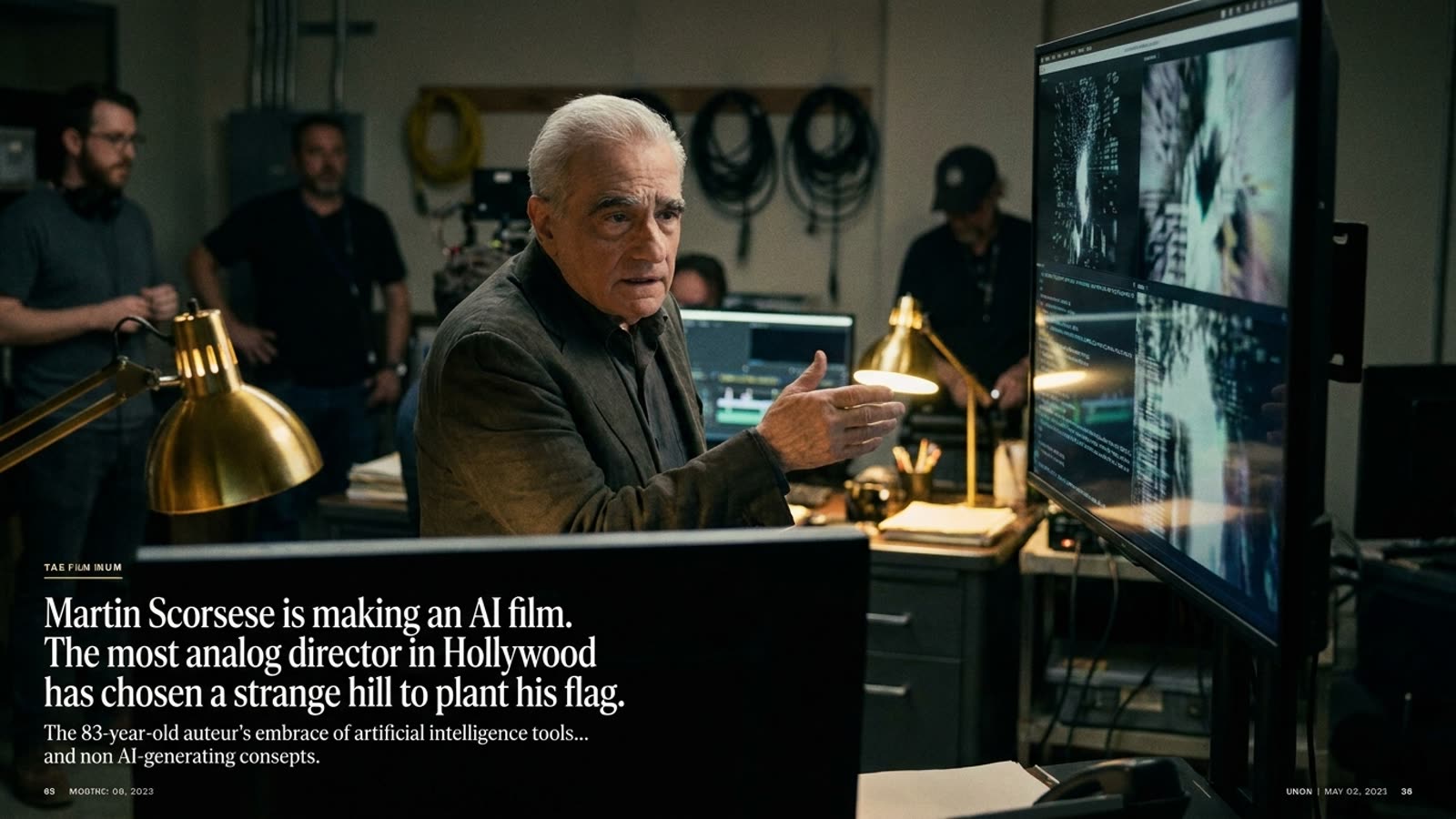
Martin Scorsese has spent six decades insisting that cinema is a craft of human imperfection, of happy accidents captured on celluloid, of actors' faces revealing truths no algorithm could compute. Now he's making a film with AI, and Hollywood doesn't quite know what to do with that information.
The director, who once described streaming platforms as an existential threat to the theatrical experience, has apparently decided that generative AI is different—a tool rather than a replacement, an enhancement rather than an erosion. His production company has begun integrating AI-assisted pre-visualization and script analysis into an upcoming project, making Scorsese perhaps the most unlikely convert in an industry still wrestling with the technology's implications.
The auteur's calculation
Scorsese's pivot is less surprising when you examine his recent frustrations. Killers of the Flower Moon cost Apple roughly $200 million and ran three hours and twenty-six minutes—a length that limited theatrical windows and tested even devoted audiences. His long-gestating Frank Sinatra biopic has languished in development hell partly due to budget concerns. At 83, Scorsese is acutely aware that time and money are finite resources, and AI promises to extend both.
The technology could allow him to pre-visualize complex sequences without expensive test shoots, to iterate on scripts with pattern-recognition tools that identify structural weaknesses, to potentially reduce the bloated post-production timelines that have made his recent films logistical nightmares. For a director who has always been a maximalist, AI offers the seductive promise of more: more takes analyzed, more options considered, more ambition realized within mortal constraints.
The industry's awkward silence
Hollywood's response has been notably muted. Directors who might otherwise rush to condemn AI adoption have found themselves unable to criticize Scorsese, whose credentials as a defender of cinema's soul are unimpeachable. The guilds, still raw from 2023's strikes over AI protections, are watching carefully but have issued no statements. Studios are quietly thrilled—if Scorsese can normalize AI tools among prestige filmmakers, the technology's integration becomes a matter of craft rather than controversy.
The silence from Scorsese's usual allies is telling. Christopher Nolan, who shoots on film and disdains digital intermediaries, has offered no comment. Denis Villeneuve, another analog purist, has remained quiet. The absence of criticism suggests either deference to a living legend or genuine uncertainty about where the lines should be drawn.
Our take
Scorsese has always been a pragmatist disguised as a romantic. He adopted digital color correction when it served his vision, embraced streaming distribution when it funded his ambitions, and now apparently views AI as another tool in the kit rather than a philosophical threat. Whether this represents wisdom or capitulation depends entirely on what appears on screen. If the resulting film feels unmistakably Scorsesian—that restless camera, those moral reckonings, that Catholic guilt—then the technology will have proven itself neutral. If it doesn't, Scorsese will have inadvertently demonstrated exactly what the skeptics feared: that some ineffable human quality gets lost in the optimization. At 83, he's betting his legacy that the former is true. It's the most Scorsese gamble imaginable.