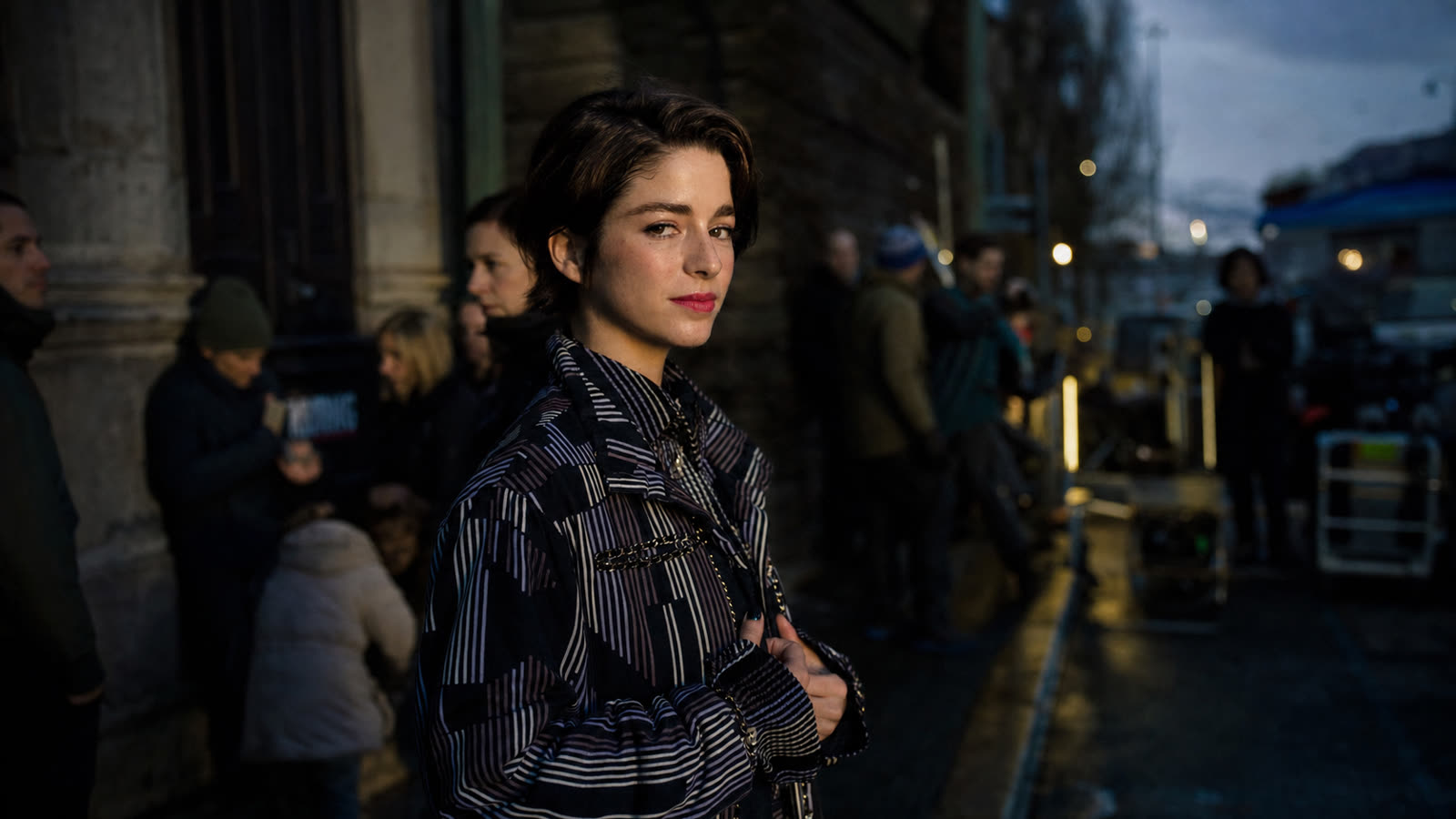
The calculus of international stardom has always been brutal for Latin American actresses: learn English, move to Los Angeles, and spend years auditioning for roles that flatten your origins into a single adjective—fiery, exotic, mysterious. Mariana di Girólamo, the 32-year-old Chilean star best known for Sebastián Lelio's Ema and Pablo Larraín's El Conde, appears to have skipped the queue entirely. Her English-language debut in Martin McDonagh's Wild Horse Nine has generated the kind of early awards-season heat that publicists dream about and rarely deliver.
The film, which premiered at Venice in September and opens wide next month, casts di Girólamo as a veterinarian in 1970s rural Montana who becomes entangled with a group of horse thieves led by a character played by Barry Keoghan. McDonagh, whose The Banshees of Inisherin swept the 2023 awards circuit, has spoken in interviews about discovering di Girólamo through Ema and writing the role specifically for her—a vanishingly rare courtesy extended to foreign-language actors.
The Larraín pipeline
Di Girólamo's path to Hollywood runs through Santiago's most reliable export: director Pablo Larraín. Her vampiric turn as the daughter of Augusto Pinochet in El Conde (2023) announced her as an actress capable of operating in registers that American studios rarely ask of Latina performers—cold, mordant, politically charged. Larraín's constellation of collaborators, which includes Kristen Stewart and Natalie Portman, has functioned as an informal finishing school for actors seeking prestige-project credibility. Di Girólamo is the first Chilean actress to emerge from that orbit with leading-lady momentum of her own.
What McDonagh sees
McDonagh's attraction to di Girólamo makes sense when you consider his preoccupations: moral ambiguity, dark comedy, and characters who refuse to be likable. In Wild Horse Nine, her veterinarian is neither victim nor femme fatale but something harder to categorize—a woman whose complicity in the thieves' scheme is driven by economic desperation and a quiet contempt for the ranchers who employ her. Early reviews have praised the performance's stillness, a quality that reads as confidence on screen and stands in sharp contrast to the theatrical energy of her co-stars.
The awards math
Searchlight, the film's distributor, has scheduled Wild Horse Nine for a limited release in late November before expanding in December—the classic awards-corridor rollout. Di Girólamo is expected to campaign in the Best Actress category, where she would face a field that currently includes Cate Blanchett and Saoirse Ronan. The Chilean actress's odds are long but not absurd; the Academy has shown recent appetite for international performers in English-language roles, and McDonagh's imprimatur carries significant weight with voters.
Our take
The real story here is not whether di Girólamo wins an Oscar but whether her trajectory becomes a template. For decades, Latin American actresses have been asked to shed their accents and their specificity to compete in Hollywood. Di Girólamo kept both and let a prestige auteur come to her. That is not a path available to everyone, but it is a path—and its existence matters.