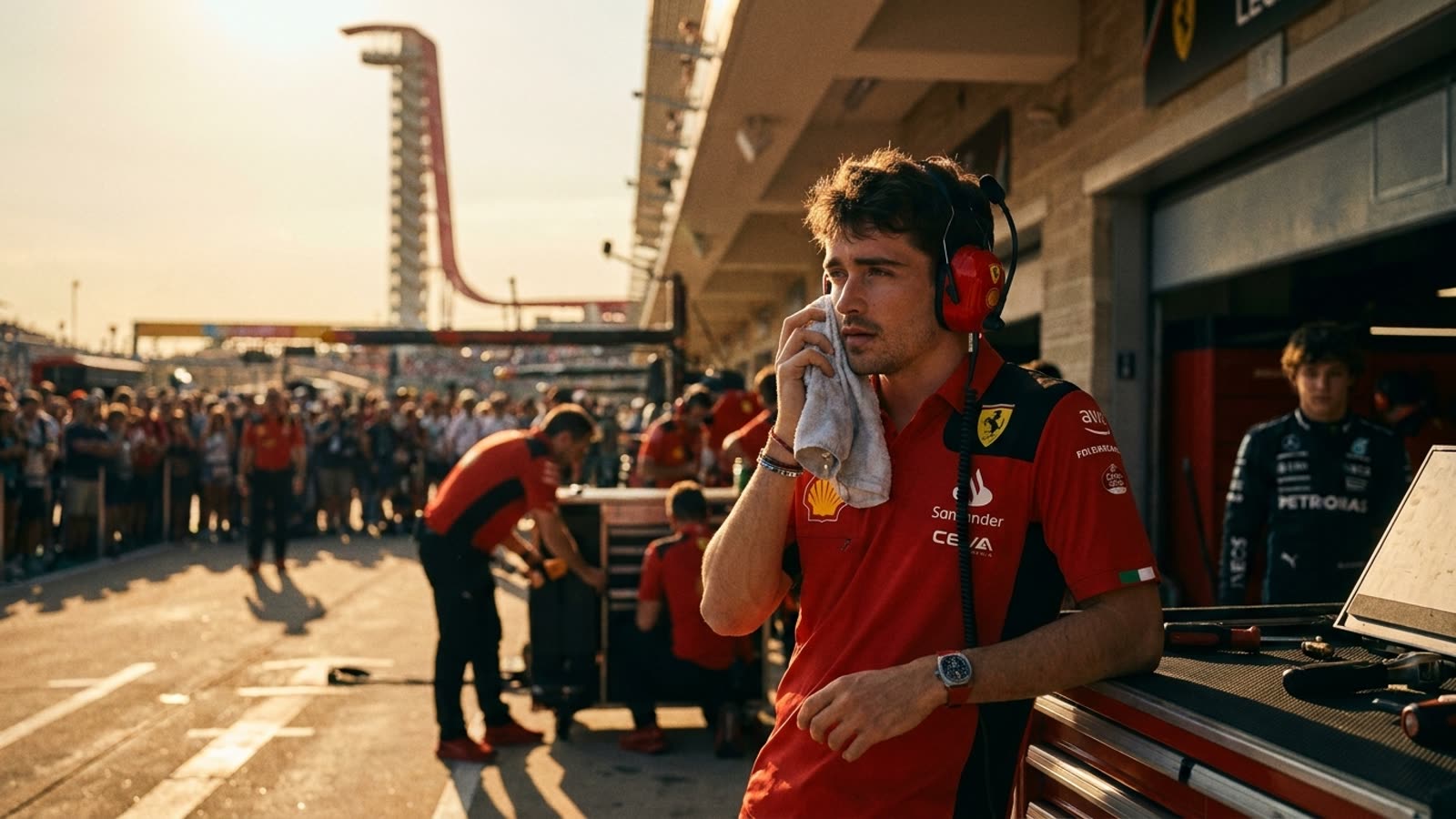
Ferrari arrived at the Circuit of the Americas with a car that finally seems to match its livery — fast, aggressive, and capable of challenging for a constructors' title that slipped away last season. Charles Leclerc's quickest time in Friday practice confirmed as much. But the paddock's attention drifted, inevitably, to the silver car that finished a fraction behind him, piloted by an eighteen-year-old who was racing karts when Lewis Hamilton won his seventh championship.
Kimi Antonelli's presence in the second Mercedes seat is no longer a curiosity or a development project. It is a statement. And Friday's session in Texas suggested the statement is being heard.
The Leclerc benchmark
Leclerc's pace was genuine. Ferrari's SF-26 has shown consistent single-lap speed across the last four races, and the Monegasque driver has been extracting every tenth from it. The Austin circuit, with its elevation changes and high-speed sweepers, rewards driver confidence, and Leclerc has that in abundance after his Monza victory. His Friday time was not sandbagged; it was a marker laid down for qualifying.
But practice sessions are about more than the P1 name on the timing sheet. They are about trajectories, and Antonelli's trajectory is steeper than anyone in the paddock anticipated.
The Antonelli question, answered early
When Mercedes announced Antonelli would replace Hamilton for 2026, the assumption was that the team would spend the first half of the season managing expectations. The Italian teenager had dominated Formula 2 but had never raced a full F1 season. Growing pains were budgeted.
They have not arrived on schedule. Antonelli has qualified in the top five in three of the last four races and has shown racecraft that belies his age — patient when necessary, ruthless when gaps appear. Friday's second-place finish in practice was not an outlier; it was a continuation.
Toto Wolff has been careful not to burden his young driver with comparisons to the man he replaced, but the paddock is less diplomatic. Antonelli's driving style — smooth entries, aggressive exits, minimal steering correction — echoes the Hamilton of 2007 more than the Hamilton of 2024. Whether that comparison is fair or premature matters less than what it signals: Mercedes believes it has found a generational talent, and the evidence is accumulating.
Ferrari's title math
For Leclerc, the weekend is about something more concrete than narrative. Ferrari trails Red Bull by forty-one points in the constructors' standings with five races remaining. A win in Austin, combined with a Verstappen stumble, would make the final stretch genuinely competitive. The SF-26 has the pace. The question is whether Ferrari has the operational discipline to convert speed into points — a question the Scuderia has failed to answer convincingly for most of the hybrid era.
Leclerc's Friday dominance is encouraging, but Ferrari has been quick on Fridays before. The test comes Saturday afternoon and Sunday evening.
Our take
The most interesting development in Formula 1 this season is not the title fight. It is the quiet confirmation that the sport's next era has a face, and that face belongs to a teenager from Bologna who drives like he has been doing this for a decade. Leclerc may win in Austin. Verstappen may clinch another championship. But the story that will matter in three years' time started on a Friday afternoon in Texas, when Kimi Antonelli finished second and no one was surprised.