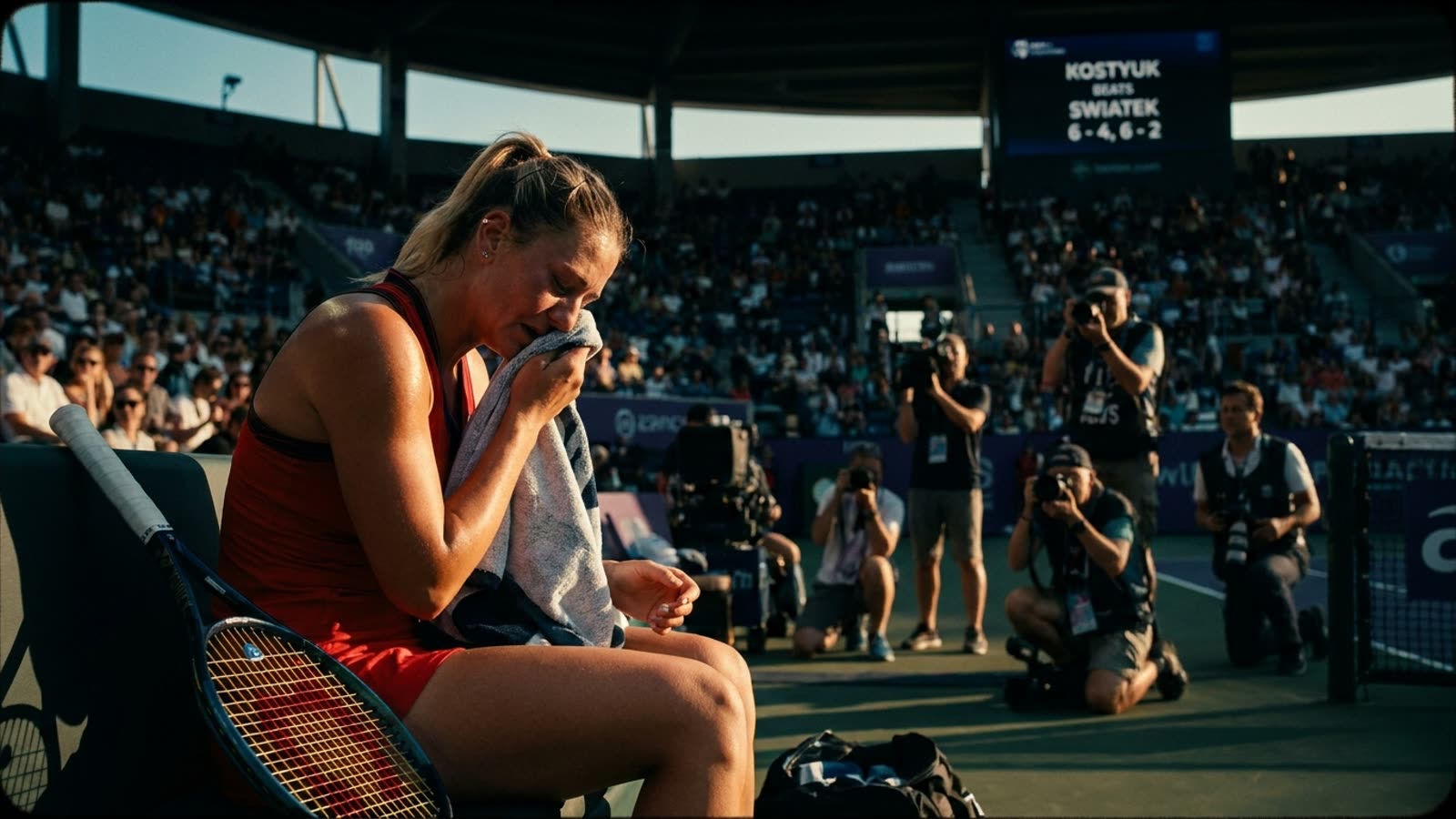
Iga Swiatek does not lose at Roland-Garros — not like this. The Pole had won 22 consecutive matches on Philippe-Chatrier, the closest thing to a home court a player can claim without actually being French. Then Marta Kostyuk walked on, dismantled her in straight sets, and walked off with the kind of victory that rewrites narratives.
Kostyuk, ranked outside the top 20, did not merely upset the tournament's overwhelming favourite; she exposed vulnerabilities that had been papered over by Swiatek's sheer dominance on clay. The Ukrainian's flat, aggressive groundstrokes neutralised Swiatek's heavy topspin, and her court positioning forced the defending champion into uncharacteristic errors. It was tactically pristine tennis, delivered under the kind of pressure that breaks most players.
The political court
Kostyuk has never been shy about her country's war. She has refused to shake hands with Russian and Belarusian opponents, a stance that has drawn both admiration and criticism on tour. Her victory over Swiatek — a player from a nation that has been one of Ukraine's staunchest European allies — carries none of that geopolitical friction, but it nonetheless amplifies her platform at a moment when Western attention on Ukraine is fragmenting.
The timing is pointed. Aid debates in Washington have grown acrimonious, European unity is fraying at the edges, and Kyiv's diplomatic bandwidth is stretched thin. A deep run at a Grand Slam by a player who wears her nationality on her sleeve offers something intangible but real: visibility. Kostyuk's post-match interview, delivered in accented but fluent English, touched on her family still in Ukraine and the difficulty of competing while her country remains under bombardment. It was understated, which made it more effective.
What it means for the draw
Swiatek's exit blows the bottom half of the women's bracket wide open. Aryna Sabalenka, the world number one, now has a clearer path to the final, though her own record on Parisian clay is spotty. Kostyuk will face a less daunting quarter-final opponent, but the psychological burden of being a sudden title contender — rather than a plucky underdog — is its own challenge. History suggests she will need to win at least two more matches against top-10 opposition to lift the Coupe Suzanne Lenglen. That is a tall order, but so was beating Swiatek 6-3, 6-4.
Our take
Sport's power to serve as proxy for larger struggles is often overstated, but occasionally the shoe fits. Kostyuk's win will not change the war's trajectory, nor will it shift a single vote in any legislature. What it does is remind a global audience that Ukraine is not merely a policy problem or a line item in a defence budget — it is a country full of people still showing up, still competing, still refusing to be reduced to victimhood. That is worth more than a trophy, though the trophy would be nice too.