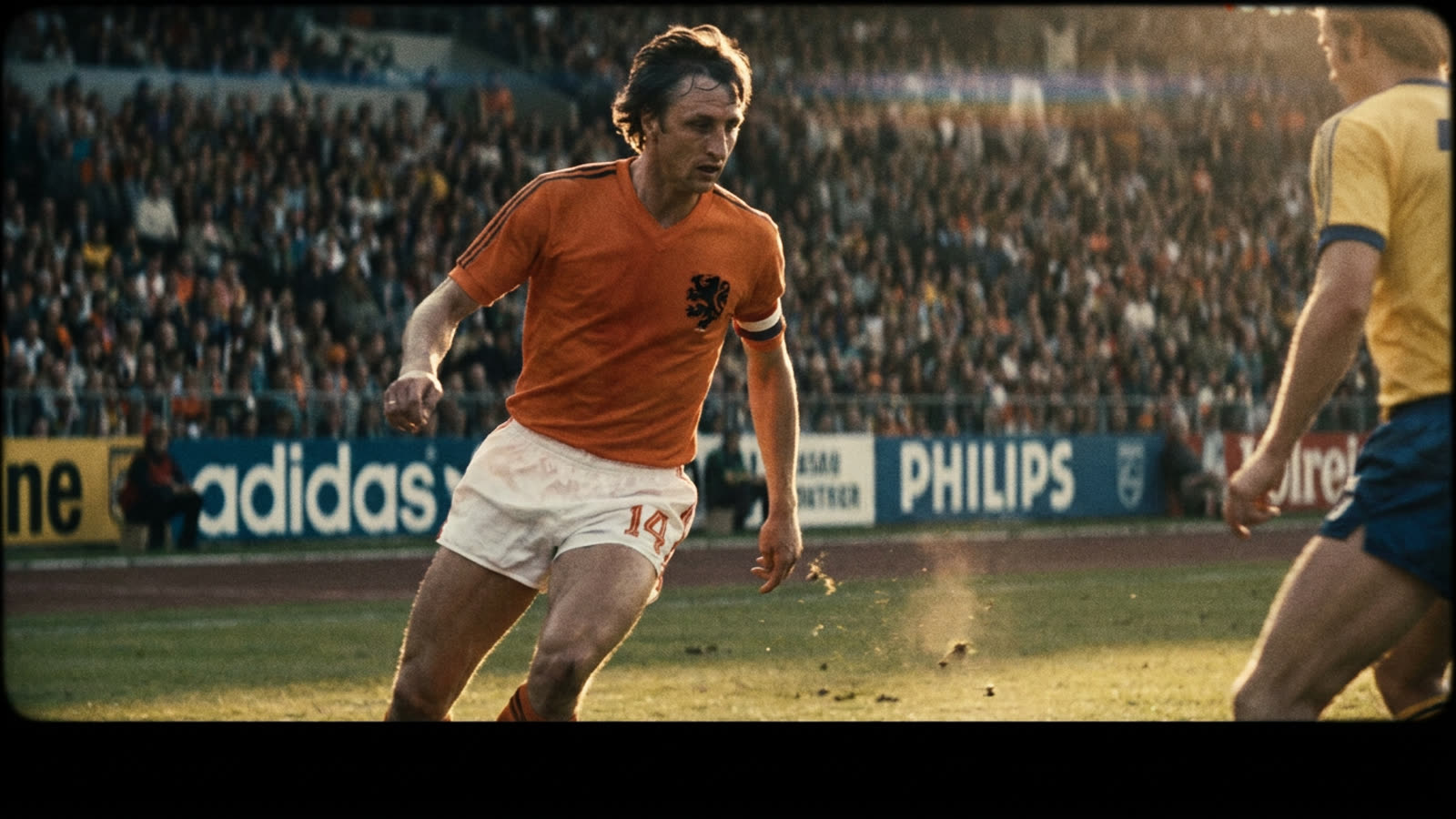
Football history is littered with goals that defined eras, but the sport's most influential moment involved no goal at all. In the 53rd minute of a group-stage match between the Netherlands and Sweden at the 1974 World Cup, Johan Cruyff received the ball near the left touchline with his back to goal. Swedish defender Jan Olsson closed in, expecting a cross. What happened next entered the lexicon of the game itself.
Cruyff shaped to pass, then dragged the ball behind his standing leg with the inside of his right foot, spinning 180 degrees and leaving Olsson grasping at air. The move took perhaps a second. The Dutch won the match 0-0 in terms of what it meant for their tournament progression—they had already qualified—but Cruyff had just given the world a new verb.
The anatomy of an improvisation
What made the turn revolutionary was not its technical difficulty—skilled players had executed similar feints before—but its context and its author. Cruyff was already the reigning Ballon d'Or winner, the embodiment of Total Football, the system in which every outfield player could occupy any position. For him to unveil something so audaciously simple on the World Cup stage, in a match being broadcast globally, was to announce that football's future belonged to those who could think faster than their opponents.
The turn also crystallized a Dutch footballing philosophy that prized intelligence over industry. Rinus Michels, the national team coach, had spent years developing a style predicated on spatial awareness and positional fluidity. Cruyff's improvisation was the individual expression of a collective idea: that the player with the ball should always have more options than the defender trying to take it.
Why imitation became the sincerest form of curriculum
Within years, the Cruyff Turn had migrated from highlight reel to training ground. Youth academies from Amsterdam to São Paulo began teaching it as a foundational skill, alongside the step-over and the drag-back. The move's elegance made it aspirational; its practicality made it essential. Unlike showboating tricks that rarely survive contact with professional defenders, the turn actually works at the highest level because it exploits a universal defensive instinct: the urge to commit.
Cruyff himself was characteristically dismissive of the fuss. He never named the move and rarely discussed it in interviews, preferring to talk about spacing and pressing. For him, the turn was simply what the moment required. That attitude—that creativity should be functional, not decorative—became the foundation of his later career as a manager, most notably at Barcelona, where he built the team that would eventually produce Pep Guardiola's tiki-taka dynasty.
Our take
The Cruyff Turn endures because it answers a question football keeps asking: can beauty and efficiency coexist? The sport's industrial tendency—toward pressing, toward defensive compactness, toward reducing risk—constantly threatens to squeeze out individual brilliance. Cruyff's one-second revolution proved that the two are not opposites. A well-timed feint is not indulgence; it is the fastest route through a problem. Every time a winger on a muddy Sunday-league pitch attempts the turn and fails, they are paying tribute to an idea that still animates the game: that football, at its best, should look like it was invented on the spot.