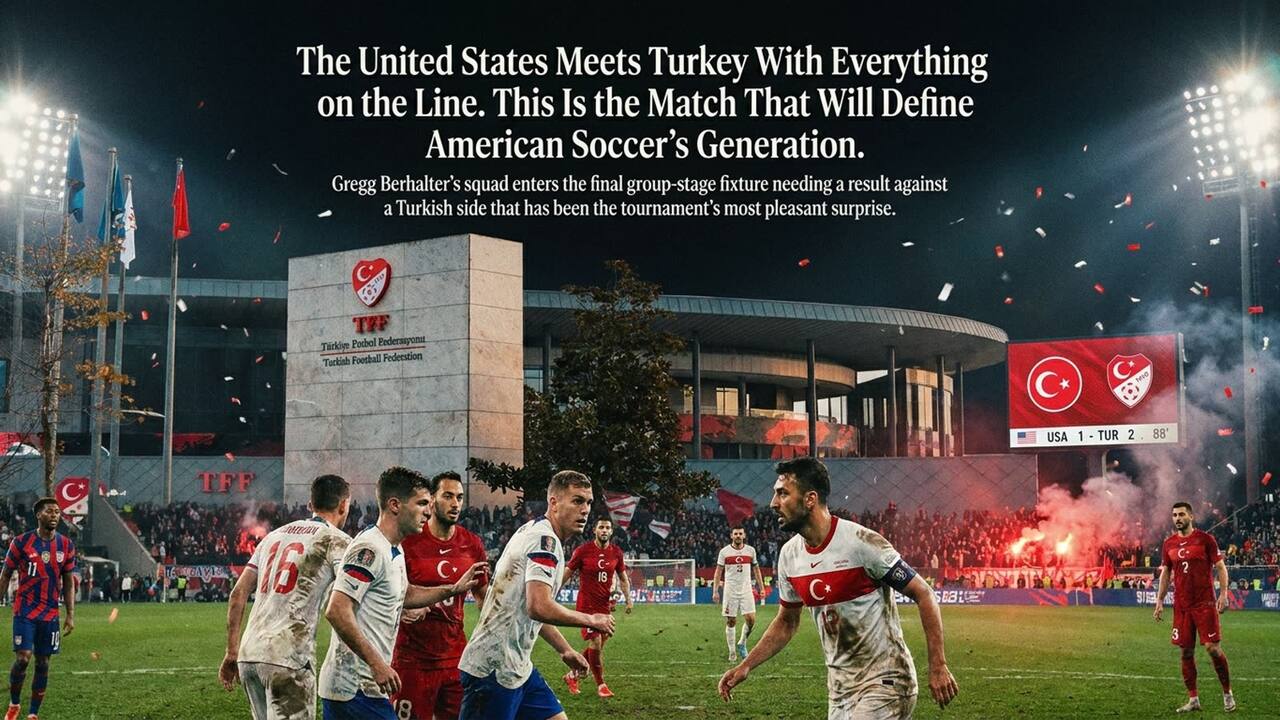
The arithmetic is straightforward, even if the task is not: beat Turkey, or at minimum avoid defeat, and the United States advances to the knockout rounds of a World Cup held on home soil. Lose, and the host nation risks an early exit that would set the program back a decade.
Gregg Berhalter has signaled tactical adjustments for the showdown, reportedly considering a shift to a more conservative midfield shape to neutralize Turkey's quick transitions. The Turks, led by the electric Arda Güler, have been the Group B revelation, playing with a fearlessness that belies their underdog status. Their opening win over a fancied European side announced them as genuine contenders; their narrow draw in the second match proved they could absorb pressure. Now they face a partisan crowd in a stadium that will be deafening.
Why intensity remains the American calling card
Berhalter's public comments have emphasized that while personnel may rotate, the press will not soften. Christian Pulisic, Weston McKennie, and Tyler Adams form a spine that thrives on chaos, and the coaching staff believes ceding that identity would be more dangerous than any lineup tweak. The question is whether legs that have already endured two high-tempo matches can sustain a third against opponents who have had an extra day of rest.
Turkey's quiet confidence
Vincenzo Montella's side arrived in North America with modest expectations and has systematically exceeded them. Güler's dribbling has drawn comparisons to a young Mesut Özil, but it is the collective discipline—midfielders tracking back, center-backs winning aerial duels—that has made Turkey so difficult to break down. A draw would likely see them through as well, which introduces a fascinating game-theory wrinkle: both teams have incentive to avoid risk, yet both possess attacking talent that could ignite at any moment.
The weight of history
The United States has never lost a World Cup match on home soil, a streak that stretches back to 1994. That tournament's run to the Round of 16 remains the high-water mark for American men's soccer. Anything less in 2026 will be viewed as a failure, regardless of the quality of opposition. The pressure is asymmetric: Turkey plays with house money, while the Americans carry the expectations of a nation that has spent billions on infrastructure and marketing to prove it belongs among football's elite.
Our take
This is the match the United States Soccer Federation has been building toward for a generation. The talent is there, the home crowd is there, and the stakes could not be higher. If Berhalter's squad cannot rise to the occasion against a spirited but beatable Turkish side, it will confirm every skeptic's suspicion that American soccer remains a project rather than a power. A win, on the other hand, would validate years of investment and send the host nation into the knockout rounds with genuine belief. The game kicks off in less than 48 hours. The entire country should be watching.