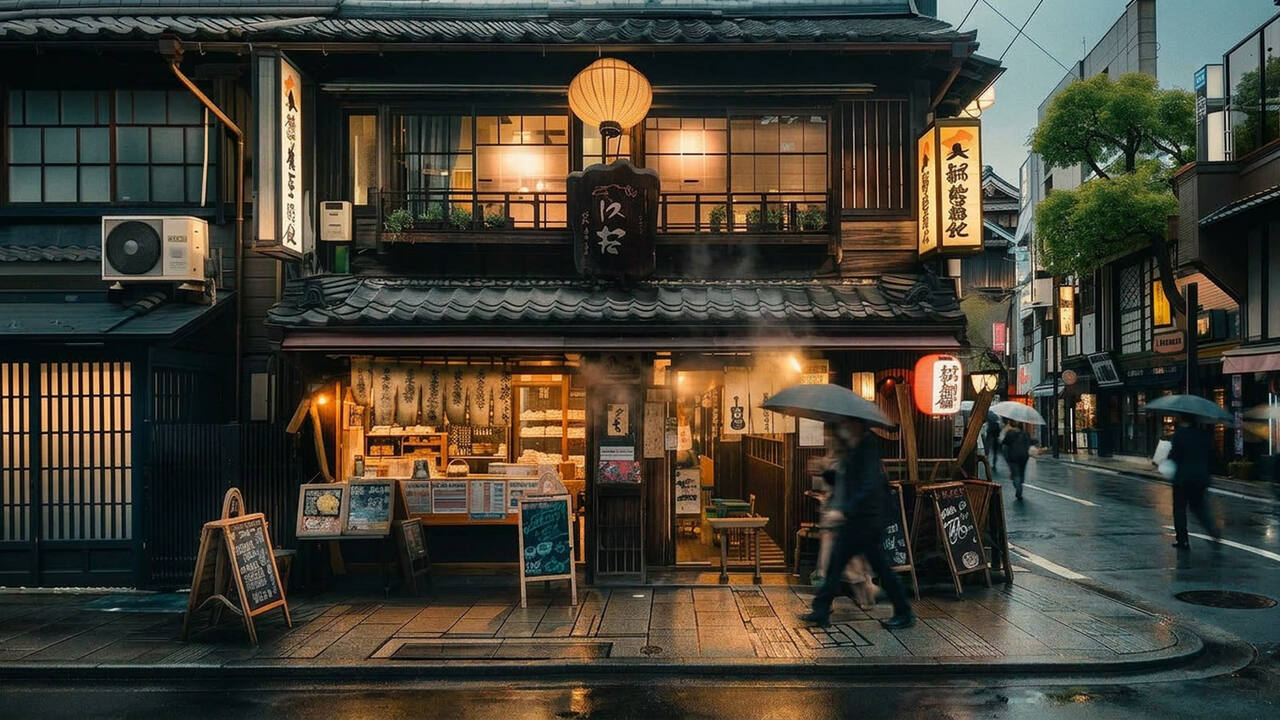
The kissaten is not trying to impress you. There is no single-origin pour-over menu, no laptop-friendly communal table, no oat milk. The lighting is too dim to photograph well. The velvet seats are worn. The master behind the counter may or may not acknowledge your presence, and the coffee—served in a delicate cup with a tiny spoon you will not use—costs roughly what you would pay at any chain. This is the point.
Japan's traditional coffee houses, which proliferated after the Second World War and peaked in the 1980s, were supposed to vanish. The arrival of Starbucks in 1996, followed by the global third-wave movement and its fetishization of traceability and technique, seemed to render the kissaten obsolete. Many did close. But a stubborn core survived, and something unexpected happened: young people started showing up.
The aesthetics of refusal
The kissaten operates on principles that read as radical in an era of perpetual connectivity. Phones are discouraged, sometimes explicitly. Wi-Fi is rare. The furniture discourages lingering in groups. What the kissaten offers instead is permission—to sit alone with a book, to stare at nothing, to let an hour pass without producing or consuming content. The coffee is a pretext; the product is sanctuary.
This is not nostalgia, or not only nostalgia. The kissaten's appeal to younger visitors lies precisely in its indifference to their preferences. It does not adapt. It does not optimize. In a consumer landscape engineered to anticipate and satisfy every micro-desire, the kissaten's stubborn sameness functions as a kind of relief.
The business of not scaling
From a commercial standpoint, the kissaten model is almost perversely inefficient. Seating is limited. Turnover is slow. The menu rarely changes. Many are single-proprietor operations, with masters who have been perfecting the same nel drip technique for decades. When they retire, the shop often closes with them—there is no franchise playbook, no brand equity to sell.
Yet this very unsustainability is part of the appeal. Each kissaten is irreplaceable, which makes visiting one feel less like consumption and more like witness. You are not a customer; you are a guest in someone's life's work. The transaction is intimate in a way that no amount of barista small talk at a modern café can replicate.
Export and imitation
The kissaten aesthetic has begun to travel. In Seoul, Taipei, and certain neighborhoods of Brooklyn, cafés have emerged that borrow the visual vocabulary—the wood paneling, the classical music, the hand-written menus—while inevitably missing the substance. You cannot import decades of accumulated atmosphere. You cannot manufacture the specific silence of a room where the same man has been making coffee since before you were born.
What can be exported is the idea: that a café might aspire to something other than growth, that slowness is not inefficiency but intention, that some experiences are valuable precisely because they cannot be replicated at scale.
Our take
The kissaten's unlikely persistence is a small rebuke to the assumption that everything must evolve or die. Some things are better for staying exactly as they are. In an attention economy that treats every moment as inventory to be monetized, the kissaten's offer—a chair, a cup, an hour of your life returned to you—feels less like anachronism than antidote. The world does not need more kissaten. It needs to understand why the ones that remain still matter.