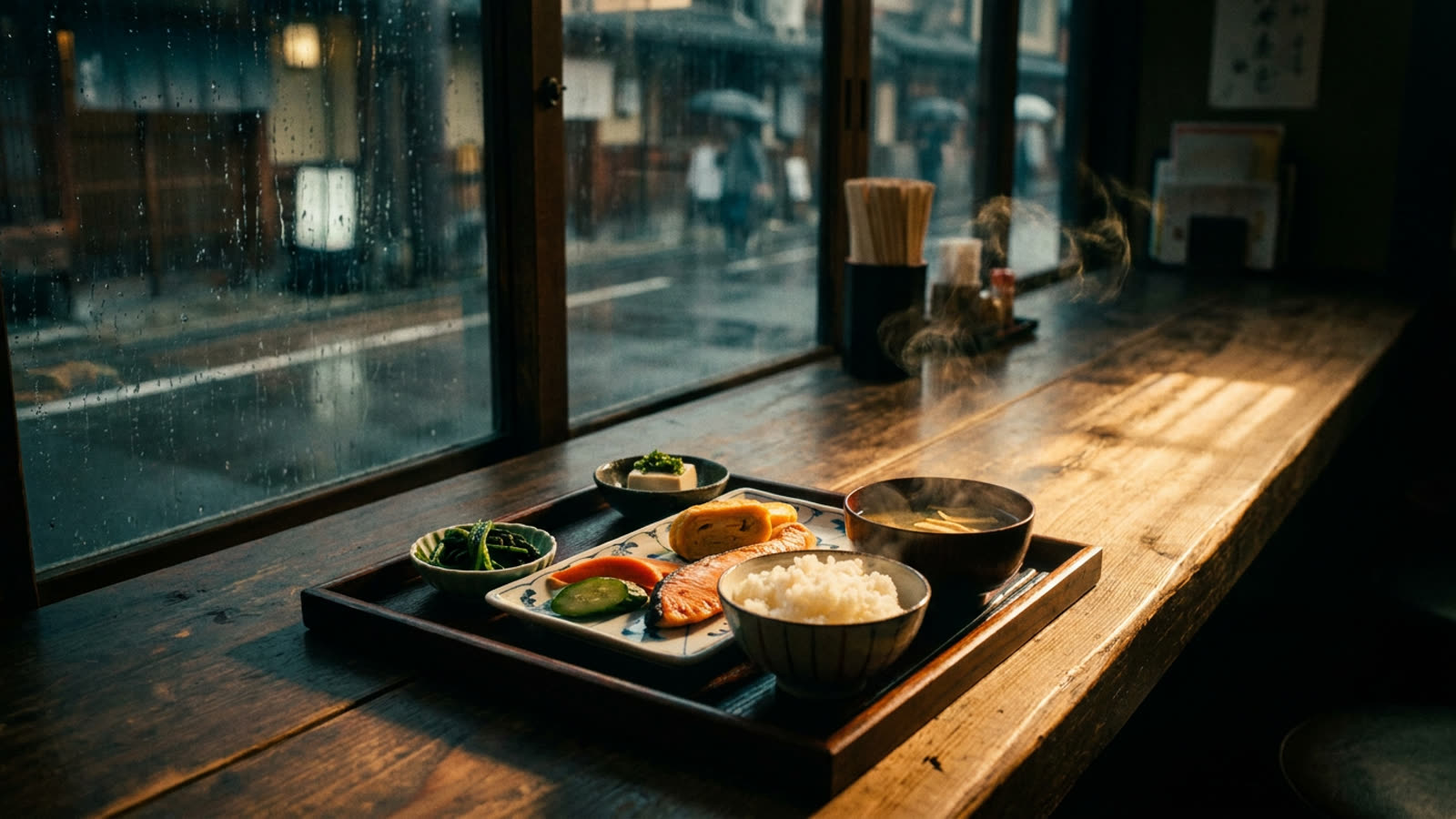
The most subversive meal in the world right now is not some avant-garde tasting menu or a plant-based provocation. It is a bowl of rice, a piece of grilled fish, pickled vegetables, miso soup, and perhaps a soft-cooked egg — eaten slowly, seated, before the day begins. The traditional Japanese breakfast, long dismissed by Western travelers as too savory, too substantial, too much for morning, has become the unlikely lodestar for a generation reconsidering its relationship with time itself.
This is not about nutrition trends or superfood fetishism, though the meal's virtues are real enough. It is about the cultural exhaustion with optimization, with protein bars consumed standing over sinks, with mornings treated as obstacles to productivity rather than experiences worth having. The Japanese breakfast — asa-gohan, literally "morning rice" — represents an older, more demanding proposition: that the first hour of consciousness deserves architecture.
The anatomy of intention
A proper Japanese breakfast is not one dish but a composition. The rice is freshly steamed, never reheated. The fish — often salmon or mackerel — is salted and grilled with attention to the char. The pickles (tsukemono) provide acid and crunch. The miso soup anchors everything with umami depth. Each element arrives in its own vessel, arranged with consideration for color, texture, and sequence of consumption.
This multiplicity is the point. Where Western breakfasts tend toward the monolithic — a stack of pancakes, a bowl of cereal, a single smoothie — the Japanese approach distributes attention across many small pleasures. The meal cannot be rushed without becoming absurd. It resists the grab-and-go impulse not through portion size but through formal complexity.
Why now
The timing of the West's embrace is not accidental. The pandemic years collapsed the boundary between waking and working, turning mornings into an undifferentiated blur of screens and anxiety. The backlash was inevitable: a hunger for ritual, for meals that mark transitions, for practices that insist on presence.
High-end hotels from London to Los Angeles now offer Japanese breakfast options alongside their eggs Benedict. Cookware brands market donabe clay pots and single-serving fish grills to home cooks. Social media overflows with carefully photographed ichiju sansai ("one soup, three sides") arrangements. The aesthetic has become aspirational shorthand for a life more considered.
Yet something is lost in translation. In Japan, this breakfast is not a lifestyle statement but a baseline — the unremarkable way millions of people have started their days for centuries. The Western adoption often treats it as a weekend project, a special occasion, rather than a daily commitment. The gap between admiration and practice remains vast.
Our take
The Japanese breakfast's appeal is finally less about Japan than about what it reveals in its admirers: a society that intellectually venerates slowness while structurally prohibiting it. We fetishize the ritual while maintaining the conditions that make ritual impossible. The meal itself is not the lesson. The lesson is that a culture chose, collectively and over generations, to protect the morning from efficiency. That choice is available to anyone. It simply requires deciding that the first hour of the day is not a cost to be minimized but a life to be lived.