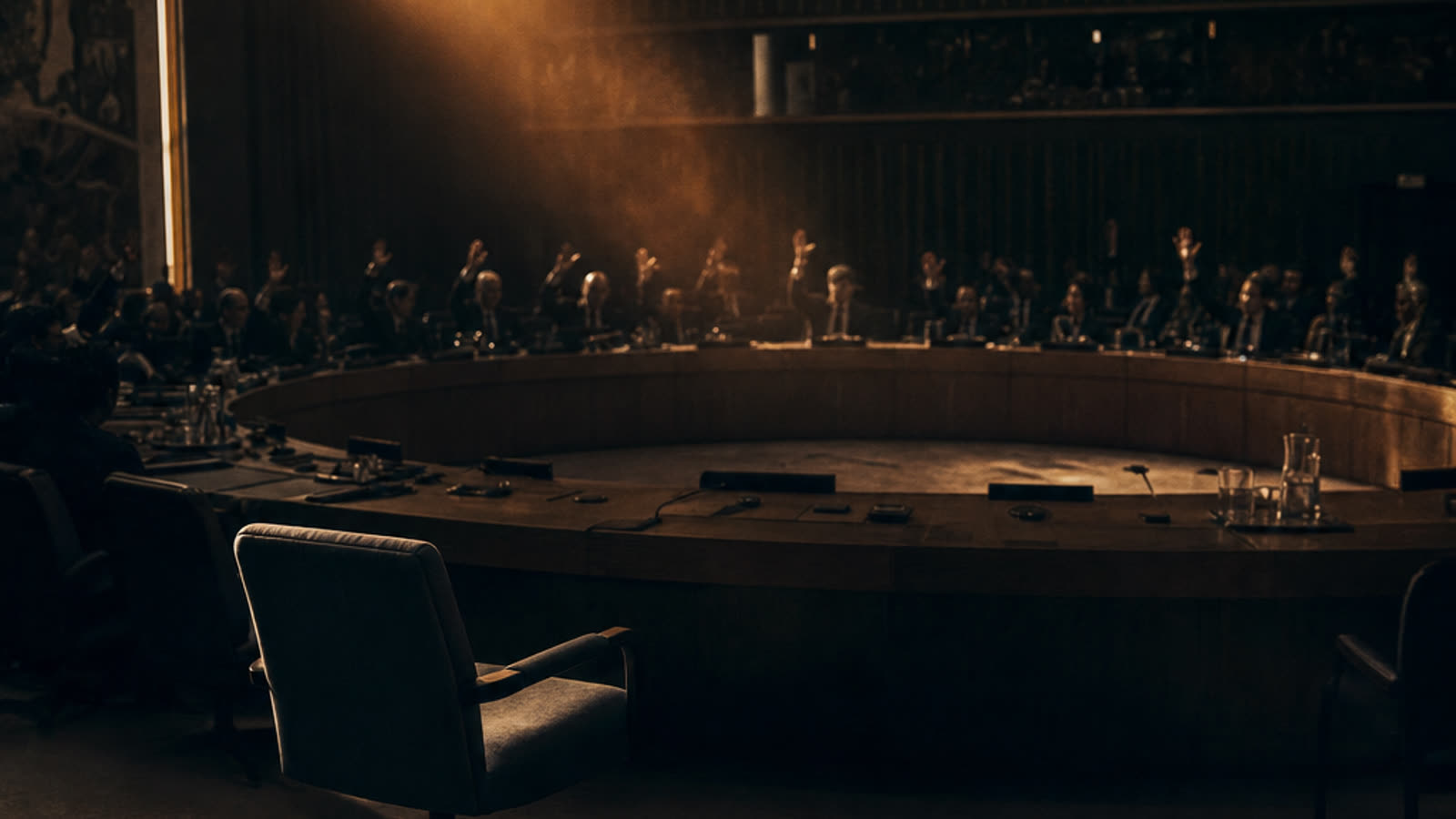
The United Nations Security Council has failed to act on countless crises not because the institution is broken but because it is functioning precisely as intended. The veto power held by the five permanent members—the United States, Russia, China, France, and the United Kingdom—is the feature that made the UN possible in the first place, and it remains the feature most likely to render it irrelevant.
The architects of the post-World War II order learned a brutal lesson from the League of Nations, which collapsed in part because major powers either refused to join or withdrew when collective action threatened their interests. The UN's founders, meeting in San Francisco in 1945, made a calculated wager: a world body that included all great powers but allowed each to protect its core interests would prove more durable than one with lofty principles but empty chairs. The veto was the price of admission.
The mechanics of paralysis
Any of the P5, as they are known, can single-handedly block a substantive Security Council resolution by voting against it. Abstention does not constitute a veto; only an explicit negative vote does. This distinction matters because it allows permanent members to signal disapproval without assuming the political cost of outright obstruction. The threat of a veto often shapes outcomes long before any vote occurs—resolutions are drafted, watered down, or abandoned entirely based on private signals from P5 delegations.
The veto cannot be overridden. There is no supermajority mechanism, no appeal to the General Assembly that carries binding force. When Russia vetoes a resolution on Ukraine or the United States vetoes one on Israel, the matter is simply dead. The General Assembly can pass a symbolic resolution under the "Uniting for Peace" procedure, but such resolutions lack the legal authority of Security Council action.
Why reform remains a fantasy
Proposals to expand the permanent membership or curtail veto rights surface regularly, particularly after high-profile failures to address mass atrocities. Germany, Japan, India, and Brazil have long sought permanent seats. African nations argue the continent deserves representation commensurate with its population. Yet any amendment to the UN Charter requires ratification by two-thirds of member states, including all five current permanent members. The P5 have no incentive to dilute their own power, and so the structure persists.
Some reformers have proposed a voluntary "responsibility not to veto" in cases of genocide or crimes against humanity. France has endorsed this concept in principle. But voluntary restraint has proven unreliable precisely when it matters most—when a permanent member's ally or client state stands accused.
The unspoken bargain
The veto's defenders argue it prevents something worse: great-power war. If the Security Council could authorize military action over the objection of a nuclear-armed state, the reasoning goes, the UN would either be ignored or become a catalyst for catastrophic escalation. The veto forces compromise and, when compromise fails, at least ensures the institution survives to mediate another day. Critics counter that survival without efficacy is a hollow achievement, that the UN's credibility erodes each time the Security Council watches atrocities unfold and issues only statements of concern.
Our take
The veto is neither a noble safeguard nor a cynical betrayal—it is a mirror reflecting the actual distribution of power in the world. Abolishing it would not create a more just international order; it would simply prompt the powerful to abandon the forum entirely. The UN's paralysis on Gaza, on Syria, on countless other horrors, is not a malfunction. It is the honest admission that great powers will not submit their vital interests to majority rule. Understanding this does not require endorsing it. But mistaking the symptom for the disease guarantees that proposed cures will remain fantasies.