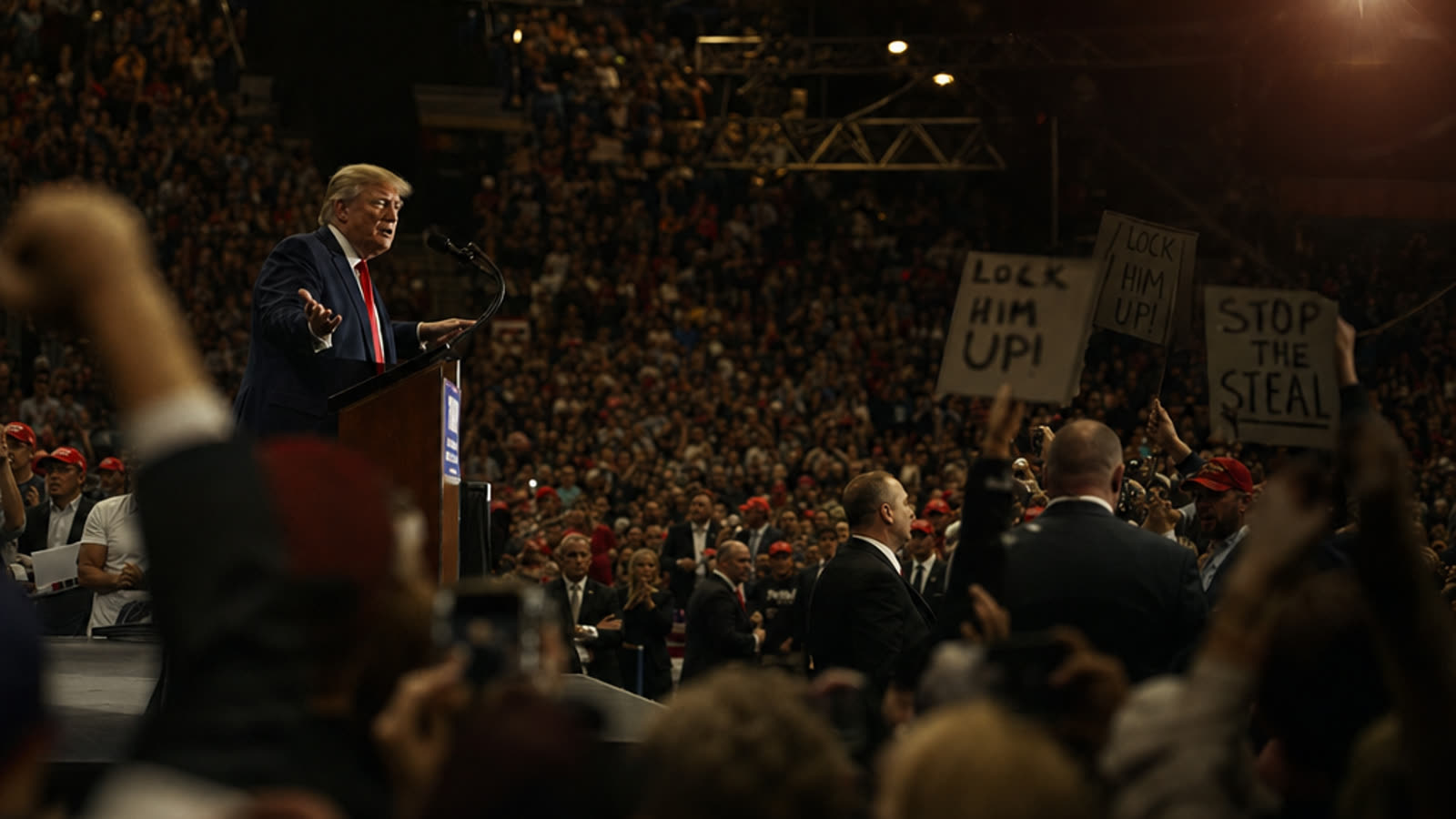
Donald Trump came to San Antonio expecting a coronation. What he got instead was a stress test — and the results were not flattering.
The rally, ostensibly a show of force in deep-red Texas, was interrupted by protesters no fewer than nine times over the course of the evening. Each disruption followed the same script: chants erupt, security moves in, Trump pauses, the crowd roars "USA! USA!" to drown out the dissent. But something was different this time. Where the 2016-era Trump would have improvised cutting one-liners and turned each ejection into a theatrical victory, the 2026 version looked genuinely flustered. He lost his place in prepared remarks. He repeated the same insult twice in succession without apparent awareness. He called San Antonio "San Antone" — a regionalism that might play folksy if delivered with confidence, but landed awkwardly amid his visible irritation.
The protest playbook evolves
The disruptions appeared coordinated, with protesters stationed throughout the venue rather than clustered in one section. This forced security to play whack-a-mole while Trump struggled to maintain momentum. The tactic is not new — it echoes strategies deployed against George W. Bush in 2004 — but its effectiveness depends on the target's response. Trump's inability to pivot each interruption into a crowd-pleasing moment suggests either fatigue or a campaign operation that has lost its improvisational edge.
Notably, the Texas Republican establishment kept its distance. Governor Abbott sent a video message rather than appearing in person. Senator Cornyn was absent entirely. The warm relationship Trump projected with Attorney General Ken Paxton — despite recently leaked audio revealing private tensions — felt performative rather than genuine, a marriage of convenience neither party seems enthusiastic about consummating.
What the faithful saw versus what the cameras caught
Inside the arena, the MAGA base remains fervent. Merchandise sales were brisk. The faithful cheered on cue. But television coverage — which is ultimately what matters for a campaign event — captured a candidate who appeared diminished by the very chaos he once weaponized. The split-screen of Trump's irritated face alongside yet another protester being escorted out is not the image of strength his campaign wanted to project.
Texas is not competitive in the presidential race, which makes the San Antonio stop strategically puzzling unless it was primarily a fundraising exercise or an attempt to boost down-ballot candidates. If so, the repeated disruptions undermined both goals by dominating the news cycle.
Our take
Trump built his political brand on the premise that he thrives in chaos — that disorder is his native element while his opponents flounder. San Antonio offered a glimpse of what happens when the chaos no longer bends to his will. Nine interruptions is not a crisis; it is a nuisance. But how a candidate handles nuisance reveals character. The man who once seemed to feed on confrontation now appears drained by it. That shift may matter more than any policy debate between now and November.