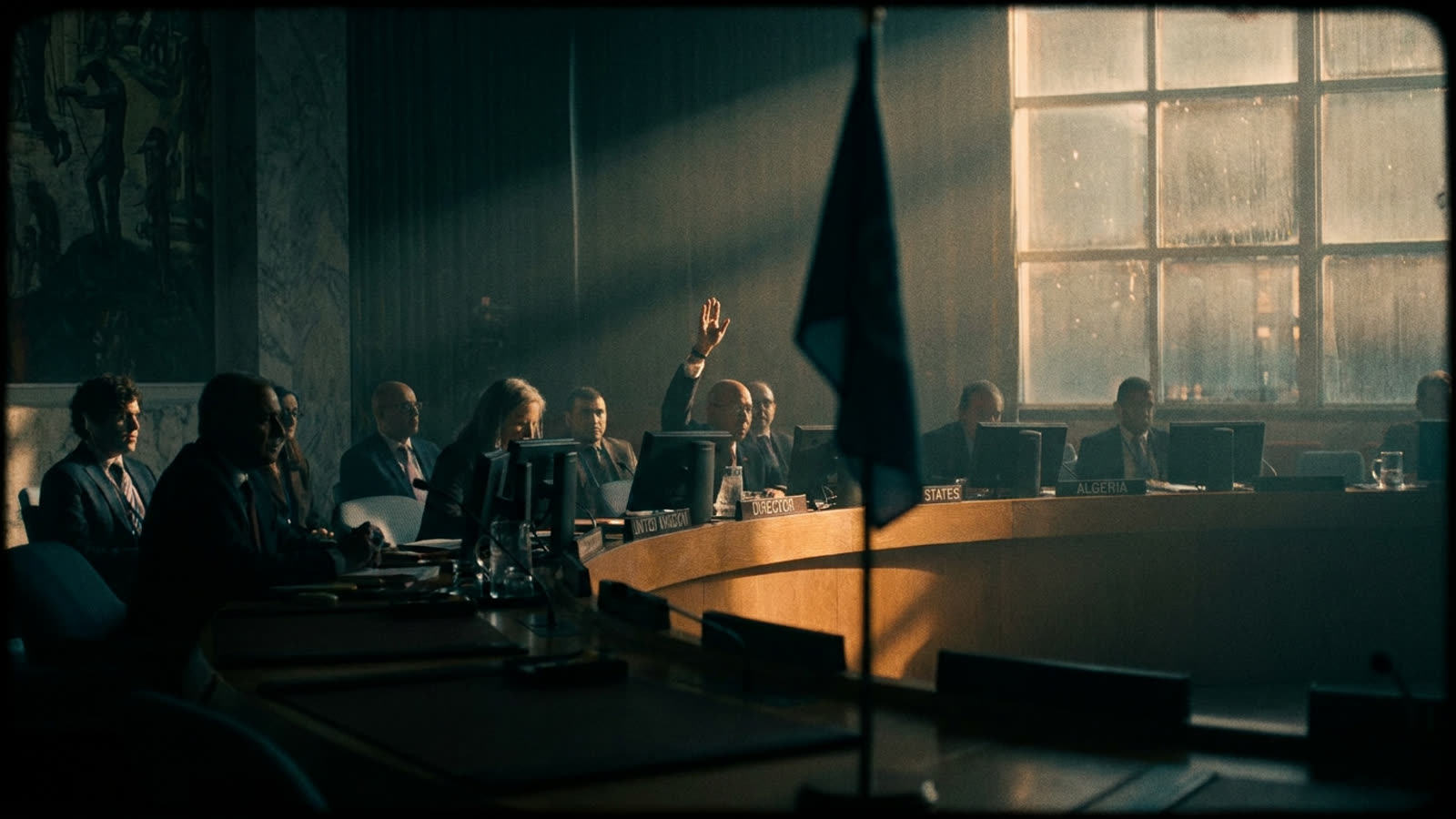
The United Nations Security Council has failed to act on virtually every major conflict of the past three decades, from Syria to Sudan to Ukraine. Critics call this dysfunction. They are wrong. The Council is working exactly as intended — and grasping this counterintuitive truth is essential to understanding why the institution persists and why reform remains impossible.
The Security Council was not designed to stop wars. It was designed to prevent a third world war by ensuring that the five victors of the second one — the United States, the Soviet Union (now Russia), China, France, and the United Kingdom — would never find themselves on opposite sides of a UN-authorized military action. The veto exists not to facilitate consensus but to guarantee that no great power can be compelled by international law to do anything against its vital interests.
The arithmetic of paralysis
The Council has fifteen members, but only five matter for any resolution touching on force or sanctions. Each permanent member — the P5 — holds an absolute veto. A single "no" from Washington, Moscow, Beijing, Paris, or London kills any substantive resolution, regardless of how the other fourteen members vote. This is not majority rule with a check; it is minority rule by design.
The founders at San Francisco in 1945 understood this would produce inaction. They preferred inaction to the alternative: a League of Nations that could theoretically compel great powers and therefore drove them away. The UN's genius, if it can be called that, was lowering ambitions to match reality. The Security Council would act only when the great powers agreed — which meant it would rarely act at all, but it would survive.
Why reform is a fantasy
Every few years, proposals circulate to expand the P5 or eliminate the veto. India, Germany, Japan, and Brazil have lobbied for permanent seats. African nations have demanded representation. None of this will happen, for a simple reason: any change to the UN Charter requires ratification by all five current permanent members, and none has an incentive to dilute its own power.
The veto is self-protecting. Russia will not vote to weaken Russia's veto. The United States will not vote to weaken its own. The structure that critics decry as outdated is precisely the structure that makes the institution impossible to update. This is not an oversight; it is the bargain that created the UN in the first place.
The value of a toothless body
And yet the Security Council endures, and not merely out of inertia. It provides something no other institution can: a permanent forum where adversaries must sit in the same room, hear each other's justifications, and occasionally find narrow areas of agreement. The Council authorized peacekeeping missions in dozens of conflicts where great-power interests did not directly clash. It imposed sanctions on North Korea and Iran when the P5 briefly aligned. It is not nothing — it is simply not what idealists wish it were.
Our take
The Security Council's critics want it to be a world government. Its architects wanted it to be a pressure-release valve. Judged against the first standard, it is a failure. Judged against the second, it has succeeded for eight decades without a great-power war. The veto is not a flaw to be fixed; it is the price of admission that keeps the major powers inside the tent. Reformers who imagine a more democratic Council should ask themselves whether China and Russia would remain members of one — and what the alternative would look like if they did not.