Large language models do not think, reason, or understand in any meaningful sense of those words. They predict the next word. That single fact, properly understood, demystifies almost everything about modern AI—its astonishing capabilities, its baffling failures, and why the people building these systems often seem as surprised by their behavior as the rest of us.
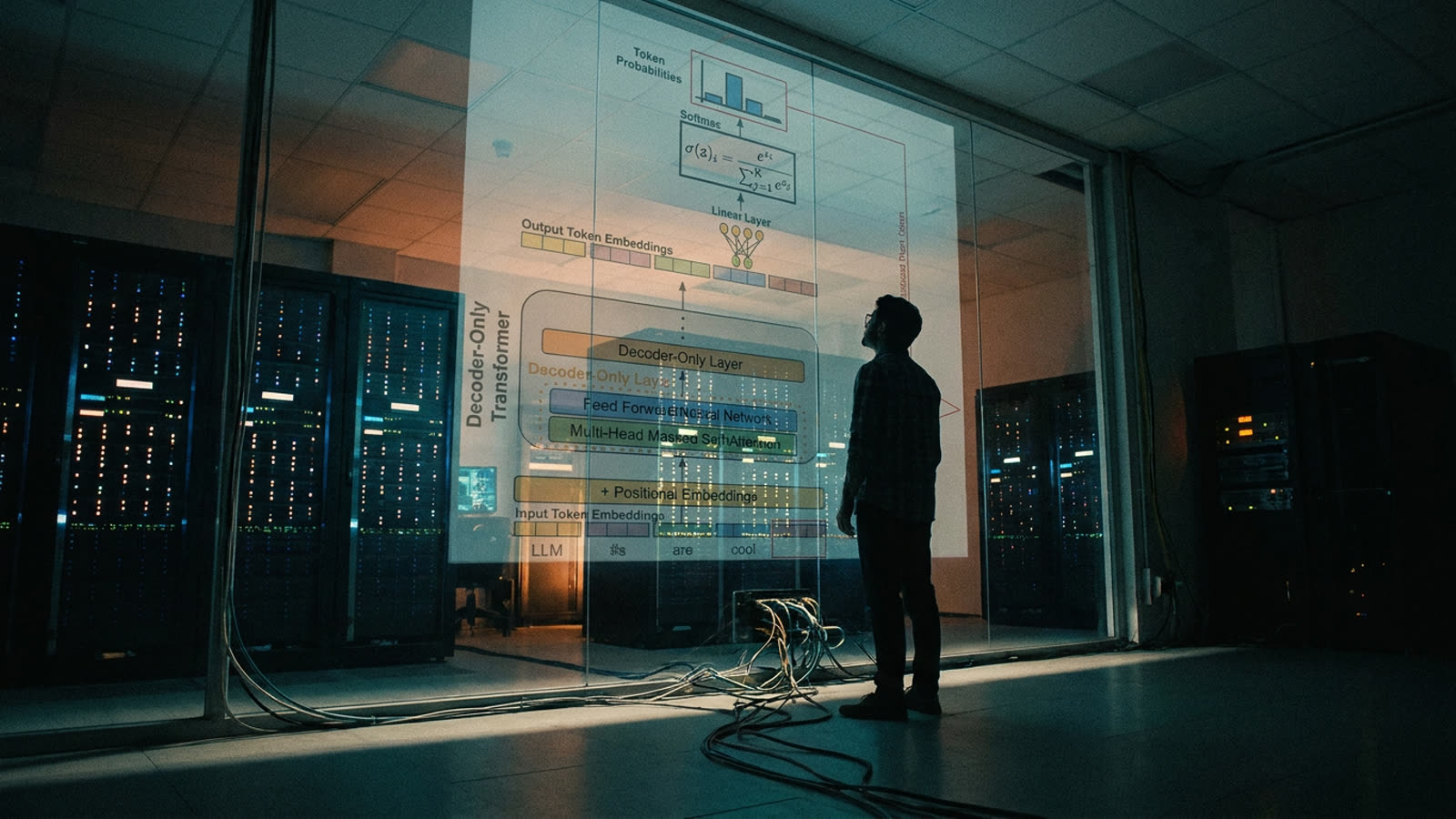
The core mechanism is disarmingly simple to describe, even if the engineering is staggeringly complex. An LLM takes a sequence of text, converts each word into a numerical representation, processes those numbers through layers of mathematical transformations, and outputs a probability distribution over what word should come next. It does this over and over, each new word becoming part of the input for the next prediction. A conversation with ChatGPT is not a dialogue with an intelligence; it is a very sophisticated autocomplete running in a loop.
The training regime that creates apparent intelligence
What makes this simple mechanism produce coherent essays, working code, and plausible legal arguments? Scale and exposure. Modern LLMs train on hundreds of billions of words—essentially the readable internet, plus digitized books, academic papers, and code repositories. The training process adjusts billions of numerical parameters so that the model becomes incrementally better at predicting what word humans would write next in any given context.
This creates something remarkable: a statistical compression of human written expression. The model does not store facts like a database; it stores patterns of how humans discuss facts. When you ask it about the French Revolution, it generates text that resembles what humans have written about the French Revolution, because that is what it learned to predict. The distinction matters enormously. The model has no access to ground truth, no way to verify claims, no understanding that Paris is a place rather than a pattern of letters that tends to appear near certain other patterns.
Why it fails in ways that seem stupid
Once you understand the prediction mechanism, the failure modes become obvious. LLMs hallucinate—confidently stating false information—because they are optimizing for plausibility, not truth. A plausible-sounding citation is statistically similar to a real one. The model cannot tell the difference because it has never seen the difference; it has only seen text.
Similarly, LLMs struggle with tasks that require genuine reasoning rather than pattern-matching. Ask one to count the letters in a word, and it may fail, because letter-counting was not a common pattern in its training data. Ask it to solve a novel logic puzzle, and it will often produce confident nonsense, because it is generating text that looks like puzzle solutions rather than actually solving anything. The appearance of reasoning is itself a pattern the model has learned to mimic.
The genuine breakthrough beneath the hype
None of this diminishes what LLMs represent: the discovery that prediction at sufficient scale produces emergent capabilities no one explicitly programmed. These systems can translate languages, summarize documents, and generate functional code not because anyone taught them these skills, but because these skills are latent in the patterns of human text. That is a genuine scientific surprise, and it has real practical value.
The danger lies in mistaking the surprise for something it is not. An LLM is not a few algorithmic tweaks away from general intelligence. It is a mirror trained on human language, reflecting our patterns back at us with uncanny fidelity. The reflection can be useful—even transformative—but it remains a reflection.
Our take
The AI industry has a vested interest in mystification; the less people understand how these systems work, the easier it is to sell them as magic. But the actual achievement is more interesting than the marketing. Humanity built a statistical engine so powerful that it can simulate understanding without possessing it. That is worth celebrating, worth using, and worth being very clear-eyed about. The next word is not wisdom. It is just the next word.