For most of the twentieth century, the insurance claims adjuster occupied a peculiar position in the economy: part detective, part accountant, part therapist. When a tree fell on your roof or a fender crumpled in a parking lot, the adjuster arrived with a clipboard, a practiced eye, and the authority to decide what your misfortune was worth. It was unglamorous work, but it required judgment—the kind that comes from seeing ten thousand dented bumpers and knowing which ones hide frame damage underneath.
That judgment is now being encoded into software, and the transformation is further along than most policyholders realize.
The automation of the obvious
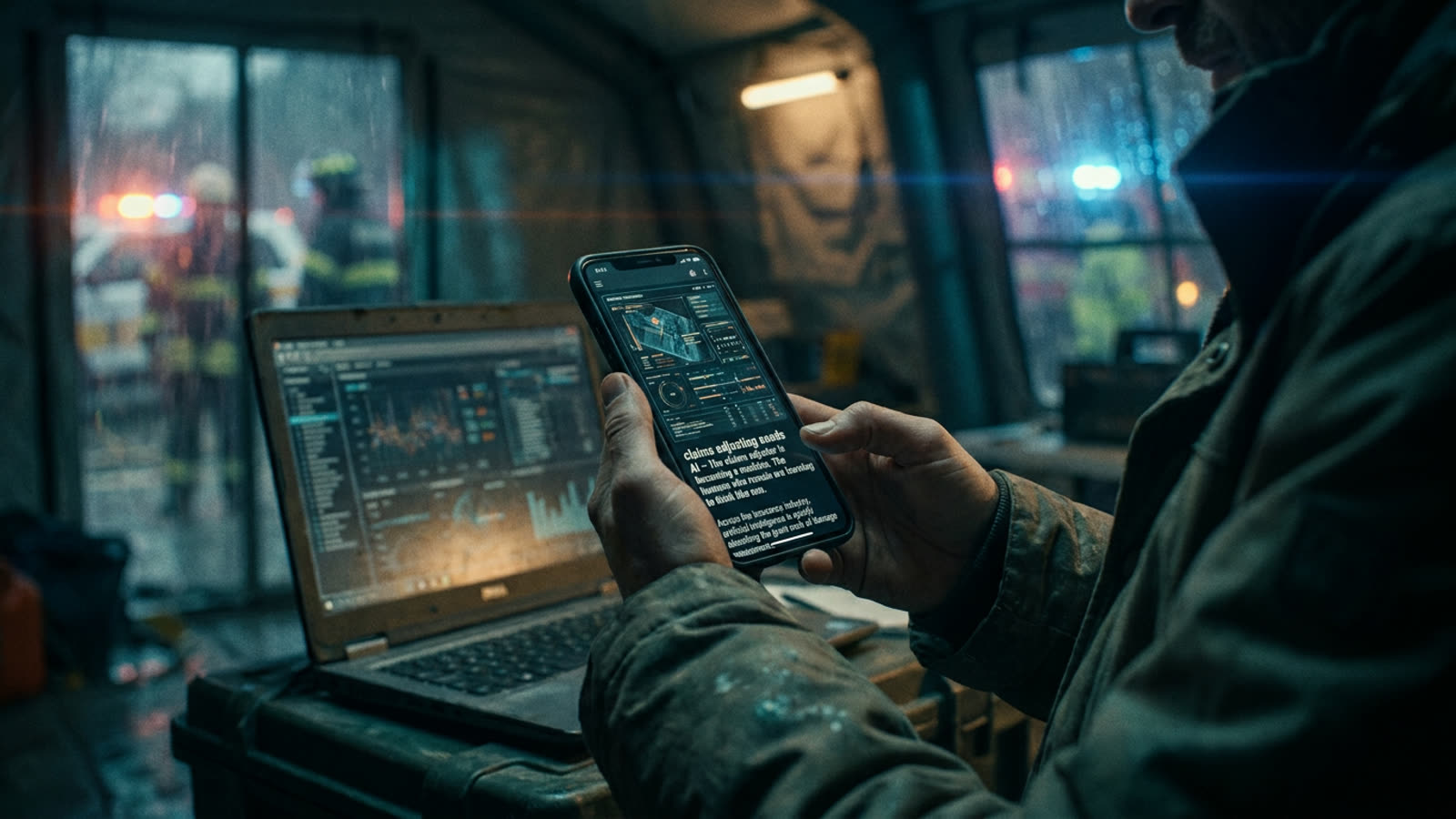
The first wave of AI in claims processing targeted the easiest cases: straightforward auto damage, minor property claims, simple medical reimbursements. Computer vision systems trained on millions of photographs can now assess a cracked windshield or a hail-dimpled hood with remarkable accuracy, often within seconds of a customer uploading images through a mobile app. What once required scheduling a visit, driving to an inspection site, and filling out paperwork can now happen before the policyholder finishes their morning coffee.
The efficiency gains are substantial. Tasks that consumed hours of human attention now resolve in minutes. Fraud detection algorithms flag suspicious patterns—the same dent photographed from slightly different angles, metadata inconsistencies, claims filed suspiciously close to policy inception dates—faster than any human reviewer could. For insurers, the calculus is straightforward: faster processing means lower operational costs and, often, happier customers.
What remains for the humans
But efficiency is not the whole story. As AI absorbs the routine, the human adjusters who remain find their work transformed rather than eliminated. They increasingly handle what might be called the residual complexity: the catastrophic losses, the disputed liability cases, the claims where human suffering demands human presence. A family whose home burned down does not want to negotiate with a chatbot. A business owner facing bankruptcy after a flood needs someone who can exercise discretion, not just apply a formula.
The adjusters who thrive in this environment are developing new skills. They are learning to interpret AI recommendations, to understand when the algorithm's confidence score warrants trust and when it signals uncertainty. They are becoming, in effect, supervisors of automated systems—responsible not for doing the analysis themselves but for knowing when the analysis has gone wrong.
The quiet displacement
The industry does not publish detailed figures on adjuster employment trends, and the picture is complicated by factors like catastrophe frequency and market growth. But the direction is unmistakable. Entry-level positions—the ones that once trained new adjusters by exposing them to thousands of routine cases—are disappearing into automation. The traditional career ladder, which began with simple claims and progressed toward complex ones, is losing its lower rungs.
This creates a curious problem: how do you train expert adjusters if the novice work no longer exists? Some insurers are experimenting with simulation-based training, using AI-generated scenarios to give new hires the case volume they would once have accumulated over years. Others are hiring adjusters with different backgrounds entirely—engineers who can audit algorithmic decisions, psychologists who can handle traumatic claims, data scientists who can improve the models themselves.
Our take
The insurance claims adjuster is not vanishing so much as bifurcating. On one side, algorithms handle the predictable with ruthless efficiency. On the other, a smaller cohort of humans manages everything the machines cannot parse: ambiguity, tragedy, the irreducible messiness of real loss. Whether this is progress depends on which side of a claim you find yourself on—and whether, when your house floods or your car is totaled, you want speed or you want someone who understands what it means to lose something that mattered.