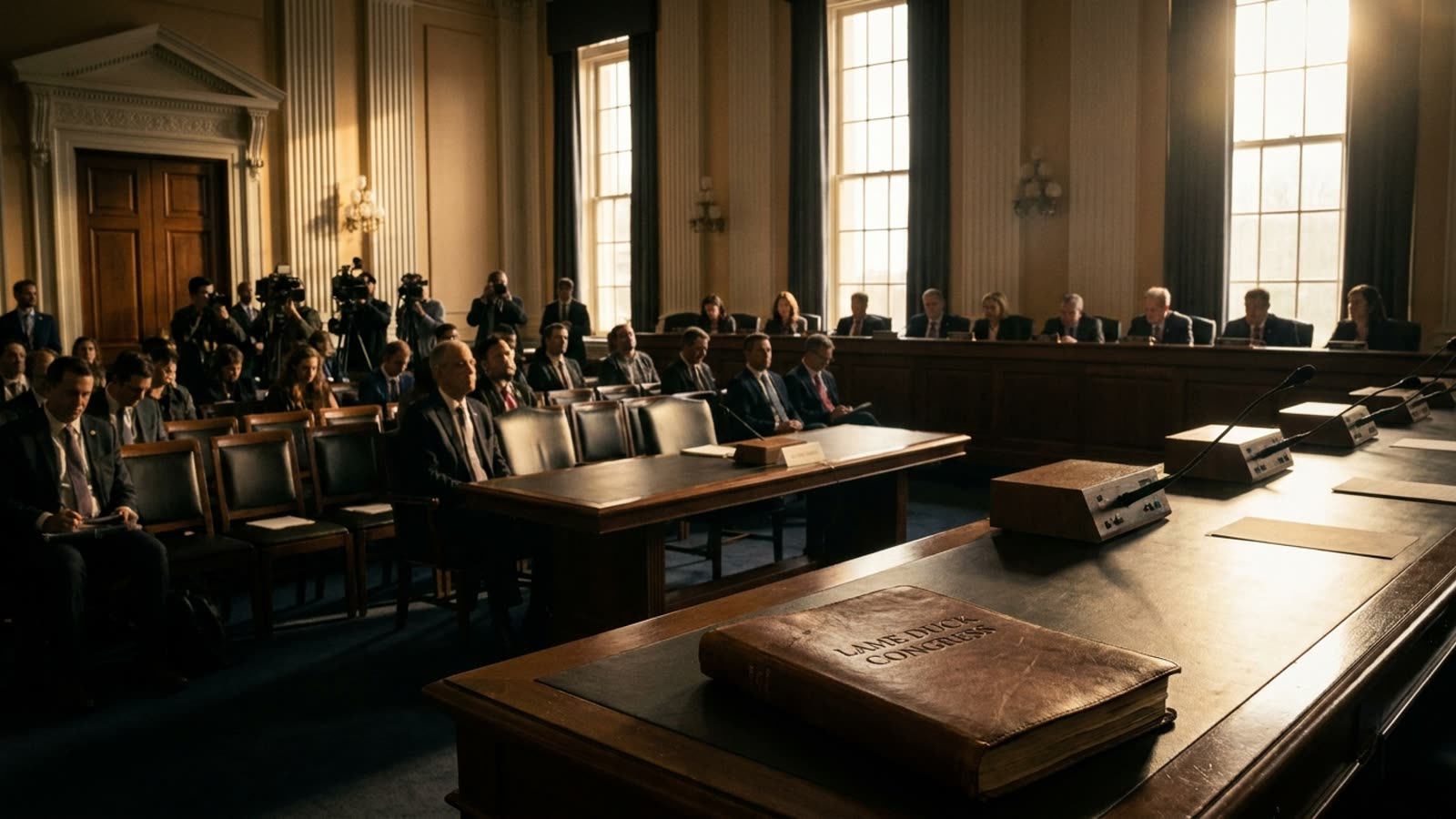
Every American schoolchild learns about the drama of election night, the transfer of power on Inauguration Day, the first hundred days. Almost no one learns about the strange interregnum between them—the lame-duck session—when outgoing legislators, freed from electoral accountability and facing political mortality, can accomplish things that would be impossible at any other moment.
This is not a bug in the constitutional design. It is a feature that has been exploited, for good and ill, since the Republic's founding.
The mechanics of twilight governance
The term "lame duck" entered American political vocabulary in the nineteenth century, borrowed from London Stock Exchange slang for a broker who couldn't pay his debts. The metaphor stuck because it captured something essential: a politician who has lost an election, or chosen not to run, is wounded—still technically empowered but stripped of the leverage that comes from facing voters again.
The Twentieth Amendment, ratified in 1933, shortened the lame-duck period dramatically. Before its passage, newly elected Congresses didn't convene until March of the following year, creating a four-month window in which defeated legislators held power. The amendment moved the congressional start date to January 3rd, compressing the window to roughly two months.
But compression didn't eliminate the phenomenon. It concentrated it.
A history of consequential midnight legislation
The record of lame-duck accomplishments is remarkable. The Thirteenth Amendment, abolishing slavery, passed the House during a lame-duck session in January 1865—after Lincoln's reelection gave the measure political momentum but before the new Congress arrived. The impeachment of Andrew Johnson began during a lame-duck period. More recently, the repeal of "Don't Ask, Don't Tell" passed in December 2010, when Democrats knew they were about to lose their House majority and decided to act while they still could.
The pattern holds across parties and eras. Legislators facing the end of their careers often vote differently than they did while seeking reelection. Some discover principles they'd suppressed for decades. Others settle scores. A few simply stop showing up.
Why accountability evaporates
The fundamental dynamic is straightforward: electoral incentives disappear. A senator who has just lost cannot be punished by voters for a controversial vote. A representative who has chosen retirement need not worry about primary challengers. The usual calculus—will this help or hurt me in two years?—becomes irrelevant.
This creates opportunities for both courage and mischief. Outgoing presidents sometimes issue controversial pardons or executive orders. Outgoing legislators may finally vote their conscience on issues they'd dodged for years. Occasionally, both parties collaborate on necessary but unpopular measures—deficit reduction, base closures, entitlement reforms—precisely because the electoral consequences have been neutralized.
The lame-duck session is, in effect, a brief window when American democracy operates without the constant pressure of the next campaign.
Our take
There is something clarifying about watching politicians operate when the voters can no longer reach them. It reveals what they actually believe, or at least what they're willing to do when the usual constraints lift. The lame-duck session is often dismissed as a constitutional afterthought, a period of caretaker governance before the real action begins. The historical record suggests otherwise. Some of the most durable changes in American law emerged from these twilight weeks, passed by legislators who knew they were already ghosts. The next time an election ends, pay attention to what happens in the quiet months that follow. That's when the real decisions often get made.