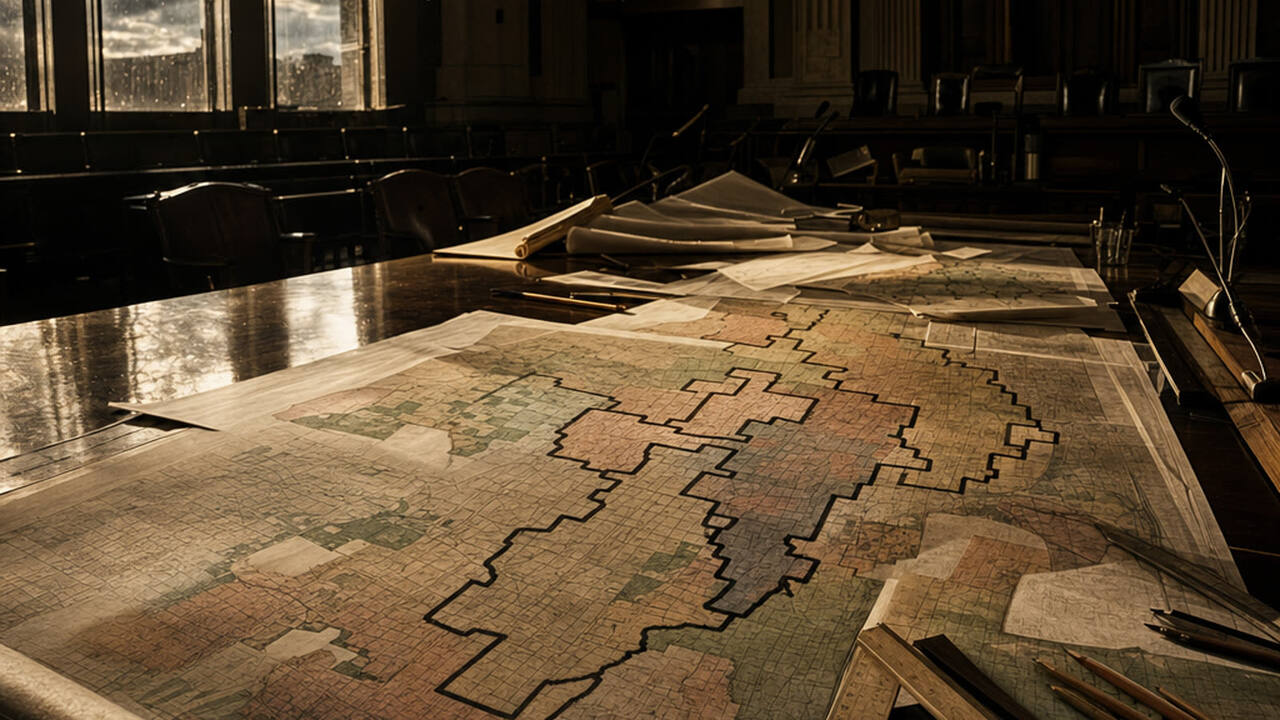
The most consequential decisions in American democracy happen not on Election Day but in windowless conference rooms where state legislators and their consultants hunch over precinct-level data, drawing lines that will shape political outcomes for the next decade. Gerrymandering—the manipulation of electoral district boundaries to favor one party—is as old as the republic itself, named for Massachusetts Governor Elbridge Gerry, whose 1812 redistricting produced a district so contorted it resembled a salamander. Yet the practice has evolved from crude cartographic mischief into a precision science, powered by granular demographic data and sophisticated mapping software that can predict electoral outcomes with unsettling accuracy.
The mechanics of manipulation
Gerrymandering relies on two complementary techniques: "packing" and "cracking." Packing concentrates opposition voters into a small number of districts, ensuring they win those seats by overwhelming margins while wasting votes that could have been competitive elsewhere. Cracking disperses opposition voters across multiple districts, diluting their influence so they fall just short of a majority everywhere. The goal is elegant in its cynicism: maximize your own seats while minimizing the efficiency of your opponent's votes.
Modern redistricting has transformed this into algorithmic warfare. Mapmakers can access voter registration data, past election results, census demographics, and even consumer purchasing patterns to predict how individual households will vote. Software can generate thousands of possible maps in minutes, optimizing for partisan advantage while maintaining the appearance of geographic coherence. The result is districts that snake through suburbs, leap across rivers, and connect communities with nothing in common except their predicted voting behavior.
The constitutional gray zone
The Supreme Court has struggled for decades to articulate a coherent standard for when partisan gerrymandering crosses constitutional lines. While racial gerrymandering—drawing districts to dilute minority voting power—violates the Voting Rights Act and the Equal Protection Clause, the Court ruled in Rucho v. Common Cause that federal courts cannot adjudicate claims of excessive partisan gerrymandering, deeming such disputes "political questions" beyond judicial competence. This effectively greenlit the practice at the federal level, leaving remedies to state courts, state constitutions, and the political process itself.
Some states have responded by establishing independent redistricting commissions, removing the fox from the henhouse. California, Arizona, and Michigan have adopted various commission models, though their effectiveness varies and their independence is perpetually contested. Other states have seen their supreme courts strike down egregiously partisan maps under state constitutional provisions guaranteeing free elections or equal protection.
Why it matters more than you think
Gerrymandering's most pernicious effect is not simply that it distorts representation—it is that it eliminates competition altogether. When districts are drawn to be safely Republican or safely Democratic, the general election becomes a formality. The real contest moves to party primaries, where turnout is low and ideological activists wield disproportionate influence. This structural incentive pushes elected officials toward their party's extremes, punishing moderation and compromise. A representative in a gerrymandered district fears a primary challenge from the flank far more than a general election opponent from across the aisle.
The cumulative effect is a legislature that does not reflect the actual distribution of voter preferences. A state where statewide elections split roughly evenly between parties can nonetheless produce a congressional delegation dominated by one side. This is not a bug but the intended feature of maps drawn by partisans for partisans.
Our take
Gerrymandering persists because those with the power to end it are precisely those who benefit from it. The practice is bipartisan in application if not always in opportunity—whichever party controls a state legislature after a census will draw maps to its advantage. The solution is structural: independent commissions with transparent criteria, algorithmic fairness standards, or constitutional amendments requiring competitive districts. Until then, American democracy will continue to operate with one hand tied behind its back, its outcomes predetermined not by voters but by the cartographers who decided which voters count where.