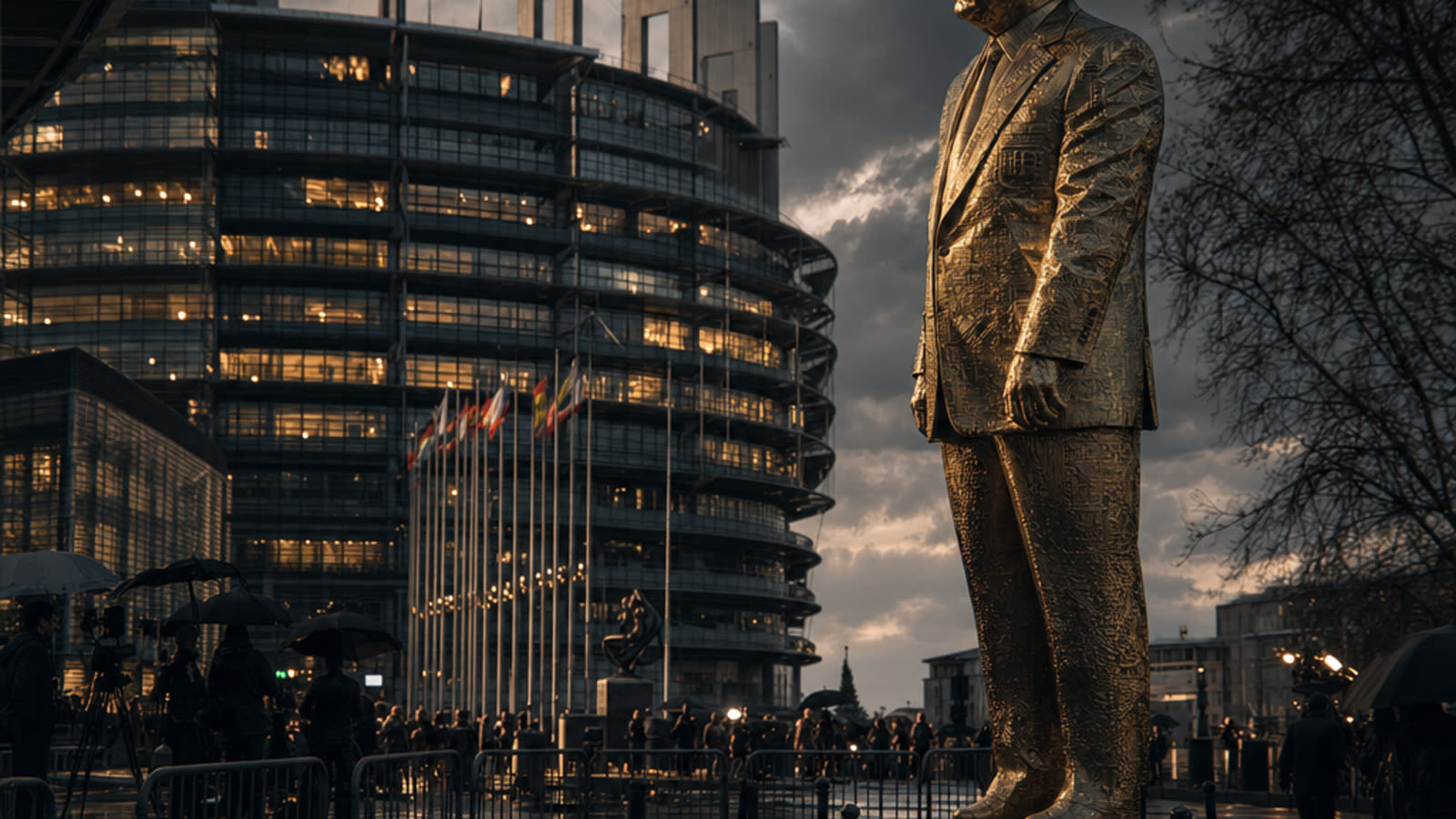
The European Parliament in Brussels woke this week to find a gilded, unclothed likeness of the former American president installed on its doorstep — a satirical work its creator has titled "King of Injustice." The timing, one year before the next US presidential cycle begins in earnest, is not accidental. Neither is the location.
Italian artist Daniele Catalli, who has made a career of provocative political sculpture, positioned the piece to face the Parliament's main entrance, ensuring that every MEP arriving for session must reckon with its presence. The statue depicts a corpulent figure wearing a crown and clutching a scepter, the physique exaggerated in the tradition of Renaissance grotesques. Catalli says the work is a commentary on American democratic backsliding and its ripple effects across the Atlantic.
Brussels as stage
The European Parliament's tolerance of the installation speaks to a deeper ambivalence. EU officials have spent years calibrating their public posture toward American political turbulence — critical enough to satisfy domestic constituencies, diplomatic enough to preserve the alliance. A satirical statue occupies useful middle ground: officially, it is art and speech; unofficially, it is a message.
Parliament security reportedly allowed the installation to remain for several hours before relocating it to a designated protest area. By then, photographs had circulated widely on European social media, accomplishing precisely what Catalli intended. The artist has previously staged similar interventions targeting Putin and various Italian politicians, understanding that the spectacle of removal often generates more coverage than the work itself.
The attention economy of outrage
Here lies the paradox. Protest art aimed at figures who thrive on controversy risks feeding the very machinery it claims to critique. The former president's political brand has always metabolized opposition into fuel — every denunciation becomes evidence of elite persecution, every satirical jab proof of cultural warfare. A golden nude statue at the European Parliament will almost certainly appear in future campaign materials, reframed as evidence that foreign elites fear and mock ordinary Americans.
Catalli is not naive about this dynamic. In interviews, he has acknowledged that his work operates within the attention economy rather than outside it. The question is whether the symbolic value of dissent — the act of saying, publicly and artistically, that this figure represents injustice — outweighs the tactical benefit it may confer.
Transatlantic context
The installation arrives as European leaders quietly prepare for multiple American electoral scenarios. Defense ministers across the continent have accelerated conversations about strategic autonomy. Trade officials are gaming out tariff responses. The statue, in this light, functions less as commentary on one man than as a marker of institutional anxiety — a continent uncertain whether its most important alliance will survive the decade intact.
Our take
Protest art is easy to dismiss as preaching to the converted, and this piece will change precisely zero minds about its subject. But that may not be the point. The statue's real audience is European: a reminder that democratic institutions require active defense, that the grotesque can become normalized, that what happens in Washington does not stay in Washington. Whether a naked golden effigy is the most effective vehicle for that message is another question. At minimum, it is memorable.