The House Republican conference has a governing problem, and his name is everyone.
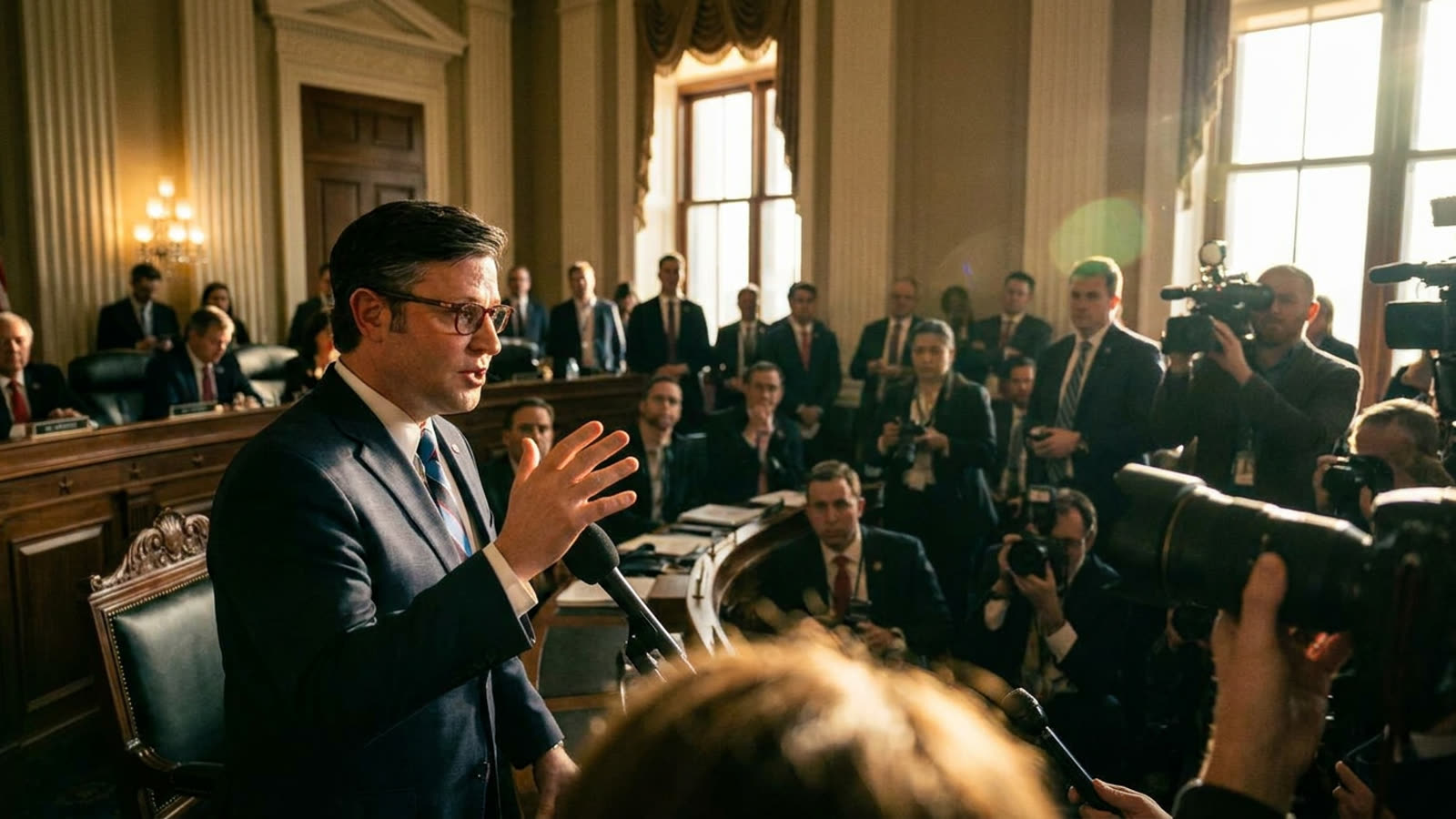
On Monday, a bloc of hardline conservatives joined with Democrats to defeat the procedural rule that would have allowed the National Defense Authorization Act to reach the floor — a bill that has passed with bipartisan support for more than six decades straight. The vote wasn't close: the rule failed by double digits, with at least fifteen Republicans voting no. For Speaker Mike Johnson, it was the most public rebuke of his leadership since he inherited the gavel from Kevin McCarthy's political corpse.
The proximate cause was spending. The NDAA's topline number — roughly $895 billion — was deemed insufficient by defense hawks and excessive by fiscal hardliners simultaneously, a mathematical impossibility that nonetheless defines the Republican coalition in 2026. But the deeper issue is structural: Johnson commands a majority so narrow that any five members can hold the entire legislative agenda hostage, and several dozen have decided that hostage-taking is their preferred negotiating posture.
The arithmetic of dysfunction
Republicans hold 220 seats to the Democrats' 215. That margin, won in the 2024 elections and barely preserved through a string of special elections, means Johnson can lose exactly two votes on any party-line matter. The NDAA is theoretically bipartisan, but the rule vote that precedes floor debate is a party-line affair — and it's where the Freedom Caucus has discovered it can extract maximum leverage with minimum accountability.
The members who tanked Monday's vote offered a buffet of justifications. Some wanted deeper cuts to non-defense discretionary spending as a condition for supporting the Pentagon's budget. Others demanded that Johnson commit to a government shutdown strategy in the fall if Democrats don't accept conservative policy riders. A few simply wanted to register displeasure with leadership's handling of previous negotiations. The common thread was a willingness to blow up the process to make a point.
The McCarthy precedent looms
Johnson's predicament is eerily familiar. McCarthy lost his speakership in October 2023 after a single member, Matt Gaetz, filed a motion to vacate and rallied seven colleagues to join Democrats in removing him. Johnson survived a similar motion earlier this year, but only because Democrats — calculating that chaos served no one — provided enough votes to table it. That goodwill has limits, and Johnson knows it.
The Speaker's options are unappetizing. He can negotiate with the hardliners, offering concessions that will alienate moderates and potentially doom the underlying bill anyway. He can work with Democrats to pass a bipartisan NDAA, which would trigger accusations of betrayal from his right flank and possibly another vacate motion. Or he can wait, hoping that the August recess and constituent pressure soften the rebels — a strategy that assumes rationality where little evidence of it exists.
What the Pentagon actually needs
Lost in the procedural warfare is the substance of the NDAA itself. The bill authorizes pay raises for service members, funds shipbuilding and aircraft procurement, and sets policy on everything from Ukraine assistance to military housing. Delaying it doesn't save money — the Pentagon continues operating under prior authorizations — but it does create uncertainty for defense contractors, military families, and allies watching American dysfunction with growing alarm.
The Senate passed its version of the NDAA last week with 82 votes, a reminder that bipartisan defense consensus still exists in one chamber. The House's failure to even begin debate suggests that consensus is a foreign concept on the other side of the Capitol.
Our take
Mike Johnson is not a weak speaker because he lacks political skill; he's a weak speaker because the job has become impossible. The House Republican conference contains members who genuinely believe that legislative failure is a form of success, that shutdowns are leverage rather than self-harm, and that any compromise with Democrats constitutes surrender. Johnson can no more satisfy these members than he can repeal arithmetic. The NDAA will eventually pass — it always does — but the spectacle of Monday's collapse reveals a governing majority that has forgotten what governing means. The Pentagon bill is a symptom. The disease is a party that has made dysfunction its identity.