The first fitting is almost always disappointing. The customer stands in a half-finished jacket, one sleeve basted on with white thread, the other missing entirely, while a tailor circles with chalk and pins, muttering measurements to an assistant. Nothing fits. Nothing is supposed to. This is Savile Row's quiet rebellion against modernity: the insistence that making something beautiful requires making the customer wait.
The street itself is modest—a single block in Mayfair, wedged between the commercial thunder of Regent Street and the Georgian calm of Burlington Gardens. Yet for more than two centuries, this unremarkable stretch of London real estate has defined how powerful men dress. Kings, presidents, rock stars, and robber barons have climbed its narrow staircases to stand in their underwear while strangers judged their posture.
The economics of slowness
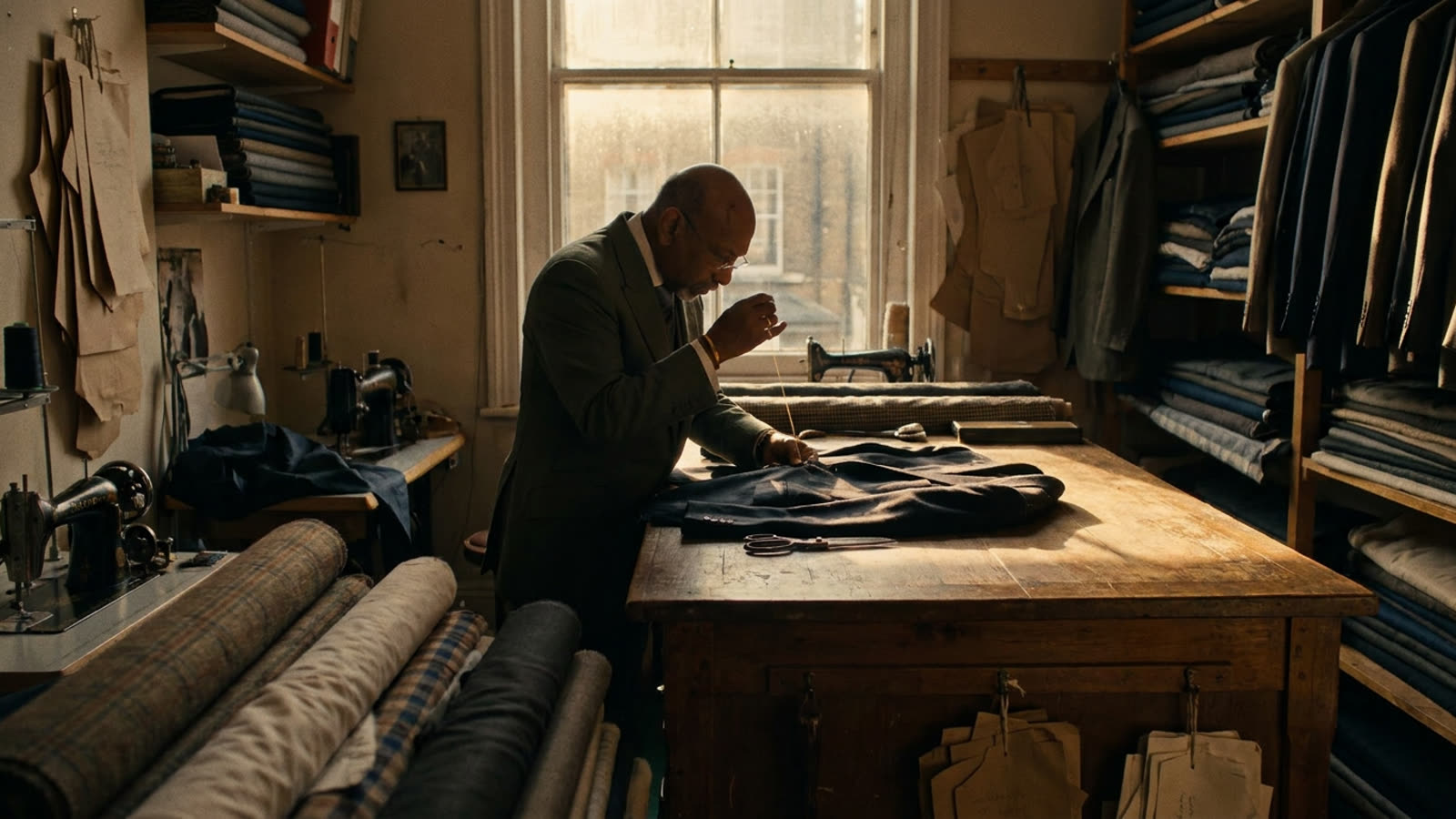
A bespoke Savile Row suit begins around £5,000 and climbs steeply from there. The price reflects not materials—though the cloth is exceptional—but time. A single jacket requires roughly fifty hours of hand labor, spread across multiple craftspeople: the cutter who drafts the pattern, the coat maker who constructs the canvas foundation, the trouser maker, the finisher. Each works at a pace that would horrify a management consultant.
The business model appears economically irrational. A house employing a dozen tailors might produce only a few hundred suits annually. Overheads in Mayfair are brutal. Yet the old firms endure, and new ones occasionally open, because bespoke tailoring sells something that cannot be rushed: the illusion of permanence. In a world where most purchases depreciate the moment they leave the store, a Savile Row suit appreciates—in sentiment if not in resale value.
What machines cannot replicate
The made-to-measure industry has spent decades trying to approximate bespoke results through technology. Body scanners, algorithmic pattern-making, and laser-cut cloth have produced garments that fit reasonably well at a fraction of the cost. Yet the gap remains visible to anyone who knows where to look.
Bespoke construction begins with a floating canvas—layers of horsehair and linen that are never glued but instead attached through thousands of invisible stitches. This internal structure moulds to the wearer's body over time, creating what tailors call a "second skin." The shoulders are built by hand, padded to correct asymmetries that every human body possesses. The buttonholes are cut and sewn one at a time, often by a specialist who does nothing else.
None of this is efficient. All of it is deliberate.
Our take
Savile Row's survival is not nostalgia; it is market positioning of the highest order. The street understood, long before luxury conglomerates articulated it, that exclusivity requires friction. The waiting list, the multiple fittings, the six-week minimum—these are not bugs but features, barriers that transform a transaction into an initiation. Fast fashion taught consumers that clothing is disposable. Savile Row teaches the opposite lesson: that some things are worth the inconvenience of patience.