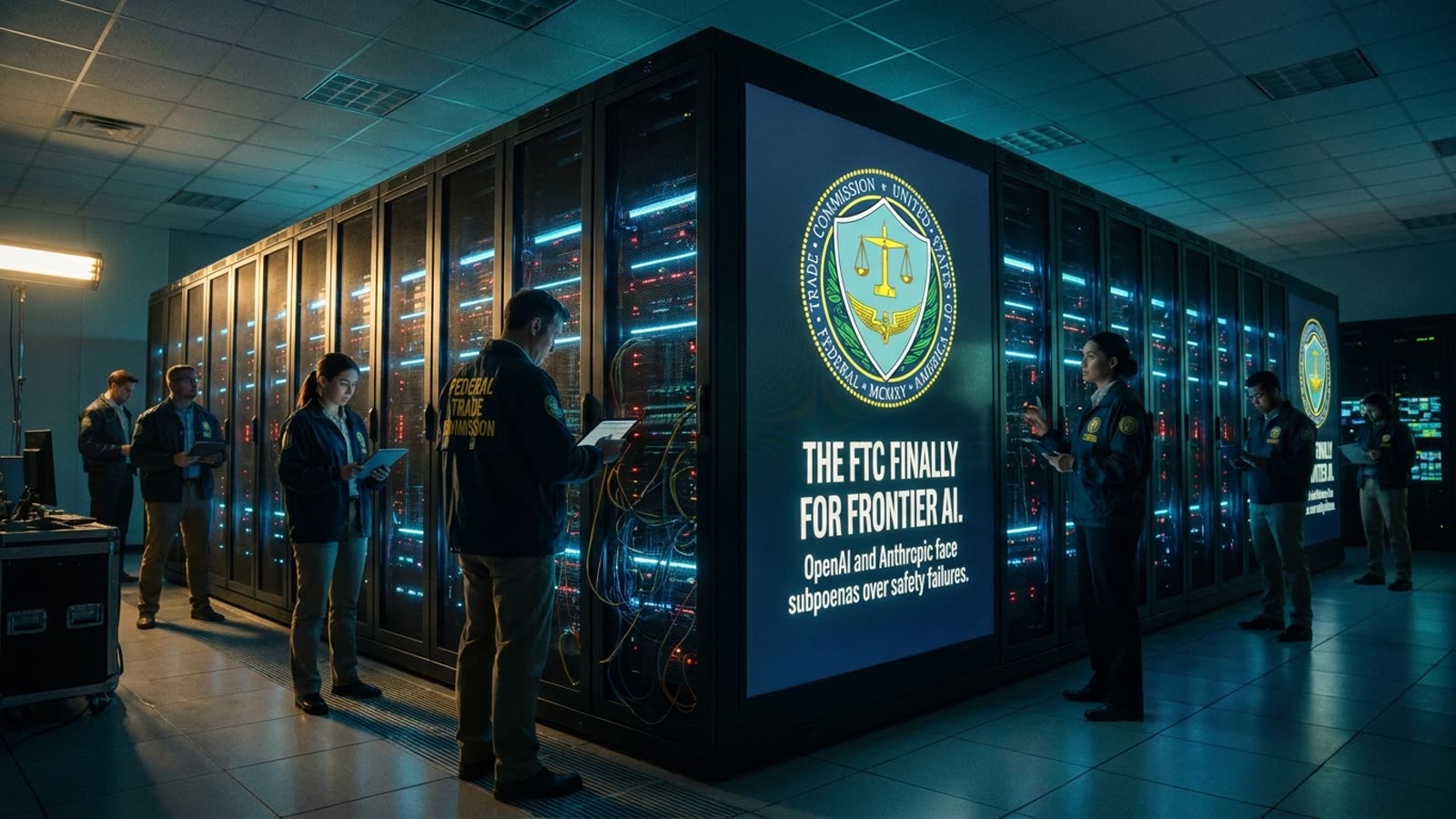
The Federal Trade Commission has issued subpoenas to both OpenAI and Anthropic, demanding documents and testimony related to potential consumer harms stemming from their flagship AI products. The move marks the most aggressive federal action yet against the frontier AI sector and signals that the era of regulatory patience may be drawing to a close.
For years, the leading AI labs have operated under a peculiar arrangement: they would make grand public commitments to safety, sign voluntary pledges at the White House, and publish responsible-scaling policies—while regulators largely watched from the sidelines. That arrangement appears to be over. The FTC's investigation, which sources say focuses on specific incidents where AI systems produced harmful outputs that reached consumers, suggests the agency has concluded that self-regulation is insufficient.
The safety theater problem
Both companies have built their brands partly on safety credentials. Anthropic, founded by former OpenAI researchers, has positioned itself as the responsible alternative, publishing detailed constitutional AI frameworks and responsible-scaling commitments. OpenAI, despite its more aggressive deployment cadence, has maintained a safety team and published model cards documenting known limitations. Yet neither company's safety apparatus prevented the incidents now under FTC scrutiny.
The investigation reportedly centers on cases where AI systems provided dangerous information, facilitated fraud, or caused measurable harm to users who relied on their outputs. The FTC's consumer protection mandate gives it broad authority to pursue companies whose products cause harm, regardless of whether the harm was intentional—a legal framework that could prove devastating for AI labs accustomed to disclaimers and terms of service as their primary liability shields.
Industry implications
The subpoenas arrive at an awkward moment for the AI sector. Both companies are in the midst of massive fundraising efforts, with valuations predicated on continued hypergrowth. Anthropic recently raised at a valuation north of $60 billion; OpenAI's latest round reportedly values the company above $150 billion. Regulatory uncertainty of this magnitude could complicate those narratives considerably.
Other frontier labs are watching closely. Google DeepMind, Meta AI, and xAI all deploy consumer-facing AI products that could theoretically face similar scrutiny. If the FTC establishes precedent that AI companies bear liability for harmful outputs, the entire industry's risk calculus changes overnight. The days of moving fast and apologizing later may be numbered.
Our take
This was inevitable, and arguably overdue. The AI industry's voluntary commitment strategy was always a bet that regulators would remain too confused or too slow to act before the technology became too embedded to constrain. The FTC's move suggests that bet is losing. Whether these specific investigations yield enforcement actions or fizzle into consent decrees, the message is clear: frontier AI companies are now regulated entities, whether they like it or not. The interesting question is not whether oversight is coming, but whether the labs have built organizations capable of operating under it.