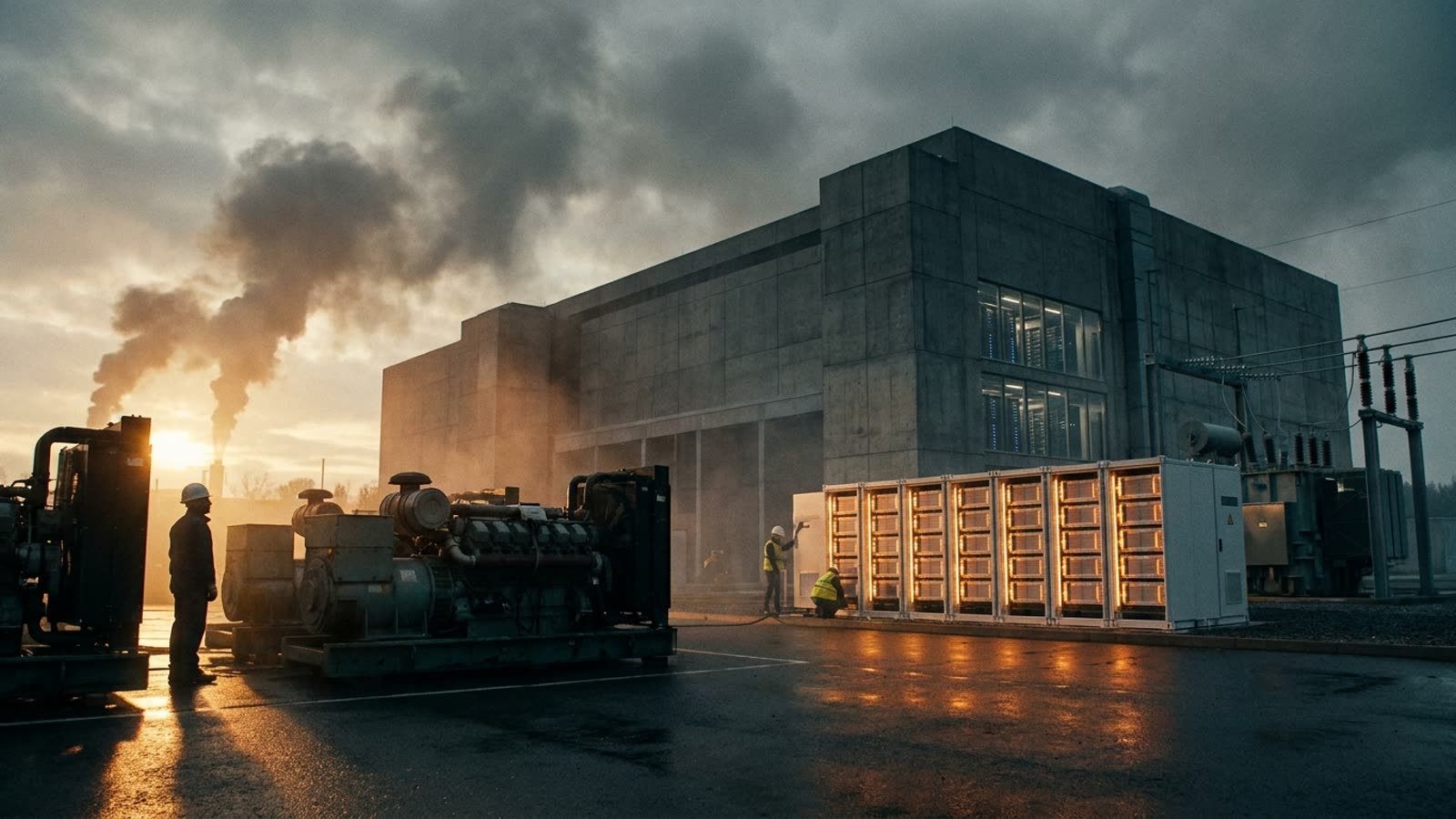
For years, the unspoken bargain of the AI revolution has been this: train the models on renewable energy, but keep diesel and natural gas turbines humming in the background for when the grid falters. Data centers, those cathedrals of compute, have quietly become some of the largest consumers of fossil-fuel backup power on the planet. Now that calculus is shifting beneath the industry's feet.
Battery storage systems have crossed a decisive economic threshold. On a levelized-cost basis, lithium-ion battery installations are now cheaper than the natural gas turbines that have long served as the default backup for hyperscale facilities. The crossover point, long forecast for the early 2030s, arrived ahead of schedule — driven by manufacturing scale in China, improved cell chemistry, and a glut of stationary-storage capacity chasing grid contracts.
Why data centers clung to gas
The attachment to turbines was never ideological; it was practical. Data centers require near-perfect uptime, and batteries historically could not deliver the multi-hour discharge windows needed to ride out extended grid outages. Gas turbines, by contrast, can run indefinitely as long as fuel arrives. For a sector where a fifteen-minute blackout can cost millions in lost revenue and reputational damage, the choice was obvious.
But the math has changed. Modern battery systems now routinely offer four-to-six-hour discharge at scale, more than enough to bridge most grid disruptions or allow for controlled shutdowns. Meanwhile, permitting for new gas infrastructure has become a regulatory obstacle course, adding years and uncertainty to projects that once sailed through approval.
The hyperscaler dilemma
Microsoft, Google, Amazon, and Meta have all made net-zero pledges, yet their actual carbon footprints have ballooned alongside AI workloads. Scope 2 emissions — those from purchased electricity — are relatively easy to offset with renewable contracts. Scope 1 emissions from on-site combustion are harder to greenwash. As investors and regulators sharpen their focus on direct emissions, the optics of spinning up gas turbines every time a storm rolls through become increasingly awkward.
The new battery economics offer an off-ramp. Hyperscalers can now credibly claim that backup power is as clean as their primary supply, provided they are willing to make the capital switch. Some already are: recent filings show several major operators piloting battery-only backup configurations at new facilities in the American Southwest and Northern Europe.
Our take
This is not the end of fossil fuels in data centers — not yet. Legacy facilities will run their turbines for years, and edge cases requiring days of autonomy will still favor combustion. But the direction is unmistakable. The AI industry's energy story is about to get a lot easier to defend, and a lot harder for critics to caricature. When the cheapest option is also the cleanest, even the most reluctant CFO tends to find religion.