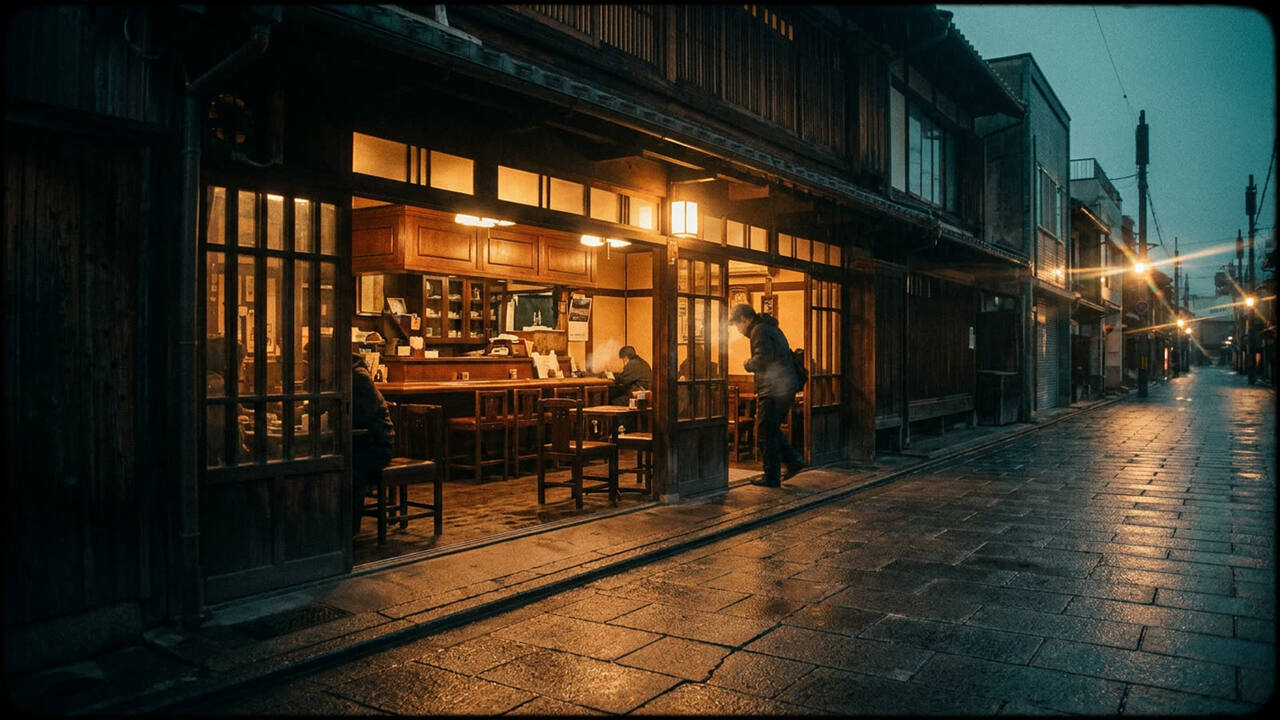
The kissaten has no loyalty program, no oat milk, and absolutely no interest in your laptop. These traditional Japanese coffee houses—dark-paneled rooms where elderly proprietors in bow ties perform elaborate pour-over rituals while classical music plays from vintage speakers—represent a philosophy of hospitality that predates and fundamentally rejects the modern café as productivity hub. That they continue to thrive, particularly among younger Japanese patrons, suggests a quiet rebellion against the tyranny of efficiency.
The word itself combines "kissa" (drinking tea) with "ten" (shop), though tea is almost beside the point. Kissaten emerged in the early twentieth century as spaces for intellectuals and artists to gather, debate, and smoke prodigiously. By the postwar decades, they had evolved into neighborhood institutions with highly specific identities: jazz kissaten played only vinyl, classical kissaten enforced silence, manga kissaten provided floor-to-ceiling comic libraries. Each cultivated an atmosphere so particular that regulars might visit the same seat for decades.
The economics of deliberate inefficiency
A kissaten makes no financial sense by contemporary hospitality metrics. The average customer occupies a seat for an hour or more, nursing a single cup of coffee that might cost eight hundred yen—respectable, but hardly the ticket-volume model that sustains modern chains. The proprietor, often working alone or with a spouse, performs every step of preparation with ceremonial attention: warming the cup, measuring beans to the gram, pouring water in slow concentric circles. This is not artisanal theater for Instagram; many kissaten forbid photography entirely. It is simply how the thing is done.
The result is a business model predicated on loyalty rather than throughput. A kissaten might serve forty customers on a good day where a chain location processes hundreds. But those forty customers return weekly, sometimes daily, for years. They come not despite the slowness but because of it—the kissaten offers a temporal sanctuary, a place where urgency is not merely unwelcome but architecturally impossible.
Why the young are returning
The narrative of kissaten decline has been written repeatedly since the 1980s, when Doutor and then Starbucks arrived to offer speed and standardization. Thousands of kissaten did close. Yet the survivors have found an unexpected constituency: Japanese patrons in their twenties and thirties who grew up with convenience-store coffee and discover in the kissaten something their generation was never offered. The appeal is not nostalgia—you cannot be nostalgic for what you never experienced—but rather novelty. The kissaten's analog rituals, its prohibition on productivity, its implicit demand that you simply sit and drink, registers as almost radical.
This cohort has also driven a modest revival in new openings, though these neo-kissaten tend to preserve the aesthetic while relaxing the stricter codes. Photography is sometimes permitted. The music might include jazz recorded after 1965. But the core proposition remains: time here moves differently, and that difference is the product.
Our take
The kissaten's persistence is not a business case study but a cultural one. It survives because it offers something that cannot be scaled, optimized, or franchised—an experience whose value is inseparable from its inefficiency. In a world that treats every moment as potentially monetizable, the kissaten's gentle insistence that you do nothing but drink coffee and exist feels less like nostalgia than resistance. The velvet seats are worn, the lighting is terrible for selfies, and the proprietor will not remember your name in an app. That is precisely the point.