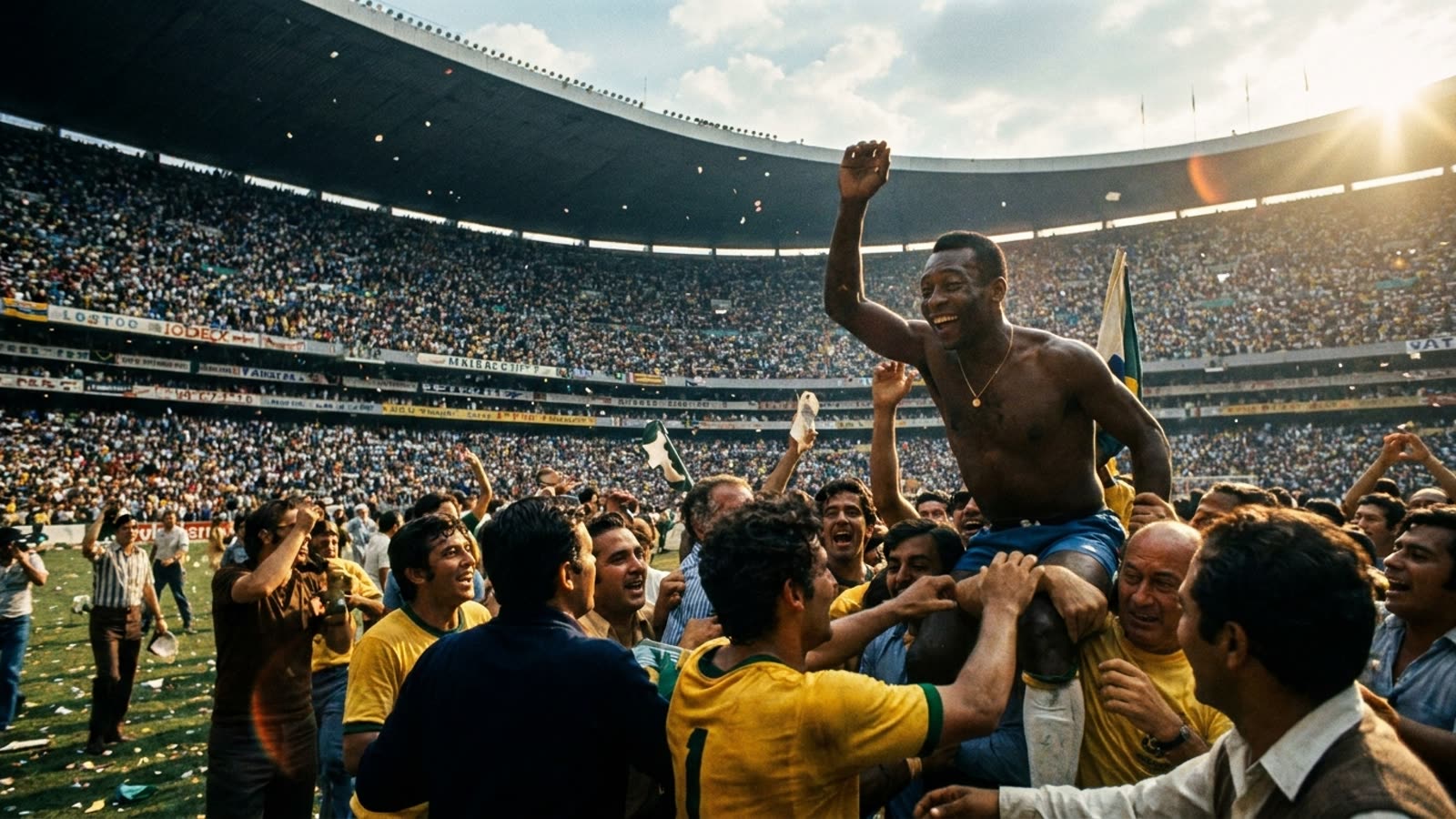
There is a particular cruelty in perfection: it renders everything that follows inadequate. Brazil's 1970 World Cup campaign did not merely win a tournament; it established an aesthetic standard that has haunted football ever since. When pundits invoke 'the beautiful game,' they are not speaking abstractly. They are speaking about seventeen days in Mexico when Pelé, Jairzinho, Tostão, Gérson, and Rivelino played football that seemed to exist outside the constraints of competition.
The numbers alone are remarkable — nineteen goals scored in six matches, every game won, Jairzinho becoming the only player to score in every round of a World Cup finals — but statistics fail to capture what made this team singular. It was the geometry of their passing, the almost telepathic understanding between players, the sense that they were solving problems that hadn't been posed yet.
The context of impossibility
What makes 1970 more impressive in retrospect is the tactical environment it emerged from. The late 1960s had seen football grow increasingly defensive. Helenio Herrera's catenaccio at Inter Milan had demonstrated that suffocating opponents could win trophies. England's 1966 World Cup victory, achieved through discipline and physical organization, suggested the future belonged to pragmatism.
Brazil's manager Mário Zagallo — himself a player on the 1958 and 1962 winning sides — rejected this entirely. His 4-2-4 formation was considered recklessly attacking even by Brazilian standards. The full-backs pushed forward constantly. The midfield existed not to destroy but to create. It was a philosophical statement as much as a tactical one: that football's purpose was expression, not prevention.
The final as thesis statement
The 4-1 demolition of Italy in the final at the Azteca remains the most complete ninety minutes in World Cup history. Italy, themselves excellent and featuring the great Gigi Riva, were reduced to spectators. Carlos Alberto's fourth goal — a sweeping team move finished with a strike of almost violent precision — is replayed endlessly not because it was decisive but because it was definitive. It said: this is what football can be.
The footage, grainy and sun-bleached, has taken on the quality of myth. Pelé's dummy that didn't touch the ball. Tostão's ability to find space that shouldn't exist. Rivelino's left foot, which seemed to bend physics. These weren't highlights; they were the baseline.
Our take
Football has become faster, fitter, and more tactically sophisticated since 1970. Modern pressing systems and data analytics have produced their own forms of excellence. Yet no team has replicated what Brazil achieved: dominance that felt like liberation rather than control. Spain's tiki-taka came closest in philosophy but was often accused of sterility. Guardiola's Barcelona dazzled but played with a tension Brazil never showed. The 1970 squad won the Jules Rimet trophy permanently — three victories meant Brazil kept the original — but what they really claimed was something more lasting: ownership of an ideal. Every great team since has been measured against eleven men in yellow shirts playing in thin mountain air, and every great team has been found, in some essential way, wanting.