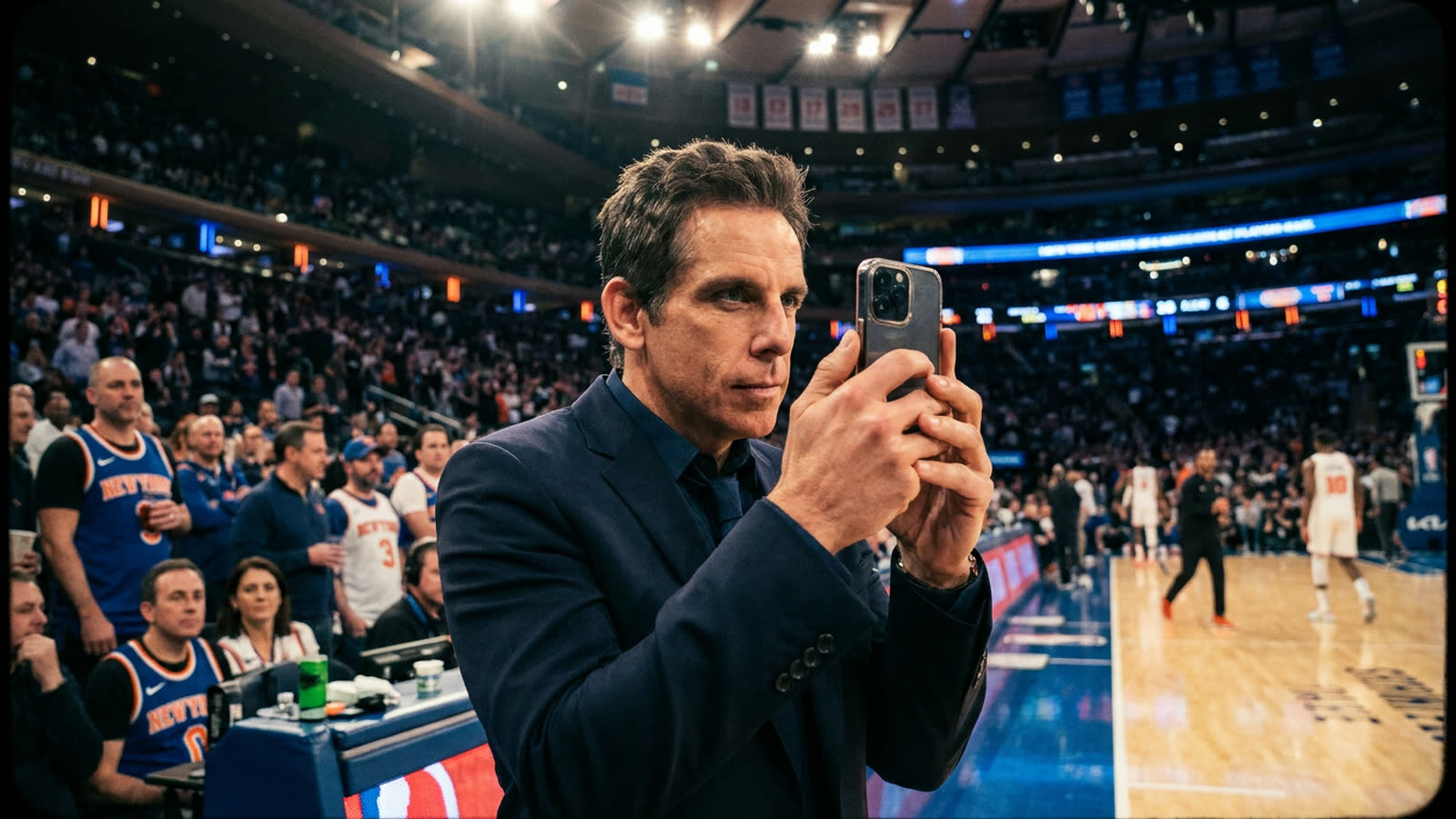
There is a particular species of celebrity courtside presence that involves looking expensive, clapping politely, and being photographed by someone else. Ben Stiller, filming the New York Knicks' victory over the Cleveland Cavaliers on his iPhone this week, chose a different path—one that involved tracking shots, instinctive zooms, and the kind of handheld urgency that film students spend semesters trying to master.
The footage, which circulated widely across social media within hours of the game, captured the final moments of New York's win with a kinetic intimacy that broadcast cameras, constrained by their fixed positions and network protocols, simply cannot achieve. Stiller panned across the crowd's eruption, held on players' faces at precisely the right moments, and demonstrated a compositional eye that reminded viewers he has, in fact, directed films.
The craft behind the chaos
What distinguished Stiller's footage from the typical celebrity phone-capture was its restraint. He didn't center himself. He didn't narrate. He let the moment breathe while maintaining visual coherence—a skill that separates documentary instinct from tourist reflex. The comparisons to Uncut Gems were inevitable and not entirely unearned; the Safdie Brothers' 2019 film, set partially in the diamond district's gambling underworld, deployed similar handheld chaos to generate anxiety. Stiller's version generated joy, but the technique rhymed.
The praise arrived from unexpected quarters. Cinematographers noted his lens choices. Sports media accounts that typically mock celebrity fans for performative enthusiasm instead shared his clips approvingly. The consensus was unusual: here was someone famous doing something well, rather than merely doing something visible.
Fame and the amateur hour
The episode illuminates a broader tension in how we consume celebrity adjacency to culture. When Jack Nicholson sat courtside at Lakers games for decades, his presence was the content—the sunglasses, the reactions, the mythology. The modern equivalent often involves influencers filming themselves watching, the event reduced to backdrop for personal brand maintenance.
Stiller inverted this. His footage was valuable because it captured something he witnessed, not something he attended. The distinction matters. It suggests that celebrity access, often criticized as unearned proximity, can occasionally produce artifacts worth having—provided the famous person in question treats the moment as something other than content opportunity.
Our take
There is something quietly reassuring about a sixty-year-old comedy actor demonstrating that decades of looking through cameras teaches you how to see. Stiller's Knicks footage won't win any awards, but it earned something rarer: genuine respect from people who know what they're looking at. In an era when courtside seats function primarily as Instagram backdrops, he reminded everyone that some celebrities became famous for reasons beyond showing up.