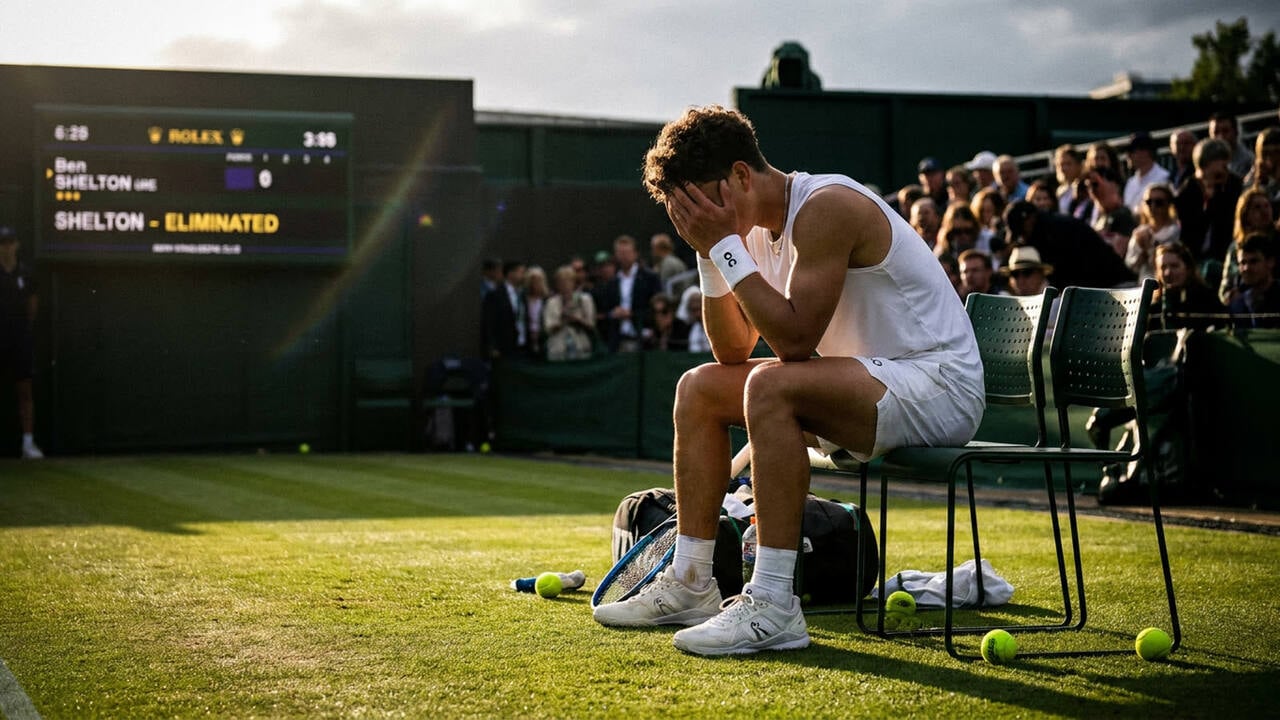
The grass at the All England Club has a way of humbling the overeager. Ben Shelton, the thunderous-serving American who entered Wimbledon as a seeded player and a supposed standard-bearer for the post-Big Three era, discovered this the hard way on Monday, bundled out in the first round by an opponent ranked well below him.
Shelton's exit is not merely a bad day at the office. It is a data point in a longer, more uncomfortable pattern: American men keep threatening to dominate tennis and then failing to close the deal when the stakes rise.
The serve isn't enough
Shelton's game is built around one of the most fearsome deliveries in the sport—a left-handed missile that regularly clocks north of 140 mph. On hard courts, particularly the American swing, this weapon can paper over deficiencies elsewhere. Grass, in theory, should amplify the advantage. In practice, the surface demands more: touch at the net, slice variety, the patience to construct points when the serve isn't landing.
Shelton's opponent read the patterns, stayed in rallies, and waited for the errors that inevitably came. The American's movement, never his strongest suit, looked labored. His net approaches were telegraphed. By the time he realized the match had slipped away, it was too late to adjust.
A generational question mark
The broader issue is that Shelton was supposed to be different. After his breakthrough run to the Australian Open semifinals in 2024, the narrative coalesced quickly: here, finally, was the American man who could challenge for majors consistently. Two years later, the major trophy case remains empty, and the pattern of early exits at the slams has become difficult to ignore.
He is not alone. The cohort of young American men—Shelton, Frances Tiafoe, Tommy Paul—collectively possess the talent to win big titles. Collectively, they have won none. The depth exists to dominate the middle rounds of tournaments; the mentality to win seven matches at a slam remains elusive.
Our take
Shelton's Wimbledon flameout is not a career-defining disaster—he is 23, with time to evolve his game and his mindset. But it should puncture some of the premature coronation that followed his early success. American men's tennis has been waiting for a slam champion since Andy Roddick lifted the U.S. Open trophy in 2003. Shelton may yet be that player. Monday's evidence suggests he is not that player yet, and the gap between potential and execution is wider than his boosters want to admit.