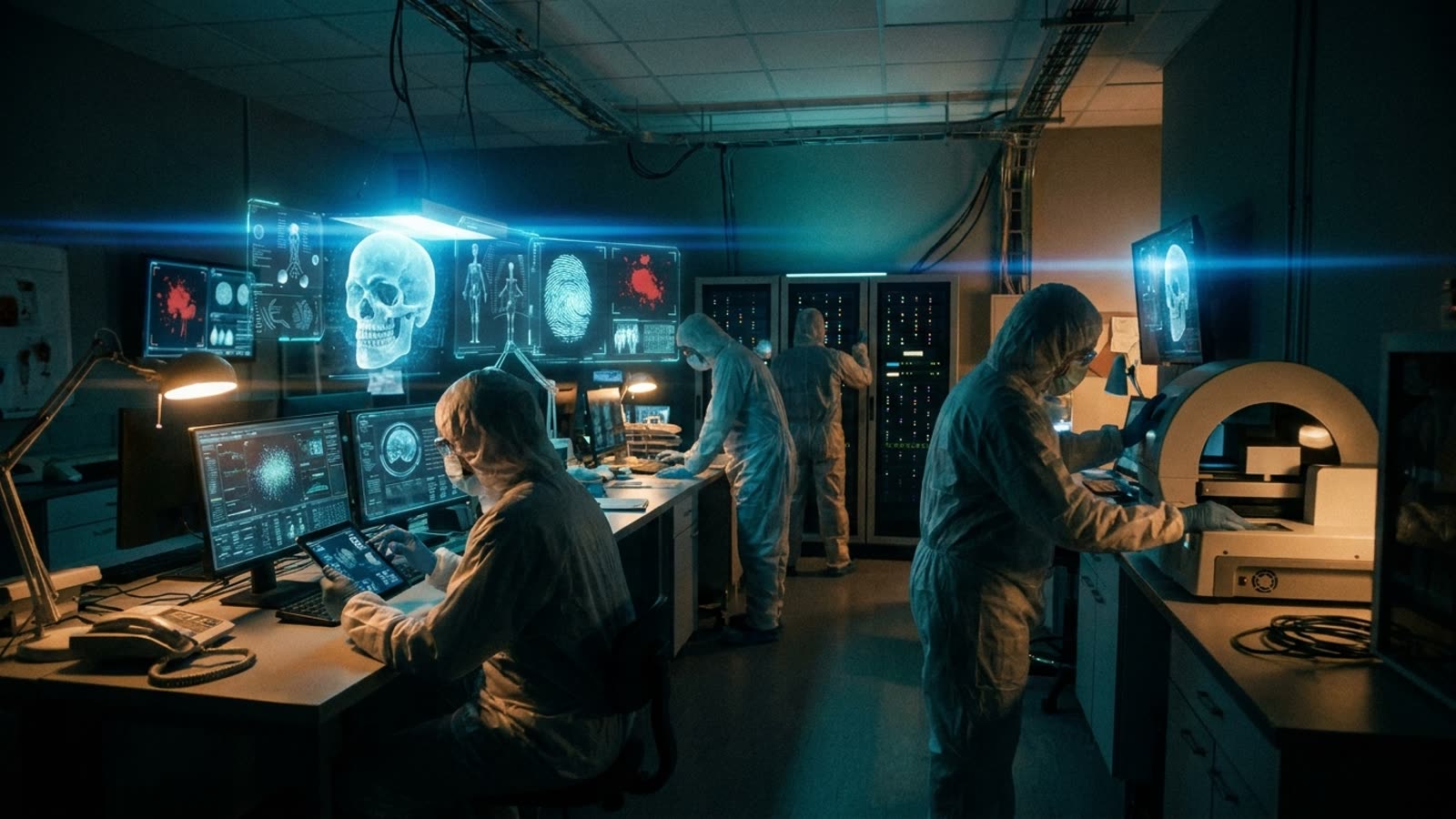
For more than a century, forensic science has rested on a peculiar foundation: the trained human eye. Fingerprint examiners squint at ridge patterns, ballistics experts peer through comparison microscopes, and bloodstain analysts reconstruct violence from spatter geometry. The work is painstaking, subjective, and—as a landmark 2009 report from the National Academy of Sciences made painfully clear—far less scientifically rigorous than courtroom juries have been led to believe. Now artificial intelligence is entering the crime lab, and its arrival is forcing a reckoning with forensic science's deepest vulnerabilities.
The transformation began with pattern recognition, the same capability that lets neural networks distinguish cats from dogs in photographs. Fingerprint analysis, long considered the gold standard of forensic identification, turns out to be an ideal proving ground. Human examiners compare latent prints—the smudged, partial impressions left at crime scenes—against known prints in databases, a process that involves judgment calls about which features matter and how much distortion is tolerable. Studies have shown that different examiners examining the same print pair sometimes reach opposite conclusions. AI systems trained on millions of print comparisons can now flag potential matches with remarkable consistency, though the final determination still typically rests with human experts.
The promise of objectivity
The appeal of algorithmic forensics is obvious. Machines do not get tired, do not succumb to confirmation bias, and do not unconsciously adjust their conclusions based on contextual information about a suspect. When researchers at several major universities tested whether forensic examiners' judgments could be influenced by irrelevant case details—being told, for instance, that a suspect had confessed—they found significant effects. An AI system, properly designed, would be immune to such contamination.
Beyond fingerprints, machine learning is making inroads into domains once thought too complex for automation. Bloodstain pattern analysis, which involves inferring the position and movement of bodies during violent events, has long been more art than science. Neural networks trained on synthetic bloodstain data—generated by controlled experiments with blood-substitute fluids—can now estimate impact angles and blood source locations with precision that matches or exceeds experienced analysts. Forensic anthropology, the identification of human remains, is being augmented by systems that can estimate age, sex, and ancestry from skeletal measurements, reducing the variability that has plagued the field.
The persistence of human judgment
Yet the integration of AI into forensic practice is neither smooth nor complete. Crime laboratories are institutionally conservative, bound by accreditation standards and legal precedent. Introducing a new analytical method requires extensive validation studies, and courts have historically been skeptical of black-box technologies. The Daubert standard, which governs the admissibility of expert testimony in federal courts, demands that scientific methods be testable, peer-reviewed, and possessed of known error rates. Many AI systems, particularly deep learning models, struggle to articulate their reasoning in ways that satisfy these criteria.
There is also the question of what happens when the algorithm and the human disagree. If an AI system flags a fingerprint as a non-match but a veteran examiner believes otherwise, whose judgment prevails? The answer varies by jurisdiction and laboratory, but the tension is real. Some forensic scientists worry that AI will become a crutch, eroding the skills of human examiners who may eventually be called upon to testify about conclusions they no longer fully understand.
Our take
The entry of artificial intelligence into forensic science is neither salvation nor catastrophe—it is an overdue stress test. For decades, forensic disciplines have operated with an aura of scientific authority that their underlying methods did not always justify. AI forces the question: what does it actually mean for evidence to be reliable? The technology's potential to reduce wrongful convictions is real, but so is the risk that algorithmic confidence will be mistaken for algorithmic infallibility. The crime lab of the future will almost certainly be hybrid, human and machine working in tandem. The challenge is ensuring that this partnership serves justice rather than merely efficiency.