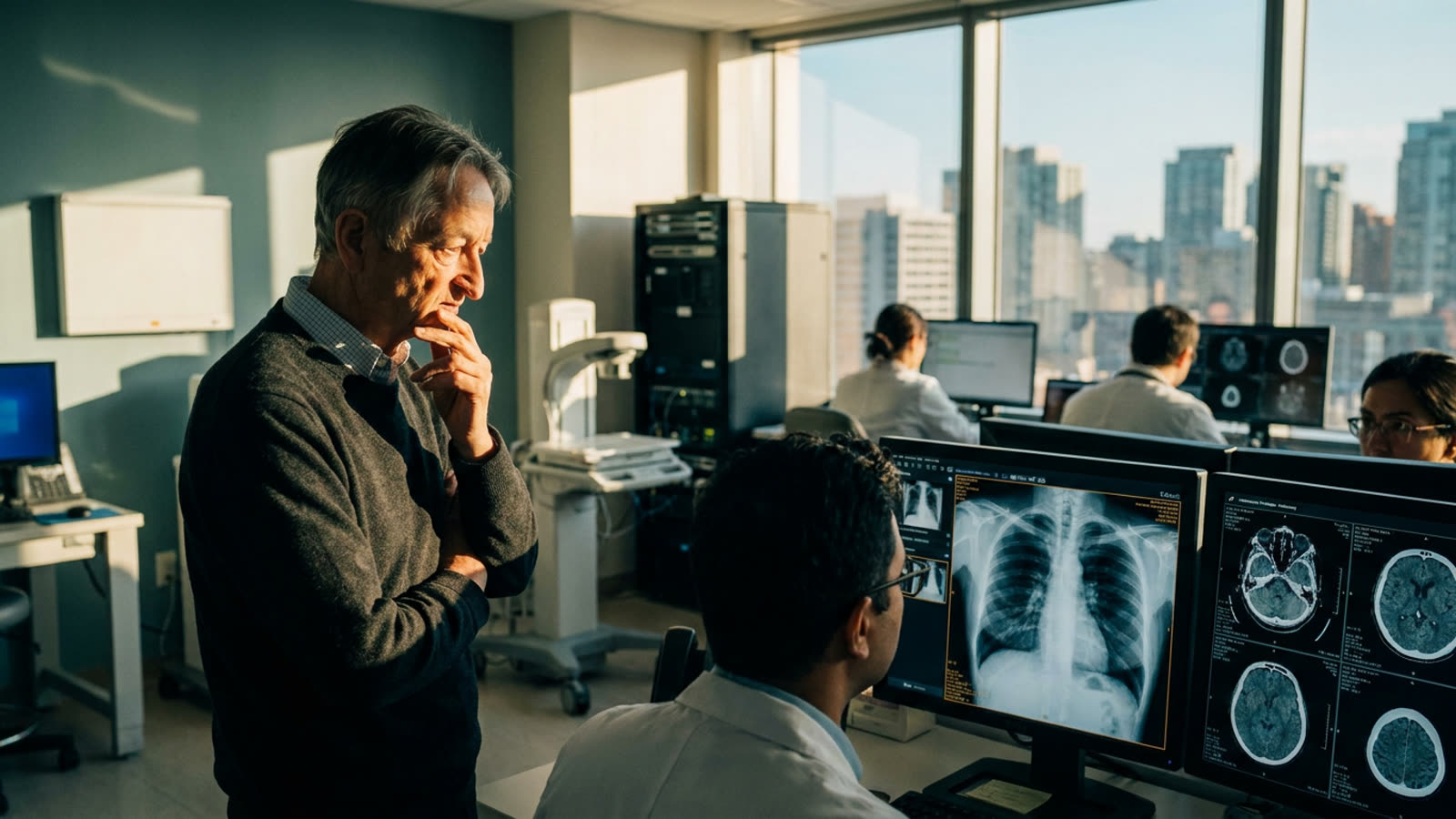
When Geoffrey Hinton won the Nobel Prize in Physics in 2024, radiologists around the world exchanged knowing glances. The godfather of deep learning had spent years warning that AI would replace radiologists, famously telling medical students in 2016 to stop training for the specialty. A decade later, the reality is more nuanced: AI hasn't replaced radiologists, but it has fundamentally transformed what they do.
From film to algorithms
Radiology was always destined to be AI's first major medical conquest. Unlike the messy, human world of clinical medicine, radiology deals in pixels and patterns. A chest X-ray is fundamentally data—a matrix of grayscale values waiting to be analyzed. When convolutional neural networks began consistently beating humans at image classification tasks around 2012, it was only a matter of time before they turned their attention to medical images.
The transformation began quietly. Early systems flagged potential lung nodules or highlighted suspicious mammogram regions. Today's AI goes far deeper. Modern radiology AI can detect diseases years before symptoms appear, predict which patients will respond to specific treatments, and even identify genetic mutations from routine scans. At major medical centers, AI pre-screens every image, triaging urgent cases and annotating findings before human eyes ever see them.
The new radiology workflow
The daily life of a radiologist has shifted dramatically. Where once they spent hours hunched over light boxes comparing films, today's radiologists navigate AI-generated heat maps and confidence scores. The technology has created a paradox: while AI can process images faster than any human, it has actually increased the cognitive load on radiologists, who must now synthesize machine predictions with clinical context.
This has spawned an entirely new skillset. Modern radiologists must understand not just anatomy and pathology, but also the strengths and biases of their AI tools. They've become quality control experts, catching the edge cases where algorithms fail—the rare diseases AI hasn't seen enough of, the artifacts that fool neural networks, the subtle findings that require human intuition.
The economic disruption
The business model of radiology is being rewritten. Traditionally, radiologists were paid per scan read—a model that incentivized volume over depth. AI has flipped this equation. When machines handle routine screening, human expertise becomes more valuable for complex cases. Some practices now charge premium rates for "AI-augmented interpretations," while others have pivoted to subspecialization, focusing on areas where human judgment remains irreplaceable.
The shift has created winners and losers. Large hospital systems with resources to invest in AI infrastructure have seen productivity soar. Small practices struggle with the cost of licensing AI tools that can run hundreds of thousands of dollars annually. Meanwhile, a new industry has emerged: companies that provide AI-as-a-service to radiology practices, democratizing access to technology that was once the province of academic medical centers.
Our take
Radiology's AI transformation offers a preview of how artificial intelligence will reshape knowledge work more broadly. The pattern is clear: AI doesn't eliminate experts; it changes what expertise means. The radiologists thriving today are those who've embraced a hybrid role—part physician, part data scientist, part quality controller. As AI capabilities expand, this model will repeat across medicine and beyond. The question isn't whether AI will transform your field, but whether you'll be ready when it does.