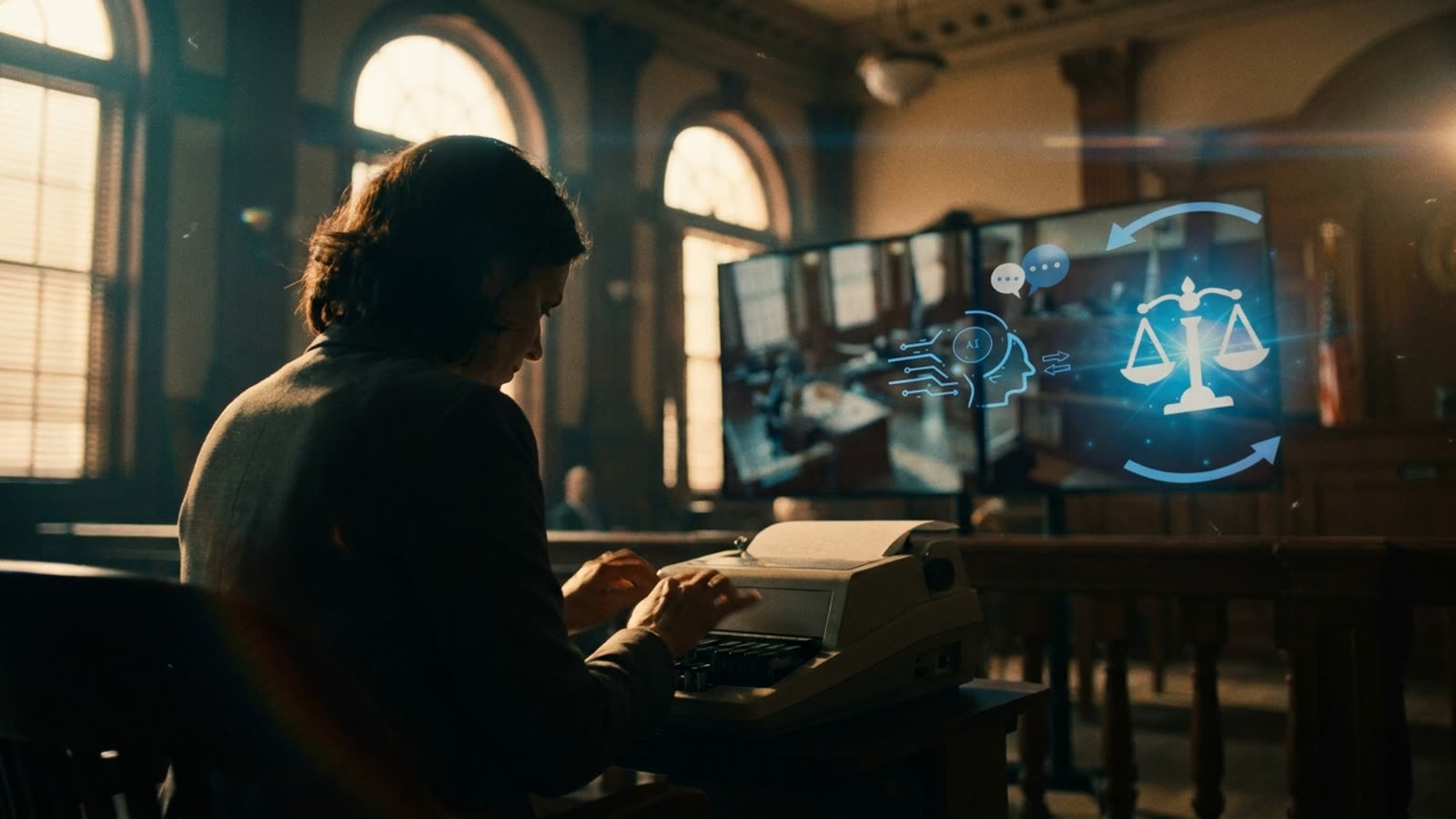
Few professions have enjoyed such a comfortable moat as court reporting. The job requires mastering stenography — a shorthand system using a specialized 22-key machine that can capture speech at 225 words per minute with near-perfect accuracy. Training takes two to four years, attrition rates during certification hover around 85 percent, and the resulting scarcity has kept salaries robust and demand perpetual. Every deposition, every trial, every congressional hearing has needed someone with this arcane skill. Until, perhaps, now.
Automatic speech recognition has improved so dramatically that several jurisdictions have begun experimenting with AI transcription for lower-stakes proceedings. The technology is not yet reliable enough for felony trials — speaker identification, legal terminology, and overlapping speech still trip up algorithms — but the trajectory is unmistakable. What once seemed like a profession insulated by sheer difficulty is discovering that difficulty was never the same thing as permanence.
The economics of scarcity
The United States faces a genuine court reporter shortage. The National Court Reporters Association has warned for years that retirements are outpacing new certifications, creating backlogs that delay justice. This shortage has paradoxically accelerated AI adoption: courts that cannot find a human stenographer at any price are forced to try alternatives. Some states now permit digital recording with human transcriptionists working from audio afterward — a hybrid model that already diminishes the stenographer's central role.
The economics cut both ways. Experienced court reporters in major metropolitan areas can earn well into six figures, particularly in the lucrative freelance deposition market. That income reflects genuine skill and genuine scarcity. But it also creates an obvious target for cost-conscious law firms and budget-strapped court systems. Every profession with high wages and a learnable task eventually attracts automation's attention.
What machines still cannot do
The honest assessment is that AI transcription remains imperfect in ways that matter enormously in legal contexts. A single misheard word can change the meaning of testimony. Speakers with accents, speech impediments, or soft voices challenge current systems. Courtrooms are acoustically chaotic environments with coughing, shuffling, and simultaneous speech. Human stenographers handle these situations through a combination of training, real-time clarification requests, and contextual inference that AI cannot yet match.
More subtly, court reporters serve functions beyond transcription. They administer oaths, mark exhibits, and provide an official human presence that carries procedural weight. The record they produce is not merely a transcript but a certified legal document with evidentiary standing. Replacing that human certification with algorithmic output raises questions that technology alone cannot answer.
The hybrid future
The most likely near-term outcome is not replacement but restructuring. AI handles the bulk transcription; humans review, correct, and certify. This model preserves accuracy while reducing the number of stenographers needed and shifting their role from real-time capture to quality assurance. It is, in essence, the same transformation that has already reshaped radiology, legal research, and financial analysis — humans overseeing machines rather than performing the primary task themselves.
For current court reporters, this means the skills that took years to acquire may become less valuable than the judgment to know when AI has erred. For aspiring stenographers, it raises the uncomfortable question of whether to invest in a credential whose half-life is now uncertain.
Our take
Court reporting is a case study in how AI disrupts not by being better than humans, but by being good enough and cheap enough to change the calculus. The profession's practitioners are not wrong to note AI's current limitations — they are simply wrong to assume those limitations are permanent. The moat was never the machine; it was the years of training required to operate it. When software can approximate that training in milliseconds, the moat drains faster than anyone inside it expects.