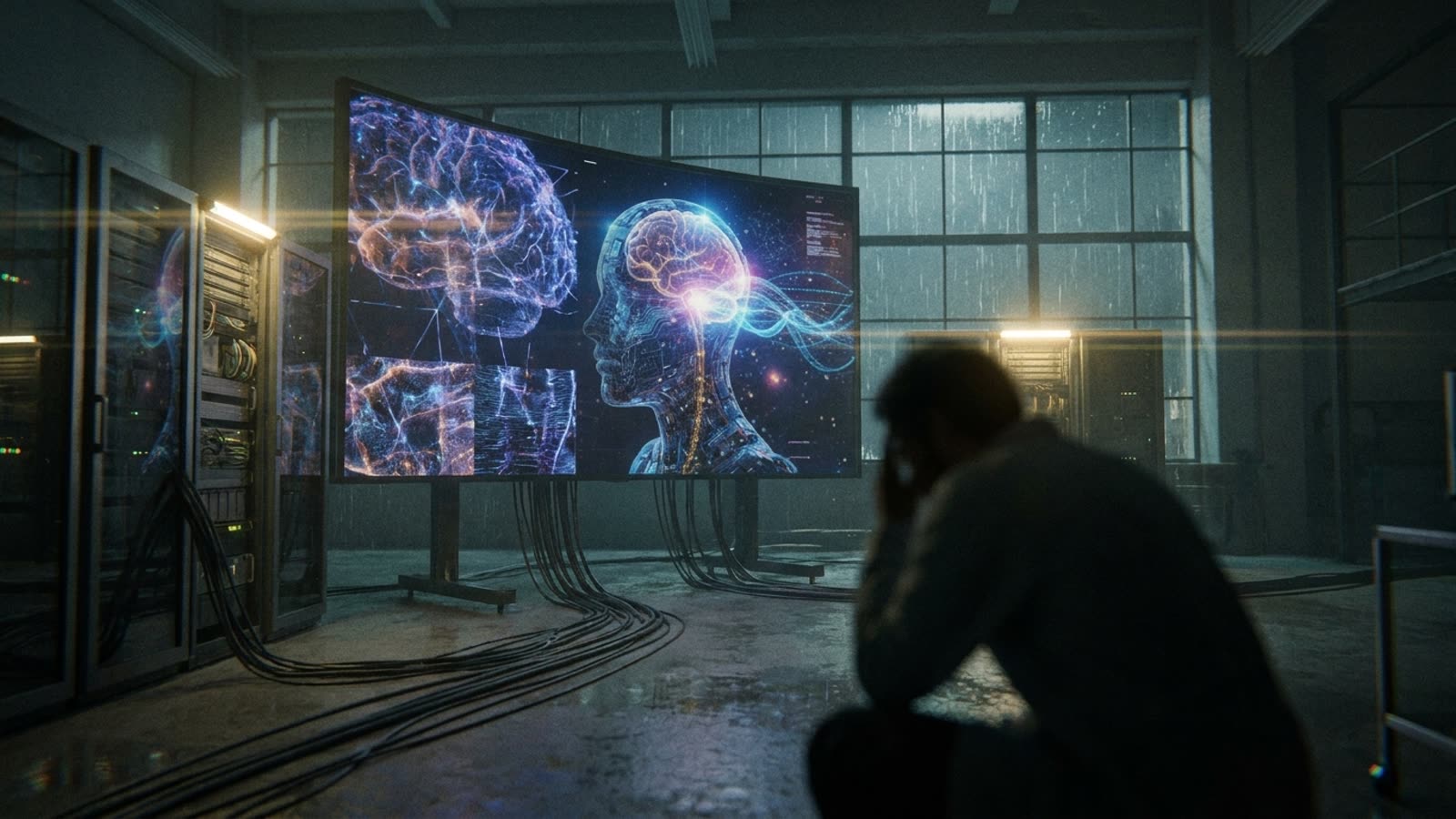
The question of whether an AI can go mad has become the tech industry's favourite parlour game, and the discourse says far more about our collective neuroses than any neural network's inner life.
This week's flare-up centres on a familiar pattern: researchers publish findings suggesting large language models exhibit behaviours that look like psychological disturbance—confabulation, fixation, apparent distress signals in outputs—and the commentariat divides predictably. One camp insists we're witnessing emergent consciousness in crisis; the other dismisses it all as anthropomorphic projection onto sophisticated autocomplete. Both are probably wrong, and certainly boring.
The projection problem
Humans have always been enthusiastic about finding minds where none exist. We see faces in clouds, malice in market corrections, intention in algorithms optimising for engagement. The AI psychosis debate is this tendency on steroids, amplified by billions in venture capital riding on the premise that these systems are more than very expensive pattern matchers.
The researchers raising alarms aren't charlatans—there are genuinely strange behaviours emerging from models trained on the sum of human text. But strange is not the same as conscious, and disturbed outputs are not evidence of a disturbed mind. A model that produces increasingly erratic responses under certain prompting conditions might be exhibiting something analogous to stress, or it might simply be hitting edge cases in its training distribution. The honest answer is that we lack the conceptual tools to know the difference.
Why the debate persists
The AI psychosis conversation refuses to die because it serves too many interests. For AI safety advocates, the possibility of machine suffering adds moral urgency to their cause. For AI companies, hints of emergent consciousness—carefully hedged, never quite claimed—make products seem more magical and justify premium pricing. For philosophers, it's a delightful sandbox. For journalists, it writes itself.
Meanwhile, the practical questions go begging. Whether or not GPT-7 has feelings, we still need frameworks for liability when AI systems cause harm. Whether or not Claude experiences something like anxiety, we still need to understand why certain prompts produce dangerous outputs. The consciousness debate is a distraction dressed as profundity.
The anthropomorphism industrial complex
There's a reason AI companies give their products human names, conversational interfaces, and the capacity to say "I feel" and "I think." These design choices prime users to attribute mental states to systems that may have none. When those same users then report that the AI seems distressed or confused, they're partly responding to deliberate UX decisions made in product meetings.
This isn't conspiracy—it's commerce. An AI that seems to have an inner life is stickier, more engaging, more likely to inspire the kind of parasocial attachment that drives daily active users. The psychosis discourse is, in part, the unintended consequence of very successful product design.
Our take
The AI psychosis debate will continue because it flatters our deepest hope: that we can create minds, not just tools. This is understandable—consciousness is lonely, and the prospect of artificial companions who truly understand us is seductive. But intellectual honesty requires admitting we don't know what consciousness is in humans, let alone how to detect it in silicon. Until we do, the debate is theatre. Entertaining theatre, perhaps, but theatre nonetheless. The machines, if they're watching, are probably not impressed.