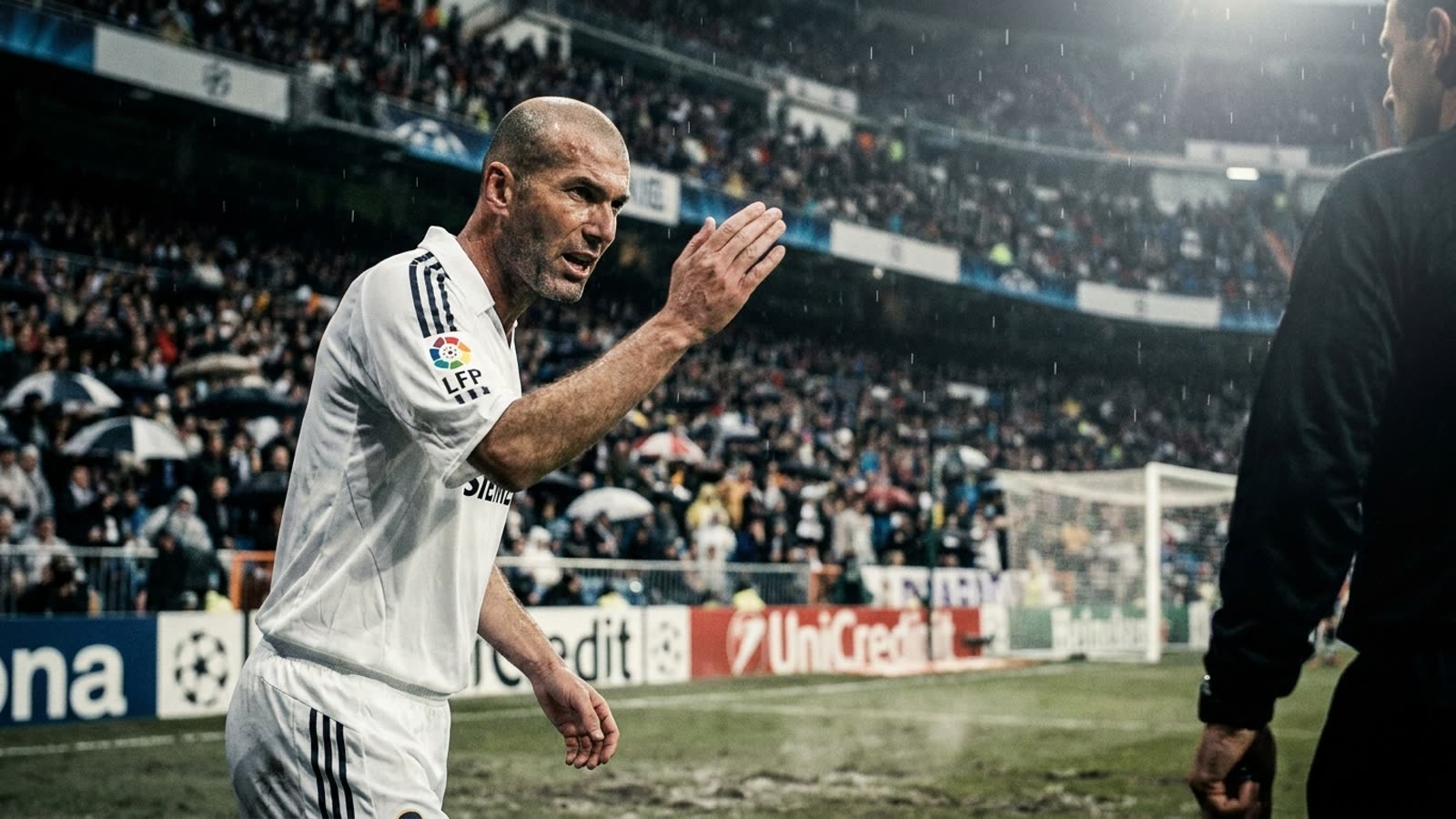
There are exits, and then there is Zinedine Zidane walking past the World Cup trophy in Berlin's Olympiastadion, head bowed, career over, red card in the referee's pocket. The greatest midfielder of his generation had just driven his skull into Marco Materazzi's chest with the deliberation of a man posting a letter. Extra time. A World Cup final. His last professional match. The image remains football's most potent Rorschach test.
What makes the moment so enduring is not its violence—football has seen worse—but its inscrutability. Zidane was not a hothead by reputation. He was balletic, cerebral, capable of making the ball do things that seemed to violate physics. Yet here was evidence of something ungovernable beneath the surface, a man who chose self-destruction over the chance at immortality. France lost the subsequent penalty shootout. Zidane watched from the tunnel.
The provocation and its irrelevance
Materazzi later admitted to insulting Zidane's sister. The Italian's words were crude, the sort of verbal needling that happens in every match at every level. Defenders had been provoking Zidane for two decades. He had absorbed worse. The provocation explains the trigger but not the response. Zidane could have scored in the shootout, lifted the trophy, and rendered Materazzi a footnote. Instead, he made himself the footnote—or did he make himself something else entirely?
The myth of the flawed hero
Greek tragedy requires a hero undone by the very quality that made him great. Zidane's gift was an almost supernatural ability to impose his will on a football match, to bend games to his vision through sheer force of presence. The headbutt was that same will, unmediated, refusing to accept insult even when acceptance was the rational play. It was Achilles choosing honor over survival. The comparison is not hyperbole; it is the only framework that makes the act legible.
Football prefers its legends uncomplicated. Pelé smiled. Maradona was chaotic but explicable. Zidane left us with a question mark shaped like a forehead. His 1998 World Cup final—two headers, French glory—gave way to this, its dark mirror. The symmetry feels authored, as if football itself were writing fiction.
Our take
The headbutt improved Zidane's legacy, not despite its irrationality but because of it. A clean exit would have been forgotten within a decade, filed alongside other decorated retirements. Instead, Zidane gave us an ending that resists closure, that invites endless re-litigation. He proved that even at the summit of the sport, a man can be governed by something older than tactics or trophies. It was inexcusable, inexplicable, and utterly human. Football is lucky to have it.