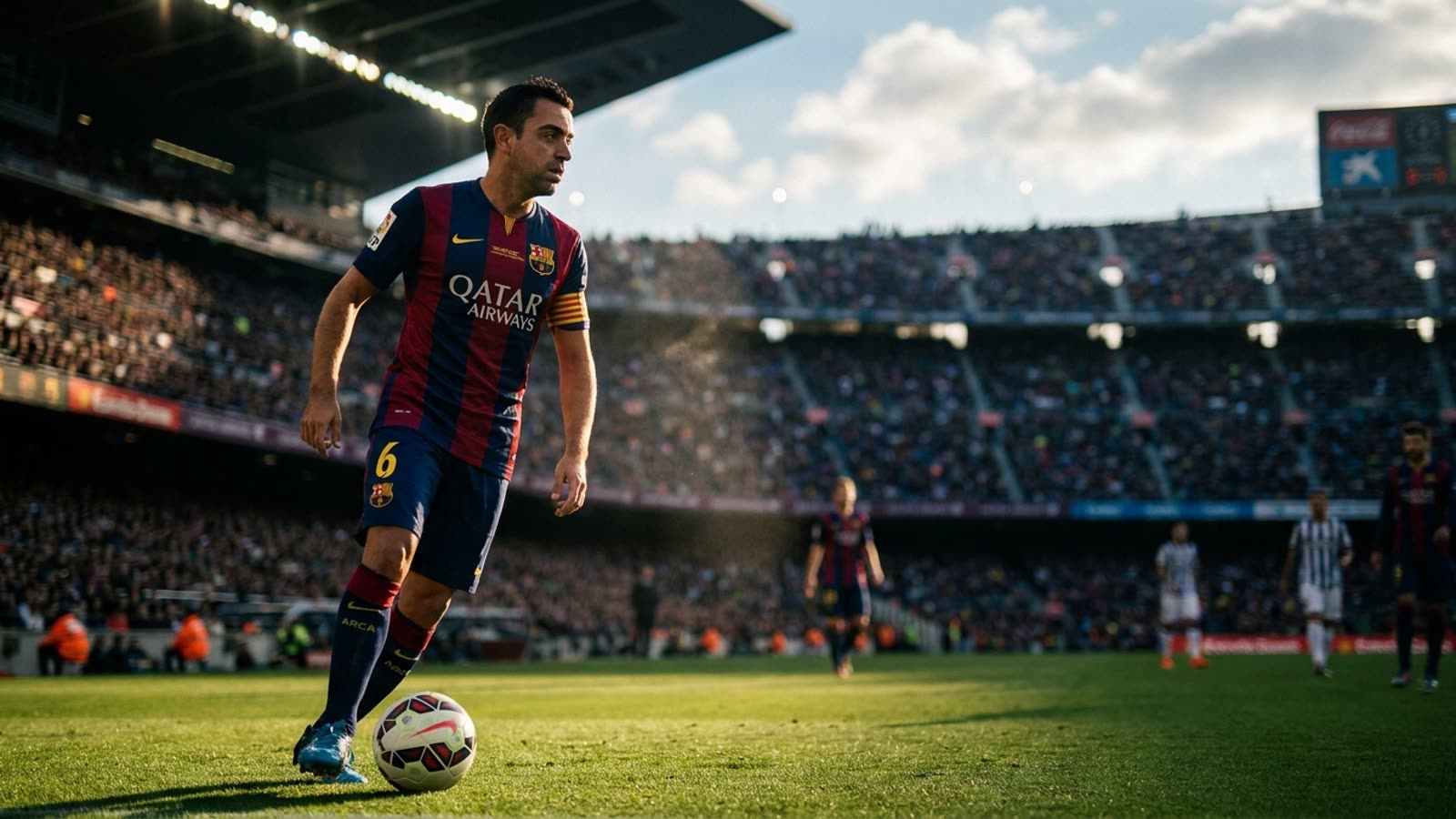
There is a particular kind of genius that looks, to the untrained eye, like nothing much at all. Xavi Hernández spent his career doing things that seemed almost too simple — a five-yard pass, a half-turn, another five-yard pass — and yet the cumulative effect was the most dominant midfield play the sport has ever seen. He won everything: four Champions Leagues, eight La Liga titles, a World Cup, two European Championships. He did it while appearing to barely break a sweat.
The numbers alone fail to capture it. In Spain's 2010 World Cup triumph, Xavi completed an absurd 91% of his passes across the tournament. But pass completion is a statistic that flatters the cautious. What made Xavi singular was that he completed those passes while consistently choosing the most dangerous option available. He didn't recycle possession; he weaponised it.
The geometry of space
Xavi's gift was spatial. He understood the pitch as a series of triangles and passing lanes that shifted with every movement of every player. While others saw chaos, he saw architecture. His positioning — always at a slight angle to receive, always with his body open to the next phase of play — meant he had processed his options before the ball arrived. The first touch was never about control; it was about execution of a decision already made.
Pep Guardiola, who coached Xavi at Barcelona during the club's most successful era, once said the midfielder had a "map of the pitch in his head." This was not metaphor. Xavi famously checked his shoulder dozens of times per minute, building and updating a mental model of where space would open next. Lesser players scan to find teammates. Xavi scanned to find the future.
The partnership that defined an era
Xavi's relationship with Andrés Iniesta remains the gold standard for midfield partnerships. Where Xavi was the metronome — reliable, rhythmic, relentless — Iniesta was the improviser, capable of moments of individual brilliance that broke defensive structures. Together, with Sergio Busquets anchoring behind them, they formed a triangle that opponents simply could not solve. Press one, the ball moved to another. Press all three, and Lionel Messi received the ball in space.
This was tiki-taka at its apex: not possession for its own sake, but possession as a form of suffocation. Barcelona and Spain under this system did not merely beat opponents; they made them chase shadows until their legs gave out and their shape collapsed.
Our take
Football has moved on. The high pressing and vertical directness of the current era have made pure possession football look almost quaint. But Xavi's legacy is not about a system that can be copied or discarded. It is about the demonstration of a principle: that football intelligence, properly developed, can compensate for almost any physical limitation. He was not fast. He was not strong. He was not tall. He was simply always right about where the ball should go next. That kind of rightness cannot be coached into existence, but it can be studied, admired, and remembered as proof of what the sport can be when played by someone who truly understands it.