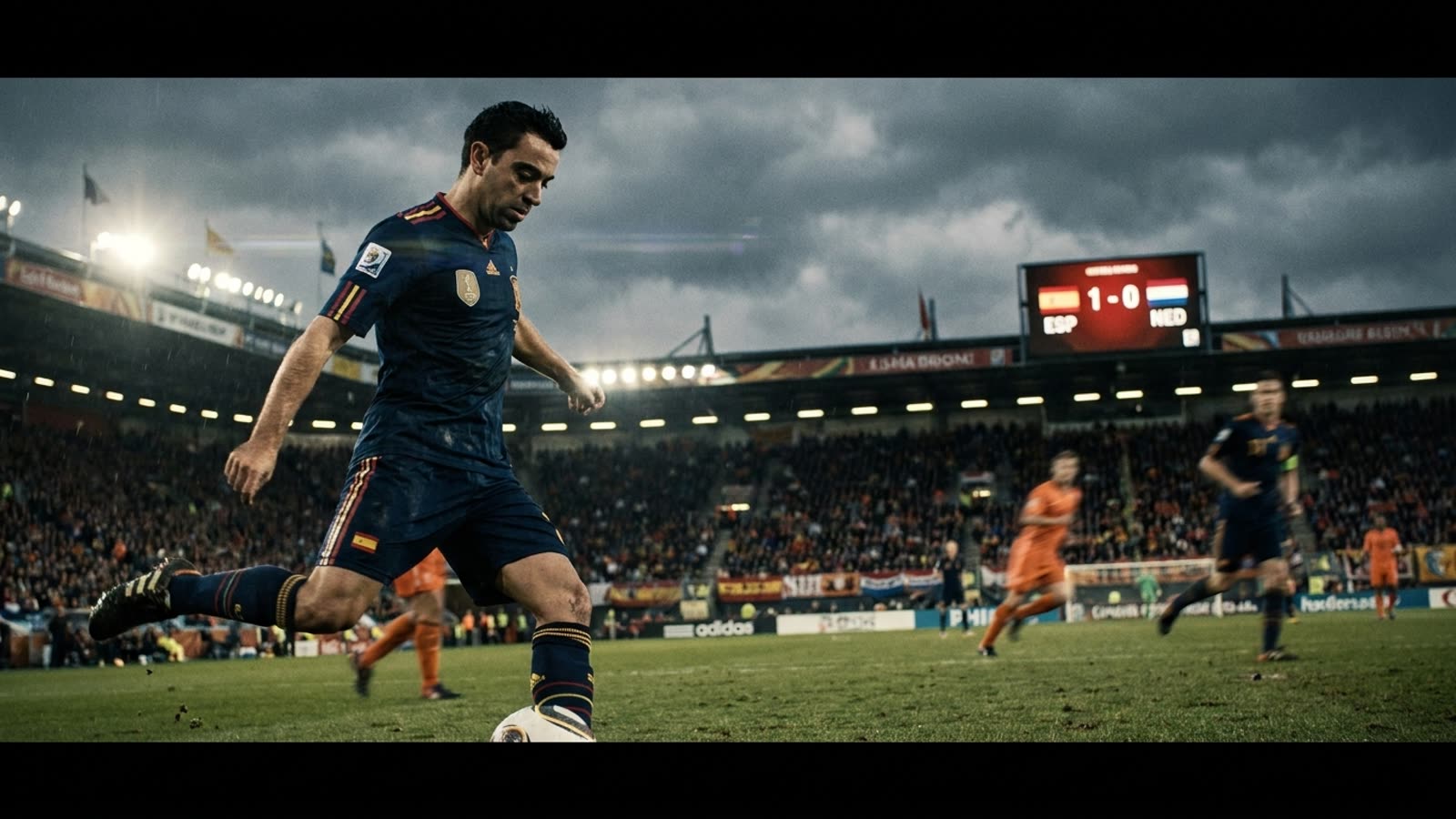
Football has always worshipped speed, power, and the spectacular. Xavi Hernández possessed none of these qualities in abundance, yet he dominated the sport's most decorated era with an attribute that cannot be measured by a stopwatch: spatial intelligence. At his peak, watching him play was like watching someone solve a puzzle in real time while everyone else was still locating the pieces.
The numbers alone are staggering. Four La Liga titles. Four Champions League trophies. A World Cup. Two European Championships. But statistics fail to capture what made Xavi singular. His gift was not scoring goals or preventing them; it was controlling the invisible architecture of a match—the angles, the distances, the tempo. He turned passing into a form of territorial conquest.
The geometry of dominance
Xavi's Barcelona and Spain teams did not merely keep possession; they weaponized it. The tiki-taka style that defined an era was built around his ability to receive the ball in tight spaces, assess seventeen options in a fraction of a second, and select the one that advanced the collective position. His passing accuracy routinely exceeded ninety percent, but the statistic misses the point. It was not that he completed passes; it was that he completed the right passes, the ones that drew opponents out of shape and created the conditions for the next move.
His partnership with Andrés Iniesta became football's most elegant double act—two players who seemed to communicate telepathically, their movements choreographed by years of shared understanding forged in La Masia. Where Iniesta provided the dribbling brilliance and the decisive final ball, Xavi provided the metronome, the steady pulse that kept Barcelona's heart beating at precisely the rhythm they wanted.
The triumph of the unheroic
What made Xavi's dominance philosophically interesting was its rejection of football's traditional hero archetypes. He was not the striker who scored the winner, not the defender who made the crucial tackle, not the goalkeeper who produced the impossible save. He was the player who made sure his team rarely needed those moments of individual salvation. Prevention through possession. Control as a form of violence.
Critics sometimes dismissed tiki-taka as boring, as sterile, as an affront to football's improvisational spirit. They missed the point. Xavi's football was not cautious; it was ruthless. Keeping the ball for seventy percent of a match is not defensive—it is a form of suffocation. His teams did not avoid risk; they eliminated the opponent's ability to take any.
Our take
Xavi Hernández proved that football intelligence is its own kind of athleticism. In an era increasingly obsessed with pressing intensity and physical metrics, his career stands as a reminder that the game's deepest pleasures are cognitive. Every midfielder who receives the ball on the half-turn, who scans the pitch before the pass arrives, who understands that speed of thought beats speed of foot—they are playing in the world Xavi mapped. He retired without ever having been the fastest player on any pitch he graced. He was simply always the first to know where the ball needed to go.