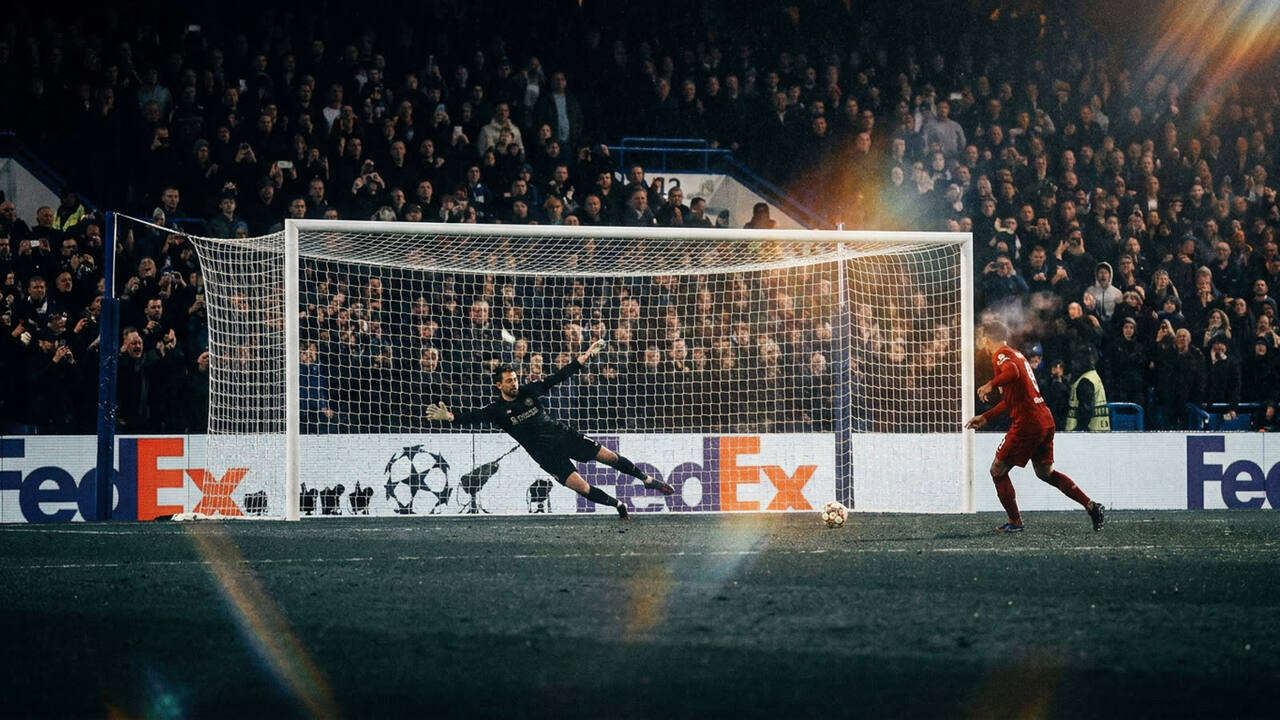
The cruelest moment in football is also its most predictable. When a knockout match stretches into penalties, broadcasters reach for the word "lottery," as if the outcome were governed by the same blind chance that determines scratch-card winners. It is a comforting fiction. In reality, penalty shootouts are a ruthlessly Darwinian test of psychological preparation, and the teams that treat them as trainable skill sets — rather than coin flips — tend to prevail.
Germany, historically, did not miss. England, historically, did. The gap was never about foot-eye coordination; German youth academies drilled shootouts under simulated crowd noise while English managers waved the exercise away as unteachable. The results accumulated across tournaments until they calcified into national mythology: Germans were "clinical," Englishmen "bottled it." Mythology, however, is just unexamined data.
The physiology of choking
A penalty kick, mechanically, is trivially easy. The goal is vast, the distance short, the goalkeeper's reaction time insufficient to cover the full frame. Laboratory studies suggest that a well-struck shot placed in either upper corner is virtually unsaveable. Yet miss rates in shootouts hover stubbornly around twenty percent, and they spike dramatically in the later rounds when the stakes compress into single kicks. The explanation is hormonal as much as technical. Cortisol floods the bloodstream; fine motor control degrades; the visual field narrows. Players describe tunnel vision, legs like concrete, a goal that seems to shrink. These are symptoms of the sympathetic nervous system hijacking the body for fight-or-flight — an evolutionary response magnificently unhelpful when the task is placing a ball inside netting.
The teams that win shootouts are the ones that inoculate their players against this cascade. Sports psychologists now embed with national squads specifically to design stress-exposure protocols: taking practice penalties after exhausting sprints, with teammates jeering, with consequences attached to misses. The goal is to make the amygdala bored of the stimulus, to downgrade a World Cup shootout from existential threat to familiar chore.
Order effects and game theory
Beyond individual nerve, shootout outcomes are shaped by sequencing. Research has shown that the team shooting first wins slightly more often — a small edge, but a real one, likely because trailing creates cumulative psychological pressure. Captains who win the coin toss and elect to go second are, statistically, making a mistake.
Then there is the goalkeeper's dilemma. Keepers almost always dive, even though standing still would improve their odds of stopping a centrally placed shot. Why? Because diving looks like effort; standing still looks like surrender. Coaches and crowds forgive a sprawling dive that guesses wrong more readily than they forgive a statue who guesses right. Goalkeepers, in other words, optimise for reputation rather than probability — a phenomenon economists call "action bias," and one that clever penalty-takers can exploit by aiming straight down the middle.
Our take
The romance of football depends on the idea that anything can happen, that plucky underdogs can topple empires on the right afternoon. Penalty shootouts are marketed as the purest expression of this chaos. They are nothing of the sort. They are a discrete, trainable skill, and the nations that invest in the science of nerve — Germany, Argentina, Spain — reap compounding returns across decades. England's recent improvement in shootouts did not arrive by accident; it arrived because the federation finally admitted that hope is not a method. The twelve-yard spot is not a roulette wheel. It is a classroom, and some countries have been studying longer than others.