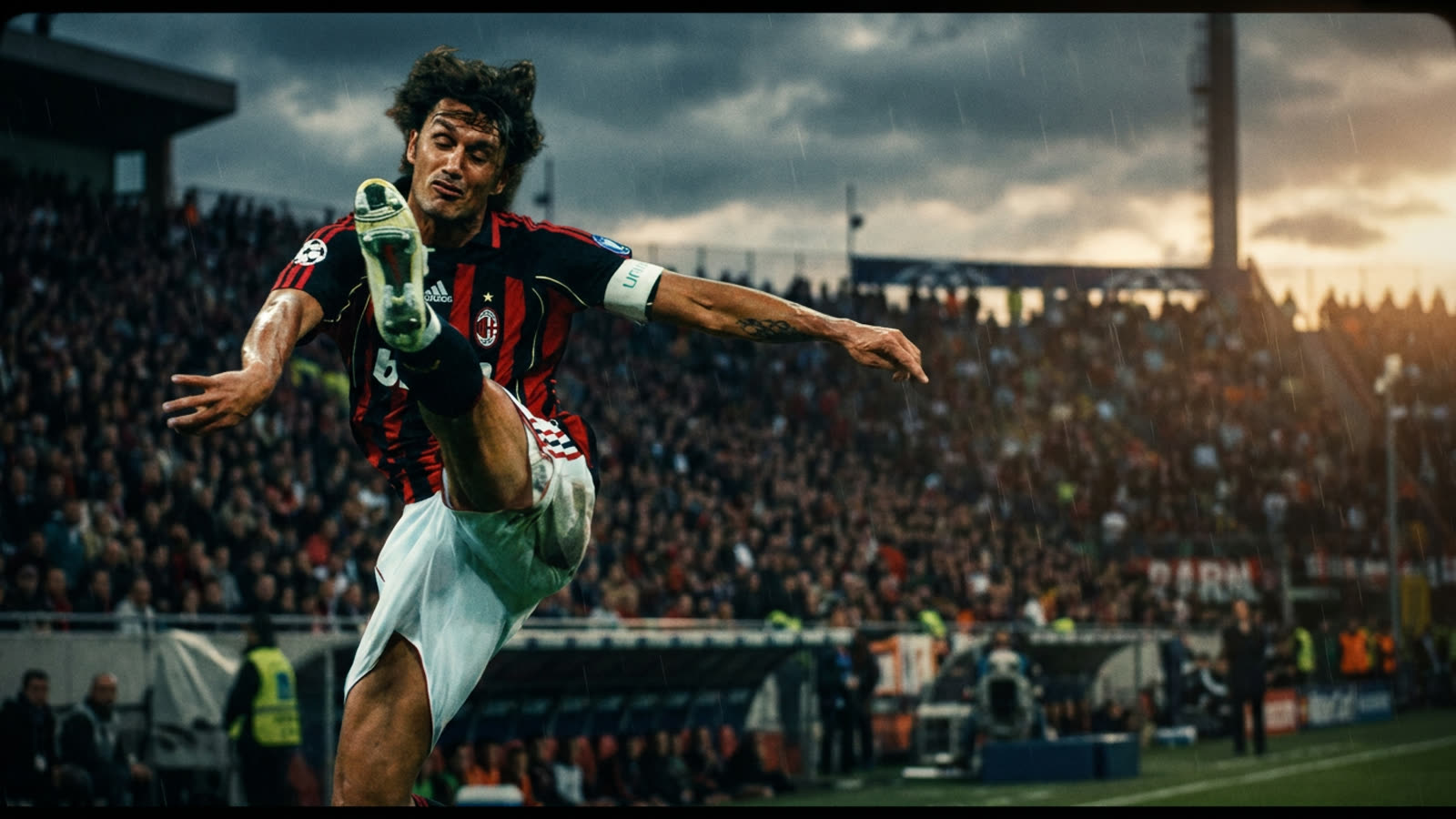
There is a famous quote, likely apocryphal but spiritually accurate, attributed to Paolo Maldini: "If I have to make a tackle, then I have already made a mistake." Whether he actually said it matters less than the fact that everyone who watched him play believes he could have. For twenty-five seasons at AC Milan, Maldini demonstrated that the highest form of defending isn't about the dramatic intervention but the quiet elimination of threats before they materialize.
This is difficult to quantify, which is partly why defenders rarely win the Ballon d'Or and why attacking statistics dominate modern football analysis. You cannot count the passes that were never attempted because Maldini's positioning made them suicidal. You cannot measure the strikers who chose the wrong option because the right one was sealed off by a man who seemed to know their intentions before they did.
The geometry of anticipation
Maldini's gift was spatial. He played football like a chess grandmaster who could see twelve moves ahead, except the pieces were moving at full sprint and occasionally trying to nutmeg him. His body positioning was so precise that opponents often felt they had options when they had none—the footballing equivalent of a magician's force. He would show you the outside, let you think you'd beaten him, and then materialize exactly where the ball needed to be cleared.
What made this more remarkable was his longevity. Maldini played at the highest level until he was forty, an age when most defenders have long since been exposed by pace. He compensated by becoming even more economical, reading the game so well that he simply didn't need to recover from mistakes he never made. His final season, in 2009, was not a victory lap but a genuine contribution to a competitive Milan side.
The dynasty and its weight
Maldini inherited his position, quite literally. His father Cesare captained Milan to their first European Cup and later managed the club. Paolo spent his entire professional career at the Rossoneri, a one-club loyalty that now seems almost quaint. He won seven Serie A titles and five Champions League trophies, the latter a record for a defender.
But the numbers undersell the aesthetic achievement. Maldini made defending beautiful in a way that transcended effectiveness. There was an elegance to his game—the way he would guide attackers into dead ends, the surgical precision of his tackles when he deigned to make them, the calm authority with which he organized chaos around him. He proved that defense could be proactive rather than reactive, creative rather than merely destructive.
Our take
Modern football's obsession with pressing, transitions, and expected goals has somewhat obscured the art Maldini practiced. We celebrate defenders now primarily for their passing range or their ability to carry the ball into midfield—essentially, for the attacking contributions they make. Maldini reminds us that there is profound intelligence in the act of denial itself, in making a striker's evening so miserable that he starts questioning his career choices. The game would be richer if we learned to see defending not as the absence of attacking but as its own complete discipline.