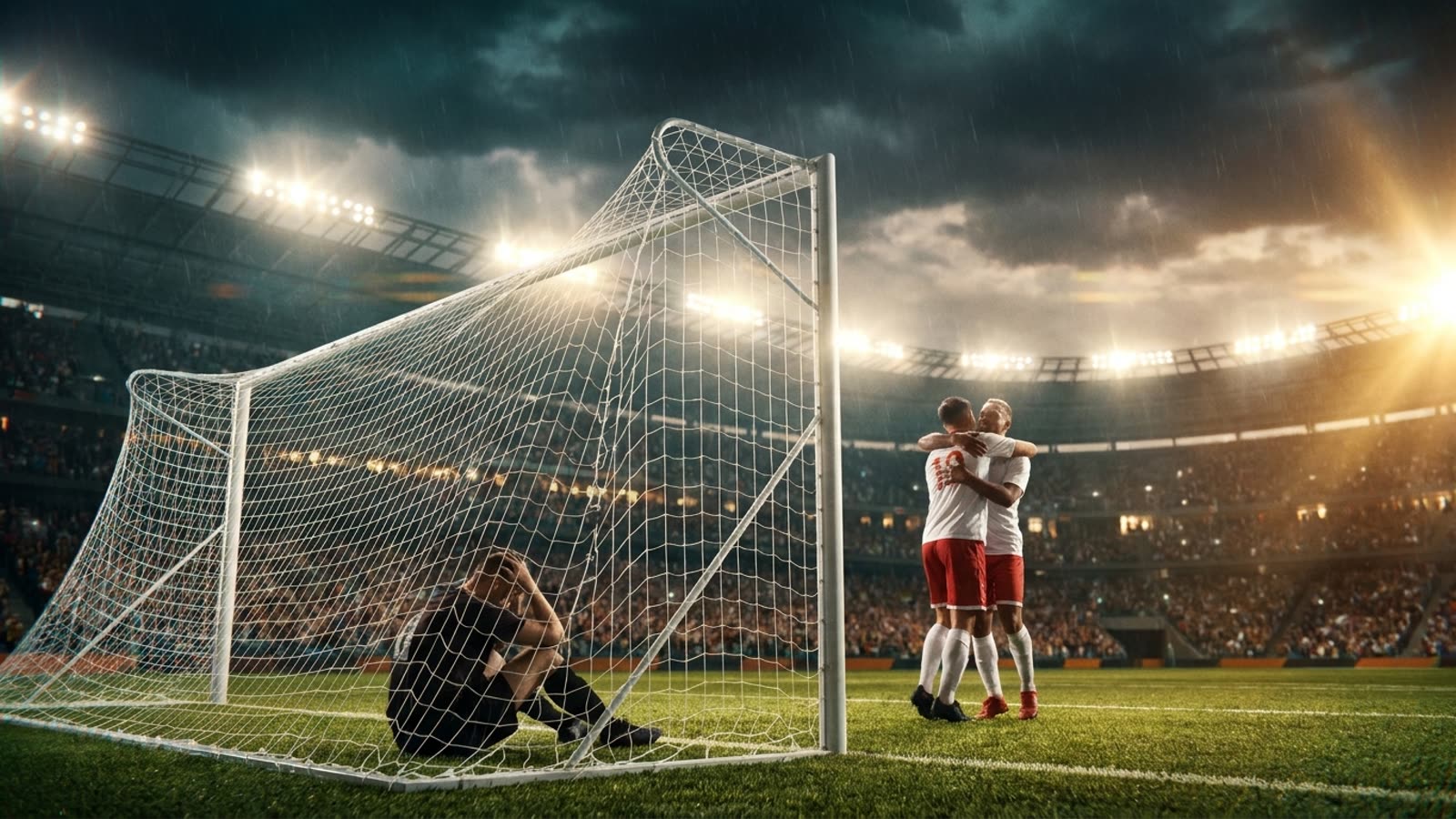
Every sport has its blunders, but only soccer awards them to the opposition. The own goal stands alone in competitive athletics: a moment where effort becomes sabotage, where the instinct to protect produces the very catastrophe it sought to prevent. In the compressed drama of a World Cup, where a single goal can end a nation's four-year dream, the own goal transforms from statistical oddity into existential tragedy.
The mechanism is deceptively simple. A defender, under pressure, redirects the ball past his own goalkeeper. The scoreboard credits the attacking team. What the scoreboard cannot capture is the psychological violence of the act—the defender has not merely failed to stop a goal, he has scored it himself. The crowd's roar belongs to the wrong half of the stadium.
The geometry of disaster
Own goals cluster around certain situations: the desperate clearance that catches a heel, the attempted header that loops backward, the sliding block that deflects a cross into the net. Modern tactics have paradoxically increased their frequency. High pressing forces defenders into hurried decisions. Low crosses into crowded penalty areas create chaos where any touch might be the wrong one. Goalkeepers sweeping behind their back lines add another body capable of catastrophic misdirection.
The 2018 World Cup in Russia produced a remarkable twelve own goals, more than the previous five tournaments combined. Some analysts attributed this to FIFA's adoption of VAR, which allowed officials to scrutinize deflections more precisely. Others pointed to the tournament's tactical tenor—teams defending deep, bodies packed into the box, probability working its grim mathematics.
The burden of memory
Certain own goals transcend their matches to become cultural shorthand for heartbreak. Andrés Escobar's deflection against the United States at the 1994 World Cup, which contributed to Colombia's elimination, acquired a tragic dimension beyond sport when he was murdered shortly after returning home. The goal itself was mundane—a sliding attempt to cut out a cross that instead guided the ball inside the near post. Its aftermath was anything but.
Not all own goals carry such weight, but all carry weight. The player who scores one at a World Cup will answer questions about it for decades. Teammates will remember the silence in the dressing room. The goal will appear in montages, in documentaries, in the cruel highlight reels that social media resurrects every four years.
Why soccer is different
Basketball has turnovers, American football has fumbles, but neither sport forces the offending player to watch his mistake register on the scoreboard as a point for the opponent. Tennis has double faults, but they cost only a point in a match of hundreds. Soccer's low-scoring nature means an own goal often represents a significant fraction of the final margin. A 1-0 defeat decided by an own goal is, statistically, a match decided entirely by one defender's misfortune.
This asymmetry produces a particular kind of sporting dread. Defenders at World Cups are not merely trying to stop attackers; they are trying to avoid becoming the story themselves. The mental calculus changes when a clearance might end your country's tournament and define your career.
Our take
The own goal reveals something essential about soccer's appeal: it is a sport where fate and skill remain stubbornly entangled, where the ball's physics can betray the body's intentions. No amount of tactical preparation or individual brilliance can eliminate the possibility that a defender's shin might catch a cross at precisely the wrong angle. The World Cup, with its winner-take-all stakes and global audience, simply ensures that when such moments occur, they become permanent. This is not a flaw in the game's design. It is the game's design—beautiful, arbitrary, and merciless.