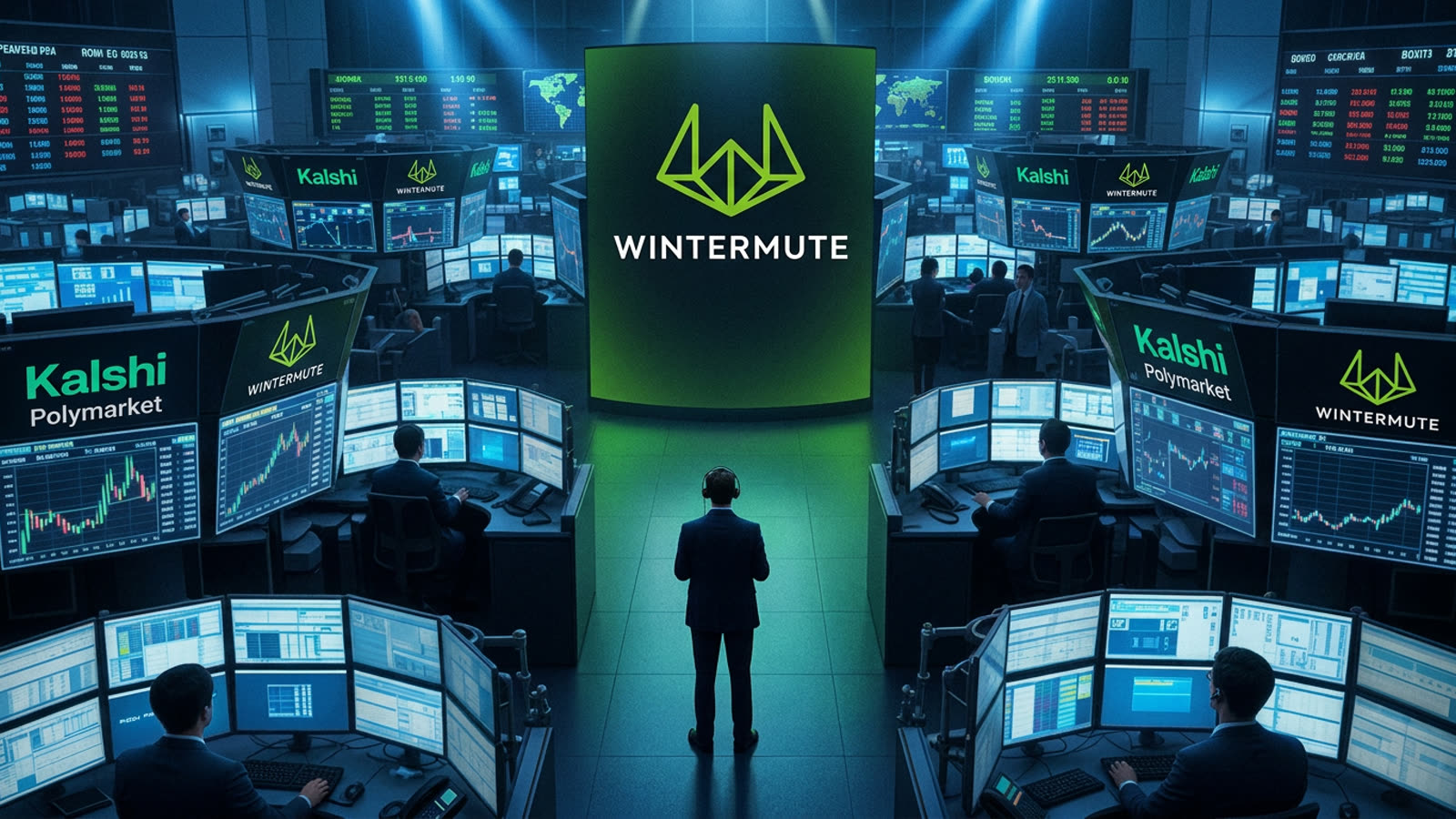
When the same firm provides liquidity on both the regulated and offshore sides of a market, that market has crossed a threshold. Wintermute, the crypto trading powerhouse that handles billions in daily volume across centralized and decentralized exchanges, has quietly begun market-making on both Kalshi and Polymarket — linking the two dominant prediction platforms through a single liquidity provider for the first time.
This is not a minor operational detail. It is the clearest sign yet that prediction markets are consolidating into a coherent asset class rather than remaining fragmented experiments.
The liquidity problem prediction markets couldn't solve
Prediction markets have always suffered from a chicken-and-egg dilemma: traders want tight spreads and deep books, but liquidity providers need volume to justify their presence. Kalshi, the CFTC-regulated US exchange, and Polymarket, the crypto-native offshore platform, have each built substantial user bases — Polymarket famously processed over a billion dollars in election betting last year — but their liquidity remained siloed.
Wintermute's entry changes the calculus. The firm already operates across more than fifty exchanges and handles roughly five percent of all crypto spot volume globally. Its algorithms are designed to arbitrage price discrepancies across venues, which means the moment it sees a contract trading at different prices on Kalshi and Polymarket, it will move to close the gap. The practical effect is price convergence and tighter spreads on both platforms.
Why Wintermute cares now
The timing is not accidental. Last week, the CFTC approved perpetual futures contracts at both Kalshi and Coinbase, effectively blessing a product category that had been confined to offshore venues. Wintermute, which has been vocal about wanting to expand in the US, sees prediction markets as a growth vertical that complements its existing crypto and traditional-finance operations.
There is also a defensive logic. Prediction markets are increasingly attracting attention from traditional market makers like Citadel and Jump, which have the infrastructure to dominate if they choose to enter. By establishing presence early, Wintermute secures a first-mover advantage in a category that could rival crypto derivatives in scale within a few years.
The regulatory arbitrage question
Wintermute's dual presence raises an obvious question: is it effectively routing liquidity between a regulated US venue and an offshore platform that American users are technically prohibited from accessing? The firm operates through separate legal entities in different jurisdictions, a structure that provides legal cover but does not eliminate the optical awkwardness.
For now, regulators appear more focused on the platforms themselves than on the market makers. The CFTC's recent lawsuit against Minnesota — filed the same day Kalshi sued the state over its prediction-market ban — suggests the agency views prediction markets as legitimate and is willing to fight state-level resistance. That political cover makes Wintermute's bet considerably safer.
Our take
Prediction markets have spent years as a curiosity — interesting in theory, underwhelming in practice. Wintermute's move is the kind of institutional commitment that transforms curiosities into categories. When a firm that processes billions daily decides a market is worth the operational complexity, the market tends to grow into its ambitions. The prediction-market era is no longer a forecast; it is a position being actively traded.